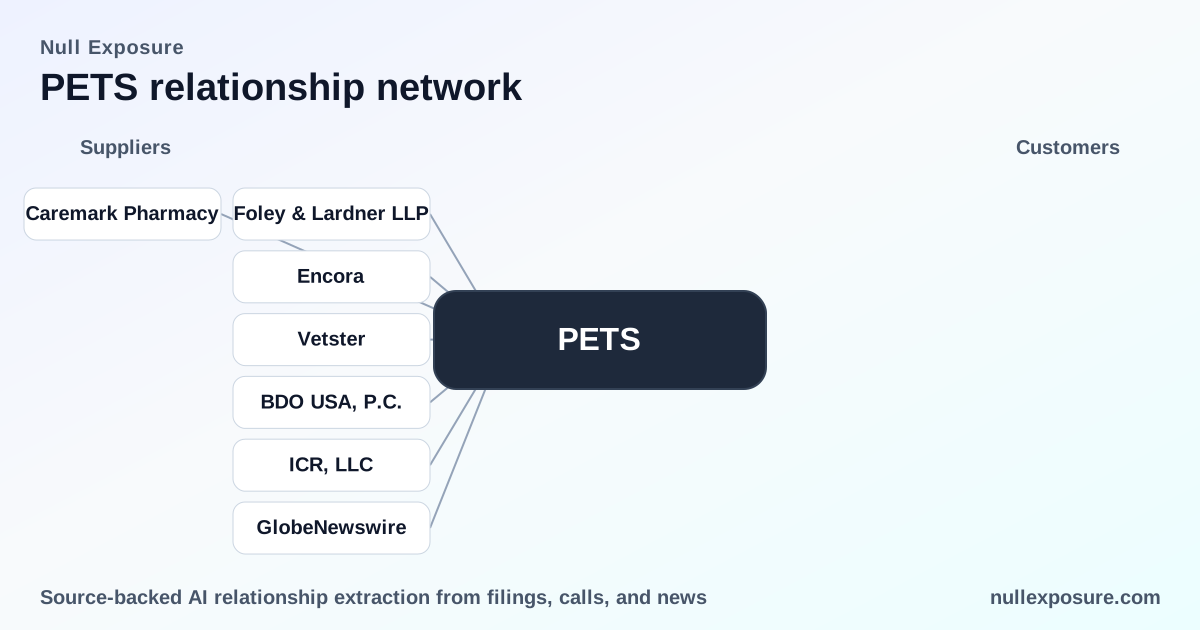
PetMed Express (PETS) — supplier map, governance flags and why vendors matter to the thesis
PetMed Express operates as an online and phone-based pet pharmacy (1-800-PetMeds) that monetizes through retail sales of prescription and non-prescription pet products, recurring AutoShip subscriptions and membership bundles that bundle shipping and telehealth/pickup services; the business generated roughly $187 million in trailing twelve‑month revenue and relies on a mix of direct manufacturer purchasing, domestic distributors and third‑party service providers to run e‑commerce, logistics and corporate controls. Investors evaluating PETS supplier relationships should focus on vendor concentration, short contract tenors for critical cloud and platform services, and recent governance work that directly implicates outside counsel and forensic accountants. For a deeper look at vendor exposure and modeled supplier constraints, see https://nullexposure.com/.
What the supplier ecosystem looks like in plain terms
PetMed’s operating model relies on three discrete supplier groups: (1) manufacturers and distributors that supply medicine and consumables; (2) service providers that deliver IT, audit, legal and investor‑relations functions; and (3) consumer services partners that augment membership benefits (telehealth, local pickup). This mix produces distinct risk vectors:
- Short contract tenors for technology and cloud services signal recurring renegotiation risk and potential switching exposure; the company disclosed one‑year cloud service terms with auto‑renewal in its filings.
- Supplier concentration at the manufacturer level is material — the 10‑K explicitly warns that losing major manufacturers would materially damage the business.
- Service providers are critical and active: audit and forensic work, compensation consultants and platform vendors are engaged continuously and billed at meaningful rates.
Per the FY2025 Form 10‑K, the company documents these dynamics, including specific vendor agreements and professional service engagements. If you want a structured vendor-risk view for investment work, start here: https://nullexposure.com/.
Supplier-by-supplier breakdown (each relationship in the record)
Below I cover every named relationship that shows up in the collected results, with a concise, investor‑oriented summary and the original source context.
-
Foley & Lardner LLP — The Audit Committee retained Foley & Lardner LLP as outside legal counsel to assist an internal investigation conducted June–August 2025 into anonymous whistleblower reports concerning AutoShip revenue timing, a $50 coupon promotion and the control environment. This is disclosed in the FY2025 Form 10‑K and reported by MarketScreener in March 2026.
-
BDO USA, P.C. — The company engaged forensic accountants from BDO USA, P.C. to support the same June–August 2025 investigation into revenue recognition and promotional practices, per the FY2025 Form 10‑K noted on MarketScreener.
-
Encora — Encora served as a software development partner credited by management for delivering an upgraded, stable e‑commerce platform under the tech lead Umesh Sripad; this partnership was referenced on the Q2 FY2025 earnings call transcript and summarized by InsiderMonkey.
-
Vetster — Vetster is listed as a telehealth partner included in the company’s current consumer services lineup (telehealth, pet insurance and grooming), referenced on the Q2 FY2025 earnings call transcript and cited by InsiderMonkey.
-
ICR, LLC — ICR is the company’s investor relations and press contact provider; the relationship appears in the company’s FY2025 press material and investor‑relations notices distributed via Yahoo Finance and QuiverQuant in March 2026.
-
GlobeNewswire — GlobeNewswire distributed the press release about corporate actions (for example, the shareholder rights plan extension); QuiverQuant’s coverage flags that the press release content was summarized by an AI agent in media syndication, with the GlobeNewswire distribution noted in March 2026.
-
Caremark Pharmacy — Caremark is integrated into membership benefits as a local prescription pickup and telehealth partner, and the company treats the bundled membership benefits (discounts, free shipping, telehealth and local pickup) as a single stand‑ready performance obligation in revenue accounting, per the FY2025 Form 10‑K reported on MarketScreener.
Why the constraints reported in filings matter to investors
Company filings and the constraint excerpts produce several company‑level operating signals that should drive diligence:
-
Short‑term contracting posture is entrenched. The Form 10‑K discloses one‑year cloud/product service agreements with auto‑renewal (Fabric, for example, has a one‑year term with auto‑renewal and explicit payment schedules), which creates recurring re‑pricing and transition risk rather than long‑dated cost visibility.
-
Large enterprise counterparties supply core inventory. The 10‑K states the company purchases directly from major pet medication manufacturers and domestic distributors, and warns that termination by these suppliers would be material to the business.
-
Service providers are central to control and operations. The company engaged external auditors, forensic accountants and compensation consultants (RSM US LLP audit fees increased materially in FY2025; Meridian Compensation Partners provided compensation benchmarking), which signals active governance work and higher professional spend.
-
Spend concentration at the vendor level is modest for certain services. The disclosed Fabric contract payment schedule ($115,000 first year; $100,000 thereafter; $105k paid in FY2025) places core cloud/product vendor spend in the $100k–$1M band rather than at enterprise‑scale outsourcing levels.
Together these constraints describe an operator that runs a manufacturing/distribution‑dependent retail model but outsources critical software and governance functions on relatively short contracts while accepting material counterparty risk on inventory.
If you want a vendor risk matrix built from these signals, the starting point is here: https://nullexposure.com/.
Investment implications and a concise risk checklist
- Governance and control risk elevated: The involvement of Foley & Lardner and BDO in an investigation is a red flag for revenue recognition and control environment scrutiny (FY2025 10‑K).
- Supplier concentration is business‑critical: Loss of major manufacturers would have material impact; procurement relationships are business‑critical and should be monitored in any investment thesis.
- Technology stability is improving, but vendor tenure is short: Encora’s platform work reduces operational risk in the short term, but one‑year cloud contracts create refinancing/renegotiation exposure.
- Professional fees are rising: FY2025 audit and advisory fees increased meaningfully (RSM US LLP billing details appear in the 10‑K), indicating higher governance costs.
- Membership partnerships affect revenue recognition: Membership bundling with Caremark and telehealth creates accounting complexity and customer stickiness that both support and complicate the revenue base.
Bottom line and next steps
PetMed Express runs a retail pharmacy model that is operationally dependent on a small set of large manufacturers for inventory, and on a network of service providers for IT, audit and customer services. The primary investor action is to monitor the outcomes of the FY2025 investigation, supplier continuity with major manufacturers, and renewal terms for key tech contracts. For vendor‑level diligence and a supplier exposure scorecard tailored to PETS, start your evaluation at https://nullexposure.com/.