Pinnacle Food Group Limited (PFAI): supplier relationships, advisory links, and what investors should act on
Pinnacle Food Group Limited operates as a provider of smart farming solutions for vertical and hydroponic farming, monetizing through the sale and support of its farming systems and related services to commercial growers and operators. For investors and operator partners, the company’s strategic signal comes from small-scale financials, concentrated ownership, and selective external advisory touchpoints that inform M&A and capital strategy.
If you want a consolidated view of supplier and advisory relationships for due diligence or strategic sourcing, visit https://nullexposure.com/ for a full supplier intelligence profile.
Why these advisor connections matter for a supplier-focused investor
Pinnacle’s external adviser mentions are not regular vendor contracts; they are historical advisory linkages that reflect past corporate strategic activity and the company’s exposure to financial markets and strategic transactions. Advisory relationships with global investment banks raise the company’s governance and deal-readiness profile, which can influence valuation multiples and strategic options for operators seeking partnerships or supply contracts.
Deal advisory listed in public coverage
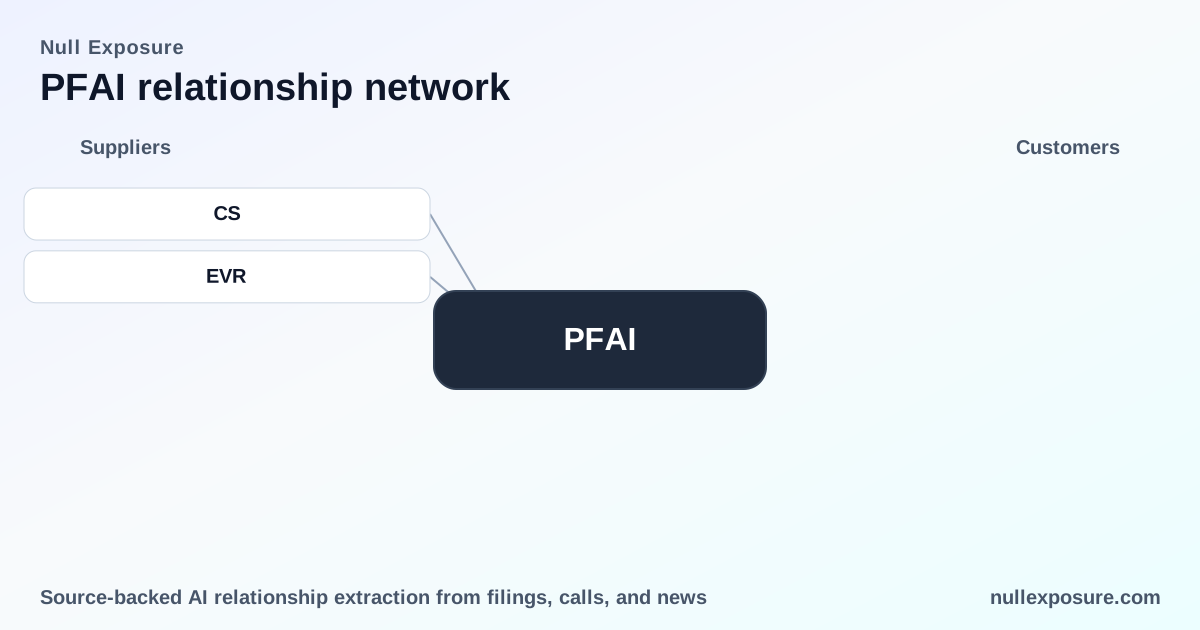
- According to a Globe and Mail article covering Conagra’s acquisition activity in 2018, Evercore and Credit Suisse were identified as advisers to Pinnacle in the transaction narrative. The article explicitly notes that Goldman Sachs and Centerview Partners advised Conagra, while Evercore and Credit Suisse advised Pinnacle. Source: Globe and Mail coverage of Conagra’s deal activity, article referenced at https://www.theglobeandmail.com/business/international-business/us-business/article-conagra-to-buy-pinnacle-foods-for-81-billion/ (first reported in the 2018 deal context; dataset entry seen 2026-03-10).
Credit Suisse — adviser linkage
Credit Suisse is listed as an adviser to Pinnacle in coverage of the Conagra transaction; this is a historical strategic advisory connection consistent with Pinnacle engaging global banks for major corporate events. Source: Globe and Mail article referenced above.
Evercore — adviser linkage
Evercore is listed alongside Credit Suisse as an adviser to Pinnacle in the same Globe and Mail coverage, indicating engagement with boutique and bulge-bracket advisers for transactional strategy. Source: Globe and Mail article referenced above.
These two relationships are advisory in nature and reflect transactional-readiness and access to deal execution capabilities, not supplier contracts for goods or agritech services.
Operating model signals that shape supplier risk and opportunity
Several company-level metrics in the public profile shape how operators and procurement teams should treat Pinnacle as a supplier:
- Small public capitalization and scale: Market capitalization is approximately $29.3 million, and trailing revenue is $3.497 million; this positions Pinnacle as a small-cap vendor where counterparty cash flow volatility can be material for fulfillment and warranty commitments.
- Thin market and insider alignment: Shares outstanding total 4,005,000 with insiders owning ~11.86% and institutional ownership effectively negligible at 0.09%, indicating concentrated ownership and limited institutional scrutiny.
- Profitability and margin profile: The company shows negative net margins (profit margin -6.36%) and operating margin -103.4%, which signals immature profitability and potential cash burn that suppliers and partners must underwrite through contract design.
- Valuation and leverage signals: High valuation multiples relative to fundamentals—Price/Sales ~8.37, EV/EBITDA 28.53—suggest investors priced growth expectations into the equity despite weak operating margins.
- Growth trajectory: Quarterly revenue growth year-over-year is reported at +28.9%, showing operational momentum even as profitability lags.
Translate these into procurement posture: contract terms should prioritize payment security, staged performance milestones, and clear recourse in the event of delayed growth or capital events. For strategic partners, the adviser relationships increase the probability that the company will pursue exit or capital options proactively.
If you want to overlay these supplier signals across your vendor book, explore supplier profiles at https://nullexposure.com/ for integrated supplier risk and relationship mapping.
Contracting posture, concentration, criticality and maturity — practical implications
- Contracting posture: Given Pinnacle’s size and financial profile, the company will likely accept commercial terms that support upfront cash and short payment cycles; long-tail payment terms elevate risk.
- Concentration: Low institutional float and modest share count mean corporate control is concentrated, which can accelerate decision-making but raises governance risk for long-term supply agreements.
- Criticality: For customers that depend heavily on Pinnacle’s unique vertical farming systems, the criticality is high; build redundancy or service-level protections into contracts.
- Maturity: Revenue growth is present but profitability is nascent; treat the company as emergent rather than mature, and price supplier credit accordingly.
Risk checklist and opportunity map for investors and operators
- Risk: operational continuity — small revenue base and negative margins create execution risk on large-scale rollouts.
- Risk: governance concentration — limited institutional oversight increases event-driven volatility around insider decisions.
- Opportunity: strategic partnership leverage — advisory relationships with banks such as Evercore and Credit Suisse indicate the company can access capital markets and M&A advice, which supports scenarios for accelerated scale or structured exits.
- Opportunity: growth-first valuation — high price-to-sales suggests market willingness to pay for scale; partners can negotiate performance-based commercial upside.
Final analysis and recommended actions
Pinnacle Food Group is a small, growth-oriented supplier with limited institutional backing and historical advisory ties to prominent banks that enhance deal-readiness. For investors and operator buyers, the priority is to balance upside from rapid revenue growth against execution and liquidity risk driven by negative margins and concentrated ownership.
- For procurement teams: insist on short payment cycles, milestone-based scaling, and contingency clauses in supply agreements.
- For strategic investors: monitor any renewed advisory activity and capital raises closely, as these will materially affect valuation and counterparty risk.
For a full supplier-intelligence view and to map Pinnacle alongside your vendor universe, visit https://nullexposure.com/ and run a consolidated supplier profile.
Act now to align contract terms with financial reality and strategic upside—review Pinnacle’s profile at https://nullexposure.com/ before committing to multi-year engagements.