Preferred Bank (PFBC): Funding counterparties and what investors should know
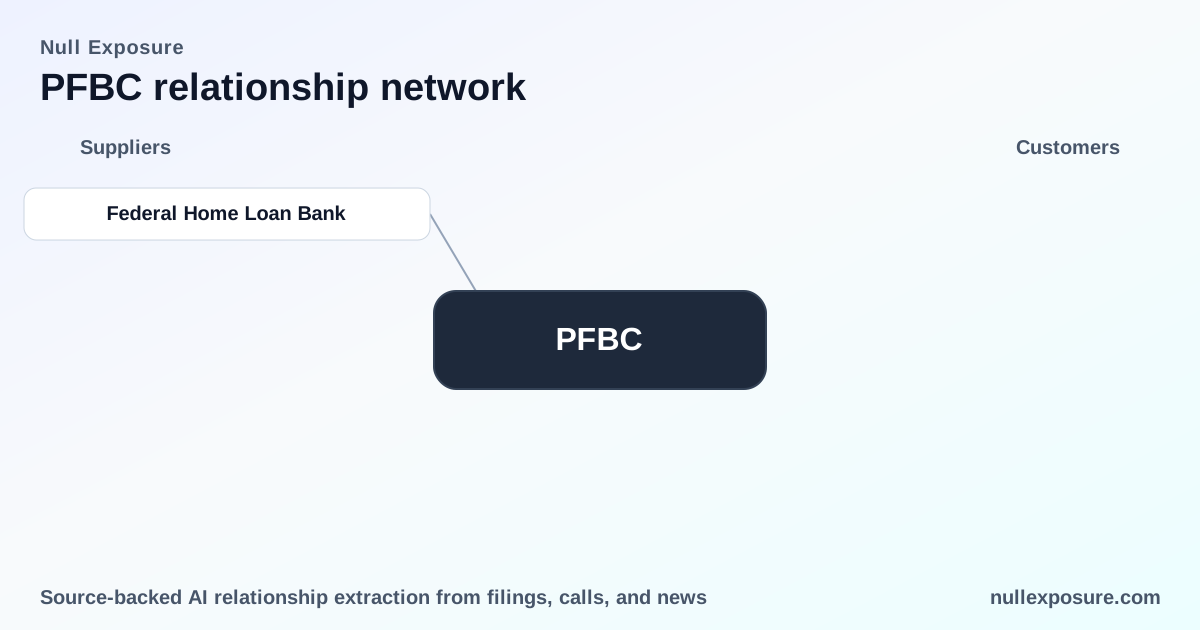
Preferred Bank is a regional commercial bank that monetizes through deposit gathering, lending to small and medium-sized businesses and real estate owners, and fee income tied to commercial banking services. The franchise generates strong operating margins and return on equity — FY2025 revenue of $281.2M, an ROE around 17.2%, and a trailing P/E near 8.6 — while returning capital through a meaningful dividend ($3.05 per share). For investors assessing supplier and counterparty exposure, the most visible supplier relationship disclosed in recent company communications is with the Federal Home Loan Bank system, which functions as a wholesale liquidity provider to the balance sheet. Explore a concise supplier map and the implications for liquidity, counterparty concentration, and dividend durability below.
Discover more supplier-focused intelligence at https://nullexposure.com/.
Why supplier relationships matter for a regional bank like Preferred Bank
Banks operate by matching asset and liability cash flows; supplier relationships in this context are predominantly wholesale funding sources, vendor platforms, and service counterparties that affect liquidity, earnings stability and regulatory capital. For Preferred Bank, the supplier signals in the public record highlight use of Federal Home Loan Bank (FHLB) advances, a conventional secured funding channel that supports lending and balance sheet management. The presence of FHLB advances signals an institutional contracting posture — the bank leverages established central credit facilities rather than exotic or opaque wholesale sources.
Company-level signals from the provided information show no explicit supplier constraints reported, which itself is meaningful: absence of disclosed supplier covenants or restrictions in the supplier dataset indicates no flagged supply-side operational constraints in the covered window. That said, investors should treat supplier disclosures as partial — monitor regular filings for material changes.
The supplier line-by-line (what the record contains)
-
Federal Home Loan Bank — advance reported in FY2026
Preferred Bank reported an item labeled “Advances from Federal Home Loan Bank 200,000” in its FY2026 fourth-quarter release; this is recorded in the company press release distributed via GlobeNewswire on January 22, 2026. (Source: Preferred Bank press release, GlobeNewswire, 2026-01-22 — https://www.globenewswire.com/news-release/2026/01/22/3223684/18770/en/Preferred-Bank-Reports-Fourth-Quarter-Results.html) -
Federal Home Loan Bank — duplicate entry from the same FY2026 release
The release also appears a second time in the public extraction with the same line item “Advances from Federal Home Loan Bank 200,000,” confirming the FHLB advance notation in the FY2026 company disclosure. (Source: Preferred Bank press release, GlobeNewswire, 2026-01-22 — https://www.globenewswire.com/news-release/2026/01/22/3223684/0/en/Preferred-Bank-Reports-Fourth-Quarter-Results.html)
Both entries reference the same FY2026 press materials; there are no other supplier relationships listed in the provided results.
What the FHLB relationship implies for investors
-
Liquidity flexibility, not structural dependence. The FHLB is a standard, secured liquidity source for U.S. community and regional banks; the recorded advance is a conventional tool to manage funding mismatches. The press release notation of an advance of 200,000 is de minimis relative to Preferred Bank’s FY2025 revenue of $281.2M, indicating the relationship is a liquidity convenience rather than a dominant funding dependency. (Company financials through 2025-12-31.)
-
Counterparty credit and operational stability are high. The FHLB system is a highly rated, regulated wholesale funding utility; the relationship reduces idiosyncratic counterparty credit risk compared with unsecured wholesale lines.
-
Contracting posture: conservative and standard. Preferred Bank’s disclosed supplier posture is consistent with established banking practice: secured advances from a central liquidity facility rather than concentrated, single-source, or bespoke vendor structures. This supports stable capital allocation and dividend distribution policies.
-
Concentration and criticality: low in the recorded window. The public supplier footprint here shows only the FHLB advance callout and no vendor constraints; that limited number suggests low supplier concentration risk within the observable record, but investors should reconcile this with 10-Q/10-K schedules to identify other funding or vendor dependencies not surfaced in the press release.
For additional context on how supplier and counterparty exposures translate into valuation and risk metrics, compare the bank’s price-to-book (~1.37), strong profit margin (47.5%), and dividend yield (~3.4%), which together suggest the market prices a profitable, cash-returning regional bank with stable funding behavior. For deeper supplier-risk screening, see https://nullexposure.com/.
Practical due diligence checklist for PFBC counterparties
- Review the bank’s most recent 10-Q/10-K for detailed schedule of FHLB borrowings and all secured lines, because press releases can omit balances and maturities.
- Track advances and repo usage quarter-over-quarter to detect shifts toward wholesale funding that would increase liquidity risk and regulatory scrutiny.
- Reconcile dividend policy against net interest margin and noninterest income trends; Preferred Bank’s DPS of $3.05 and high return on equity require sustained earnings and controlled funding costs.
- Monitor counterparty concentration beyond FHLB: vendor platform outages, third-party servicing, and payment processors are typical hidden risks for regional banks even when headline supplier listings are light.
If you want a supplier-focused monitoring dashboard for PFBC and other regional banks, start here: https://nullexposure.com/.
Final read: risk-reward framed by supplier posture
Preferred Bank’s public supplier signals are straightforward: interaction with the Federal Home Loan Bank as a liquidity partner, recorded in FY2026 press materials, and no supplier constraints surfaced in the provided record. That combination supports a thesis of measured funding conservatism and operational maturity — characteristics that align with the bank’s strong margins, solid ROE and steady dividend program. Investors should continue monitoring regulatory filings for any expansion of wholesale exposures or material supplier constraints, but the current supplier footprint reduces immediate counterparty alarm.
For ongoing supplier intelligence and alerts tailored to financial institutions, visit https://nullexposure.com/ for tools and analyst coverage.