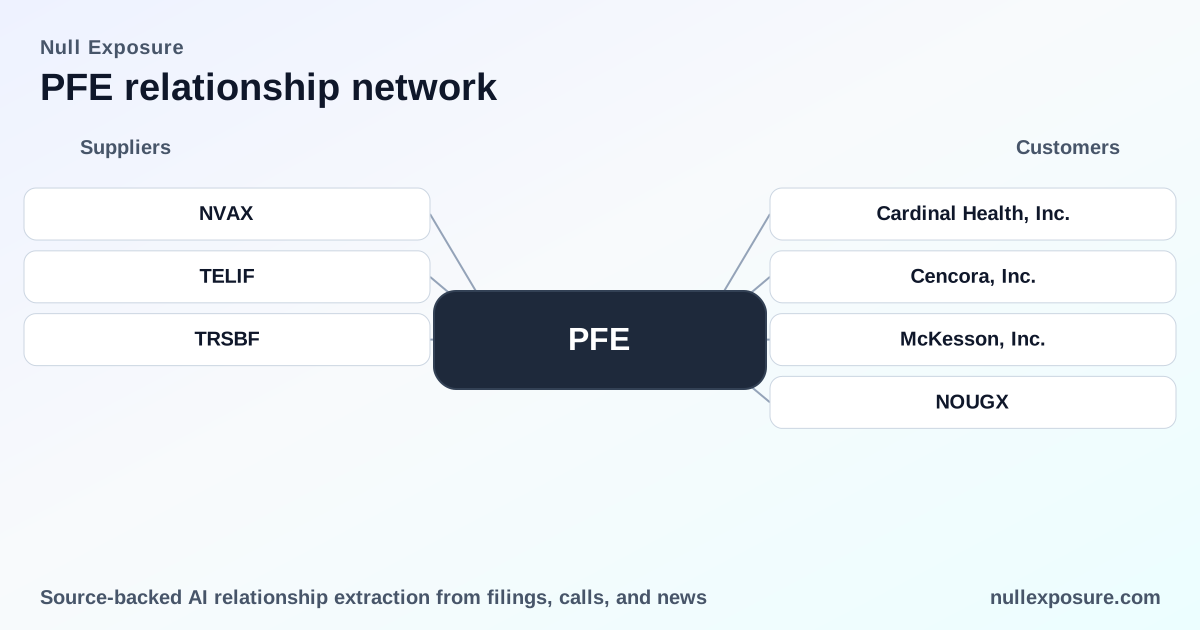
Pfizer Inc (PFE): What investors should know about supplier relationships
Pfizer monetizes a diversified biopharma portfolio by developing, licensing, manufacturing and commercializing medicines and vaccines across immunology, oncology, cardiology and other therapeutic areas. The company’s revenue mix is a blend of high-margin proprietary products and licensed/partnered assets, supported by a global procurement and contract-manufacturing footprint; Pfizer’s cash flow comes from product sales, milestone and royalty receipts, and routine distribution and supply agreements. For investors evaluating supplier risk, the key facts are scale, global sourcing, and a contracting posture that places financing obligations with suppliers and financial institutions rather than on Pfizer’s balance sheet. Learn more on the homepage: https://nullexposure.com/
How Pfizer’s supplier stance affects value creation
Pfizer operates a hybrid sourcing model: internal manufacturing for core blockbusters complemented by third-party contract manufacturers and service providers for capacity flexibility and specialized capabilities. That model preserves capital efficiency and accelerates clinical-to-commercial timelines, but it also creates exposure to third-party operational performance. With a TTM revenue of approximately $62.6 billion and market capitalization near $151.3 billion, Pfizer’s bargaining power with suppliers is meaningful; however, suppliers still negotiate their own financing and operational terms.
Key commercial implications:
- Contract tenor and payment cadence are short-term: Pfizer pays confirmed invoices on original maturity dates, generally within 90–120 days, and is not a party to supplier financing agreements, which shifts working-capital and credit risk to suppliers and their lenders.
- Global sourcing reduces single-country concentration but increases exposure to geopolitical and trade disruptions.
- Supplier role mix is broad—from contract manufacturers to research collaborators and service providers—so disruption in any node affects timelines differently.
If you’re benchmarking supplier risk across large biopharma, these operating characteristics warrant focused diligence on counterparties and manufacturing continuity. For a centralized view of supplier exposures, visit https://nullexposure.com/
Supplier relationships called out in public coverage
Below are every supplier-related relationship flagged in the collected results, summarized plainly with source notes.
Novavax — technology license for Matrix M
Pfizer holds a license agreement with Novavax that included a US$30 million upfront payment and high mid-single-digit royalties on products containing the Matrix M adjuvant, creating a defined near-term cash inflow and potential recurring royalty stream tied to adjuvanted products. (Simply Wall St, March 10, 2026 — https://simplywall.st/stocks/us/pharmaceuticals-biotech/nasdaq-nvax/novavax/news/assessing-novavax-nvax-valuation-after-strong-earnings-beat)
Telescope Innovations — automation and self‑driving lab installation
Telescope Innovations installed a second self‑driving lab at Pfizer, reflecting an operational push toward Physical AI and factory automation that is intended to improve throughput, quality, and cost efficiency for laboratory operations. (MarketBeat instant alert, March 5, 2026 — https://www.marketbeat.com/instant-alerts/filing-picton-mahoney-asset-management-acquires-shares-of-200735-pfizer-inc-pfe-2026-03-05/)
3SBio — in‑licensed oncology candidate (PF‑08634404)
Pfizer in‑licensed PF‑08634404, a dual PD‑1/VEGF inhibitor, from Chinese biotech 3SBio and plans pivotal trials; the relationship is a licensing/in‑licensing collaboration that expands Pfizer’s oncology pipeline and comes with planned clinical investment and trial starts. (TradingView / Zacks commentary, March 10, 2026 — https://www.tradingview.com/news/zacks:35162140f094b:0-pfizer-stock-buy-sell-or-hold-after-its-11-rally-so-far-in-2026/)
What the constraints tell investors about operational posture
The available constraint excerpts are not tied to a single supplier; they are company-level signals that explain how Pfizer organizes supplier finance and sourcing.
- Contract type — Short term: Pfizer pays third-party invoices within 90–120 days and is not a party to supplier financing agreements, indicating a short‑term contracting posture and limited direct credit exposure to supplier financing arrangements. This reduces Pfizer’s balance-sheet credit risk but leaves supplier liquidity and financing decisions external to Pfizer.
- Geography — Global sourcing: Pfizer explicitly procures raw materials worldwide, which lowers single-supplier concentration risk but increases exposure to cross-border trade, logistics bottlenecks and geopolitical risk vectors.
- Materiality — Immaterial (company signal): Management states it does not expect raw-material availability to significantly impact operations in 2025, suggesting that, at the company level, suppliers are not currently viewed as single points of failure for near-term revenue.
- Relationship roles — Manufacturer and Service Provider: Pfizer engages contract manufacturers and third‑party collaborators for R&D, manufacturing and commercialization; this confirms outsourced production and service reliance as a deliberate scale-and-focus strategy.
- Buyer role signal: The company also functions as a buyer in commercial arrangements, reinforcing that its supplier relationships are transactional and procurement-driven rather than equity or JV-dominant.
Collectively, these constraints outline a mature supplier ecosystem: diversified, short‑tenor commercial relationships with limited direct economic entanglement, but meaningful operational dependencies that require active oversight.
Investment implications and risk checklist
For investors and operators assessing Pfizer supplier exposure, prioritize the following:
- Operational continuity over contractual credit: Because Pfizer is not party to supplier financing, true risk is operational (manufacturing quality, capacity, logistics) rather than counterparty credit carried on Pfizer’s books.
- Pipeline and licensing are value drivers: Licensing deals (e.g., with Novavax and 3SBio) deliver upfront cash and royalty optionality or future product revenue, so diligence should focus on clinical timelines and commercialization pathways rather than supplier financing structures.
- Automation investments are strategic: Deployments like Telescope’s self‑driving lab indicate a capital-efficient push to improve margins and throughput; investors should track productivity gains and capex offset timelines.
If you want a consolidated view of supplier linkages and how they translate to operational risk, start here: https://nullexposure.com/
Final takeaways and next steps
- Pfizer’s supplier network is global, diversified, and structured around short‑term commercial terms that shift financing risk to suppliers and their lenders while keeping operational risk squarely on supply continuity and quality.
- Licensing and automation partnerships are net positive for cash flow and margins, but investors should monitor clinical progress, contract-manufacturer performance, and geopolitical supply-chain developments.
For deeper supplier-mapping and ongoing monitoring for large-cap pharma, visit our homepage and subscribe to updates: https://nullexposure.com/