Peoples Financial (PFIS): supplier relationships, funding lines and vendor concentration for investors
Peoples Financial Services Corp. operates as a regional bank: it earns net interest income from loans and investments and supplements margins with fee-based businesses such as merchant services and deposit fees. The company levers wholesale funding from the Federal Home Loan Bank (FHLB) system and contingency access to the Federal Reserve's Discount Window to manage liquidity, while outsourcing parts of its payments and digital stack to third-party vendors. For investors, the critical questions are funding durability, vendor concentration on payments and core services, and the operational risk that vendor interruptions would impose on profitability and capital.
Learn how we surface supplier and funding relationships for due diligence at https://nullexposure.com/.
How Peoples runs its business and where the supplier risk lives
Peoples is a classic regional bank: loans, deposits, and a small but meaningful slice of noninterest income produced via third-party merchant and card-processing arrangements. The company balances loan growth and margin management with tactical wholesale borrowings — principally from the FHLB — while maintaining standby access to the Federal Reserve's Discount Window for stress liquidity.
Operationally, Peoples relies on external providers for core banking services, card processing, branch capture, and internet banking functionality. These are active, ongoing relationships that are structurally critical to day-to-day operations and revenue flow. Company disclosures specifically note that merchant services revenue is derived from a third-party processor and that core banking and digital channels are supplied by vendors.
Key company-level supplier signals:
- Criticality: Company filings state that a prolonged interruption of third-party services could have a material adverse effect on operations and results.
- Role mix: The firm categorizes third parties as service providers and also transacts with related-party vendors as a buyer for items such as rent and legal services.
- Segment exposure: Outsourced services include core banking, card and debit processing, branch capture and internet banking.
- Spend scale: Related-party payments are small in the last reported year — the bank recorded $117,000 of payments to related parties for the year ended December 31, 2024 — indicating limited direct spend concentration with related entities on the disclosed line items.
- Lifecycle: Relationships are active and recurring rather than ad hoc, implying ongoing vendor management obligations.
These are company-level signals derived from the firm's public disclosures (annual and quarterly filings and earnings announcements).
Funding counterparties you need on your checklist
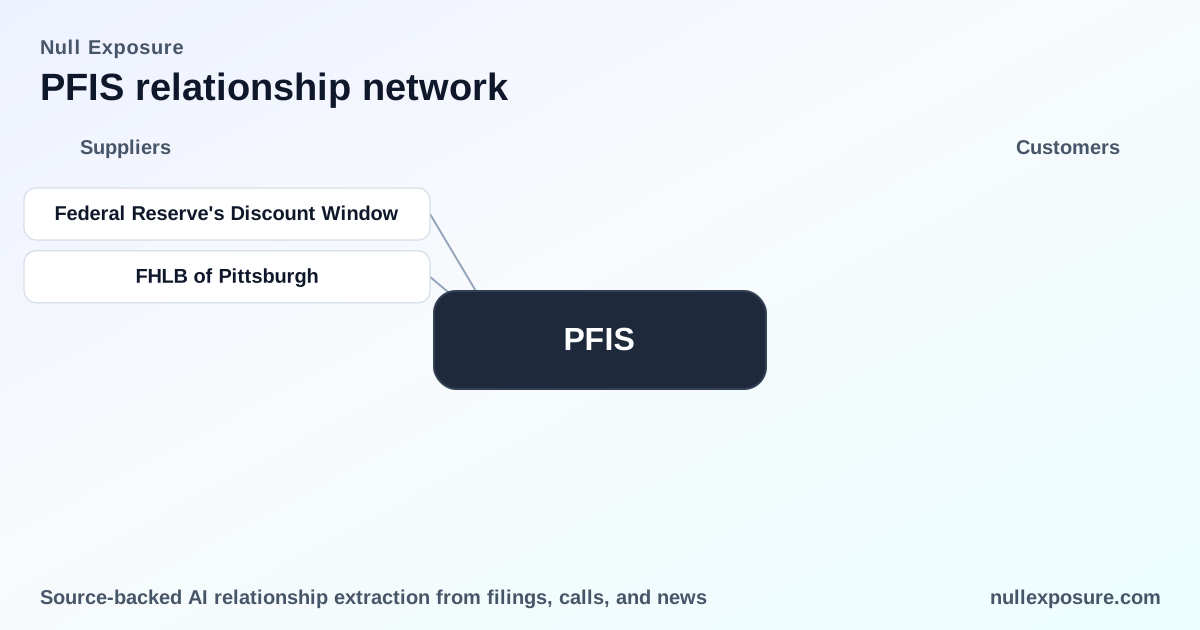
FHLB of Pittsburgh — a primary wholesale lender
Peoples counts term borrowings from the FHLB of Pittsburgh as part of its long-term debt; for the three months ended December 31, 2025, long-term debt that included FHLB borrowings averaged $145.4 million at an average cost of 4.54%, up from $111.1 million at 4.97% for the comparable prior-period quarter. According to the company’s press release reporting fourth-quarter and full-year 2025 results, FHLB advances are a material component of the bank’s funding mix and affect interest expense dynamics. (Source: company press release, PR Newswire, March 10, 2026.)
Federal Reserve's Discount Window — contingency capacity, not primary funding
Peoples reports $349.0 million of available borrowing capacity at the Federal Reserve’s Discount Window as of December 31, 2025, alongside $1.0 billion of capacity at the FHLB system. This disclosure in the FY2026 results indicates that the bank maintains formal contingency access to central bank liquidity facilities as part of its liquidity buffer. The line represents standby capacity to be drawn in stress scenarios rather than an ongoing funding source. (Source: company press release, PR Newswire, March 10, 2026.)
What every relationship summary tells an investor (one-sentence takeaways)
- FHLB of Pittsburgh: Peoples uses term advances from the FHLB as a primary source of wholesale funding, with average borrowings and interest cost detailed in the FY2026 earnings release. (PR Newswire, March 10, 2026.)
- Federal Reserve's Discount Window: The bank holds explicit borrowing capacity of $349.0 million at the Fed’s Discount Window as of year-end 2025, establishing a regulatory-age contingency liquidity buffer. (PR Newswire, March 10, 2026.)
Concentration, contracting posture and operational risk — what to watch in diligence
Peoples discloses an active vendor posture: it runs essential services externally and recognizes dependency on third parties for core systems and payments. That combination creates a classic regional-bank vendor risk profile: moderate spend scale on related-party lines but high functional criticality of outsourced providers.
Practical implications:
- Concentration risk: Merchant services and core banking are concentrated functions; replacement would be costly and operationally complex.
- Contracting posture: Relationships are ongoing and likely governed by multi-year service agreements with SLAs and termination provisions; investors should request maturity schedules and transition rights.
- Materiality: The firm explicitly warns that a prolonged vendor interruption could have a material adverse effect on results — treat vendor continuity as a top-tier operational risk.
- Maturity and substitution: The disclosures indicate established vendor use rather than nascent pilots, so contingency planning is essential.
Middle-read next step: review Peoples’ vendor contracts and liquidity playbooks at https://nullexposure.com/.
Questions for management and procurement teams
For investors and operators, prioritize these requests:
- A maturity and amortization schedule for FHLB borrowings, plus any covenants tied to those advances.
- Current utilization versus available capacity at the Fed Discount Window and historical frequency of draws (if any).
- Identity of core banking and merchant-processing vendors, contractual termination and transition terms, and SLAs for availability and settlement.
- Evidence of redundancy or fallback arrangements for payments and online banking (hot sites, alternate processors).
- Vendor concentration metrics by revenue impact, and third-party audit or SOC reports if available.
Bottom line and action items
Peoples Financial runs a stable regional banking model funded through deposits complemented by material FHLB advances and a defined Fed Discount Window capacity, while outsourcing mission-critical payment and core banking services. The two supplier relationships called out in the company release — FHLB funding and Fed contingency capacity — are central to liquidity strategy, and vendor dependence on card and core processors is central to operational risk.
For investors conducting counterparty due diligence or operators designing oversight frameworks, prioritize funding schedules, vendor SLAs and transition rights. For a deeper supplier-risk dive and automated supplier relationship mapping, visit https://nullexposure.com/.
Takeaway: validate funding durability and demand explicit contingency plans for merchant and core-platform continuity — these are the decisive items for valuation and operational resilience.