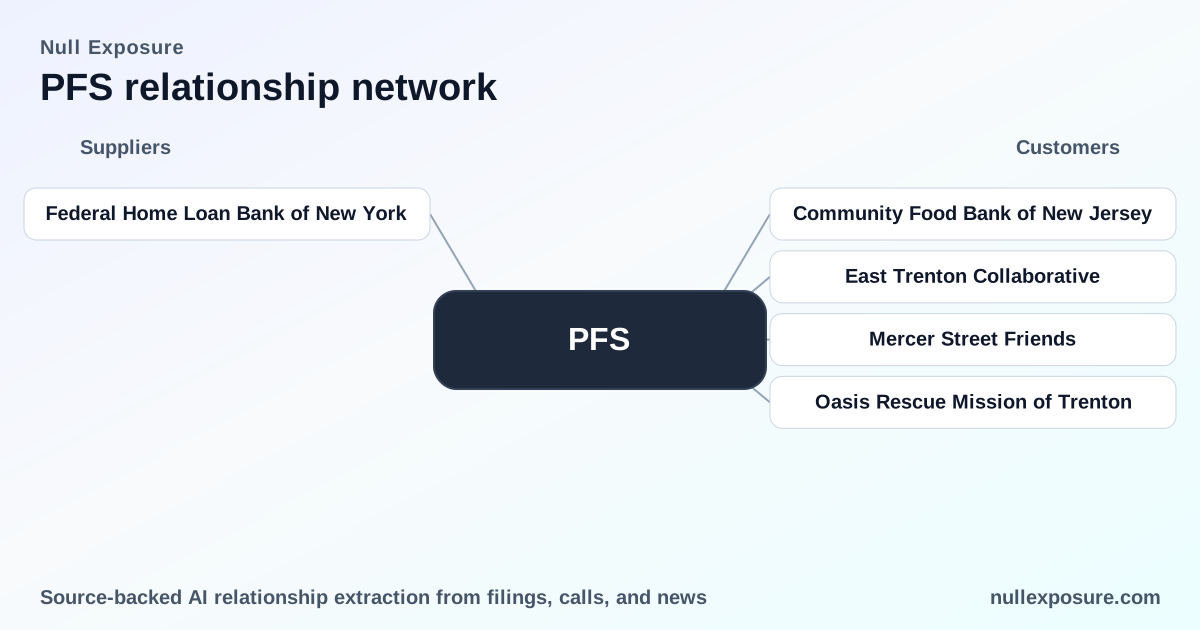
Provident Financial Services (PFS): supplier relationships, operational levers, and investor implications
Thesis: Provident Financial Services operates as the banking holding company for Provident Bank, monetizing through net interest income on loans and investments, fee income from deposit and service products, and capital returns to shareholders via dividends; its stable profitability and below‑market price/book reflect a regional bank with consistent margins and material reliance on third‑party technology and community funding programs. For investors evaluating supplier exposure and counterparties, the combination of solid profitability (33.6% profit margin) and explicit third‑party dependence for core technology shapes both opportunity and operational risk. Learn more at https://nullexposure.com/.
How Provident makes money and what the numbers tell you
Provident is a Jersey City‑based regional bank that earns net interest income from lending and investing customer deposits, supplemented by non‑interest fees and service income. The company’s trailing revenue stands at $866.8 million with a profit margin of 33.6%, return on equity of 10.7%, and a forward P/E under 9, signaling an earnings yield attractive to value‑oriented investors. Book value is quoted at $21.68, and the stock carries a modest dividend yield of 4.72%, reflecting a shareholder‑friendly capital posture.
These metrics position Provident as a profitable, cash‑generative regional bank with a conservative market valuation relative to peers. Key financial levers are net interest margin and deposit franchise stability; where those hold, Provident converts deposits into healthy earnings and cash returns.
Community funding and counterparty relationships that matter
Provident’s supplier and funding relationships extend into community and cooperative programs. These partnerships are not just social‑good gestures — they reflect access to liquidity pools, risk‑sharing structures, and reputational capital that influence local deposit flows and lending pipelines.
- According to news coverage in March 2026, Provident Bank awarded an additional $50,000 in grants to five non‑profit organizations through the Federal Home Loan Bank of New York (FHLBNY) Small Business Recovery Grant (SBRG) Program, demonstrating active participation in FHLBNY programs that route capital to community borrowers and nonprofits. (Financial news report, March 10, 2026: https://finviz.com/news/288095/provident-bank-announces-an-additional-50000-in-grants-to-5-non-profit-organizations)
Federal Home Loan Bank of New York
Provident participates in the FHLBNY SBRG program and distributed $50,000 in grants to local nonprofits, illustrating access to cooperative funding mechanisms and community engagement channels that support small business recovery and local credit demand. A news report documented this activity on March 10, 2026. Source: Finviz news coverage, March 10, 2026 (https://finviz.com/news/288095/provident-bank-announces-an-additional-50000-in-grants-to-5-non-profit-organizations).
What the corporate constraints reveal about operations and sourcing
Provident discloses that “we are dependent for most of our technology, including our core operating system, on third‑party providers.” This company‑level disclosure creates several actionable signals for investors and operators:
- Contracting posture: Provident operates with a vendor‑outsourced core IT posture rather than an insourced tech stack, which concentrates negotiating leverage with a small set of providers and creates dependency on contract terms and service levels.
- Concentration risk: The admission of dependence for “most of our technology” is a concentration indicator — a handful of vendors deliver critical functionality, increasing vulnerability to vendor outages, price changes, or contract disputes.
- Criticality: The core operating system is explicitly critical to bank operations; any supplier disruption would have direct impact on transaction processing, customer service, and regulatory reporting.
- Maturity and governance: Heavy third‑party reliance implies established vendor relationships and procurement processes, but also requires robust vendor risk management and contingency planning to match the bank’s regulatory and operational profile.
Treat these constraints as company‑level traits that affect all supplier relationships; do not infer that any single external partner is the named provider unless Provident’s disclosures specify them.
For a deeper supplier risk profile and to compare counterparties across other regional banks, review comprehensive exposure analyses at https://nullexposure.com/.
Investment implications and operator takeaways
Provident’s combination of attractive valuation metrics and consistent profitability makes it appealing to income and value investors, but supplier dependency and concentrated tech outsourcing are the principal operational risks that change the risk/reward calculus.
- Positive factors: strong profit margin, reasonable forward P/E, and community engagement through FHLBNY programs that reinforce local deposit and lending relationships.
- Risk factors: outsourced core technology (contract concentration and criticality), and any vendor disruption would materially affect operations and customer experience. Monitor vendor contracts, SLAs, and cyber resilience disclosures in future filings.
Actionable items for investors and operators:
- Monitor SEC filings and proxy statements for vendor names, contract lengths, and termination clauses to quantify outsourcing exposure.
- Track FHLBNY and other cooperative program participation to assess community liquidity channels and reputational capital.
- For operators, ensure business continuity and vendor diversification plans are tested and disclosed consistent with regulatory expectations.
Explore supplier exposure comparisons and vendor risk dashboards at https://nullexposure.com/ to benchmark Provident against regional peers.
Bottom line and next steps
Provident is a profitable regional bank with clear revenue drivers and attractive valuation, complemented by community funding activity via the FHLBNY. However, dependence on third‑party technology for core operations is an explicit operational constraint that elevates supplier risk and should factor into both investment valuation and counterparty due diligence. For investors prioritizing operational resilience alongside yield, scrutinize vendor contracts and contingency measures in upcoming filings.
For a full supplier risk assessment and comparative intelligence on regional banks, visit https://nullexposure.com/ and request the supplier exposure brief tailored to PFS.