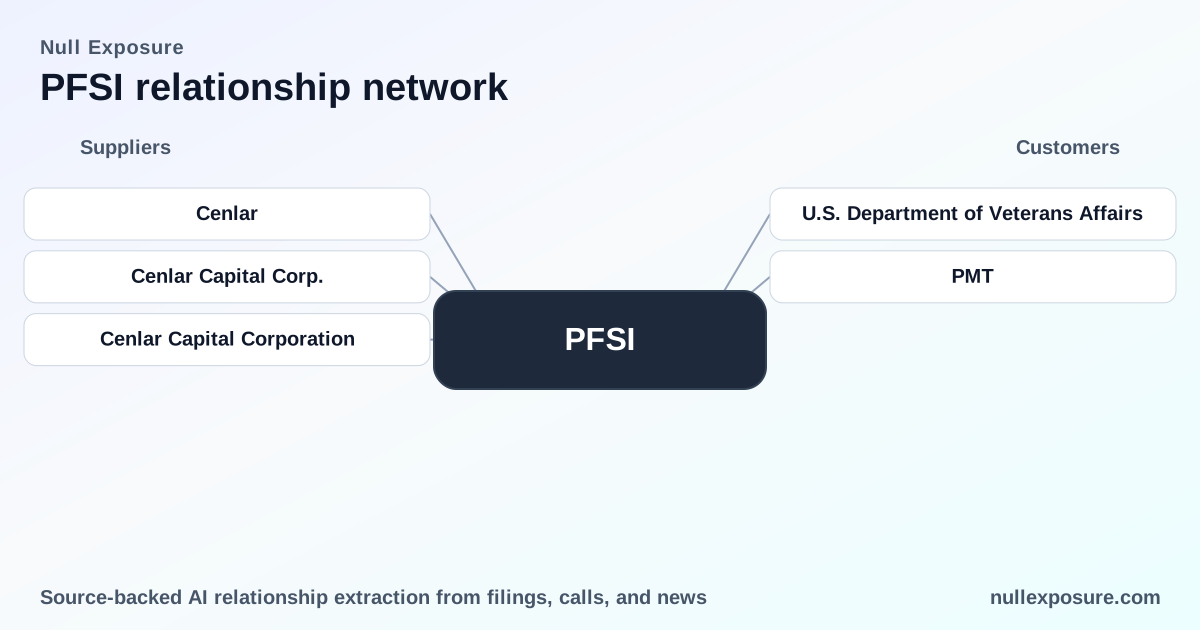
PennyMac Financial Services (PFSI): The Cenlar Acquisition and What It Means for Supplier Risk
PennyMac Financial Services operates as a combined mortgage banker and investment manager, monetizing through origination margins, mortgage servicing fees, and scale-driven subservicing contracts. The company generates recurring fee income by servicing loans on behalf of institutional clients and expands its fee base by acquiring servicing portfolios; the February–March 2026 Cenlar transaction significantly accelerates that strategy and immediately increases fee-bearing loan volume. For investors and operations leaders, the transaction shifts supplier dynamics from third-party dependency toward in-house scale — with clear implications for contracting posture, concentration, and operational criticality. For deeper supplier intelligence and monitoring tools, visit https://nullexposure.com/.
A single move that rewrites the servicing playbook
PennyMac’s purchase of Cenlar’s subservicing business is an accretive, scale-first acquisition: cash upfront with contingent earnouts aligns incentives while pushing PennyMac into a leadership position among U.S. mortgage subservicers. The deal brings approximately 2 million loans and up to $740 billion in subservicing volume into PennyMac’s remit, materially expanding recurring fee revenue and operational scope. Multiple press outlets documented the transaction as a February 11, 2026 definitive agreement with $172.5 million upfront and up to $85 million in contingent consideration payable over three years.
- Business model driver: the acquisition converts outsourced servicing contracts into owned fee streams and creates cross-selling and operational leverage opportunities across PennyMac’s servicing and investment platforms.
- Contracting posture: PennyMac is consolidating counterparty risk by acquiring contracts rather than outsourcing—this strengthens control but increases internal execution risk.
- Concentration and criticality: while the transaction reduces reliance on external servicers in some areas, the company-level disclosures show high concentration in loan production from PMT, which is a separate concentration signal that investors must track.
- Maturity: acquiring a large, established servicer portfolio implies PennyMac will inherit matured operations and client relationships, but integration complexity is non-trivial.
If you want a continuous feed of supplier risk signals and deal tracking, consider visiting https://nullexposure.com/ for targeted monitoring.
Every reported relationship captured in the coverage
Below are concise, plain-English summaries for each relationship mention in the public reporting set, with source references so analysts can verify.
- PennyMac agreed to pay $172.5 million upfront and up to $85 million in contingent consideration over three years for Cenlar’s subservicing contracts, mortgage servicing operations and roughly 100 institutional clients. This deal description was reported by MPA Magazine and picked up in coverage on March 10, 2026. (MPA Magazine, March 2026)
- PennyMac completed the acquisition of Cenlar’s mortgage loan servicing outsourcing business, positioning PennyMac as one of the leading mortgage outsourcing service providers in the U.S. This completion notice was summarized by Bitget’s market news feed in March 2026. (Bitget News, March 2026)
- PennyMac announced it will acquire the subservicing business of Cenlar Capital Corp. for $172.5 million upfront and up to $85 million of contingent consideration, per industry coverage that emphasized the deal’s strategic subservicing expansion. (Scotsman Guide, March 2026)
- PennyMac disclosed on February 11, 2026 a definitive agreement to acquire Cenlar Capital Corporation’s subservicing business in an all-cash deal valued at $172.5 million upfront and up to $85 million in contingent consideration, and stated the portfolio adds roughly 2 million loans and up to $740 billion in subservicing. This was included in the Globe and Mail press release summary. (The Globe and Mail / press release, Feb 11, 2026)
- The Globe and Mail’s press release coverage reiterated the February 11, 2026 definitive agreement terms and the scale of loans and servicing added to PennyMac’s portfolio. (The Globe and Mail / press release, Feb 11, 2026)
- PennyMac public commentary and trade coverage reiterated the all-cash transaction terms and described the acquired assets as primarily consisting of subservicing contracts and mortgage servicing operations, with the same $172.5 million upfront and up to $85 million contingent structure. (The Mortgage Point, Feb–Mar 2026)
- TradingView’s news feed reported the February 11, 2026 announcement that PennyMac agreed to acquire Cenlar’s subservicing business for $172.5 million, summarizing the headline economics for market readers. (TradingView News, March 2026)
- Multiple outlets consolidated the same facts: definitive agreement signed February 11, 2026 with the $172.5 million upfront and $85 million contingent earnout structure; coverage consistently framed the deal as a major subservicing move for PennyMac. (Synthesis across industry press, Feb–Mar 2026)
What the constraints say about PennyMac’s operating model
Company-level disclosures and constraint excerpts signal several structural characteristics investors must treat as fact-level inputs to supplier risk and operations analysis:
- Outsourcing geography: PennyMac reports it outsources certain services to vendors in countries such as India and the Philippines, which introduces geopolitical, regulatory, and operational continuity risk for its outsourced functions.
- Concentration in loan production: The company purchased 79%, 85% and 70% of its loan production from PMT in 2024, 2023 and 2022 respectively; this is high concentration in originations that creates a supplier single-point dependency for production flow.
- Third‑party software and cloud dependence: PennyMac licenses third-party software and relies on cloud infrastructure for workflow platforms, marking technology ecosystem dependency as a critical operational factor.
- Service provider role: The company explicitly relies on third-party services in its products and servicing applications, so vendor resilience and contract enforcement are central to operational continuity.
These constraints collectively shape PennyMac’s contracting posture: the company combines acquisition-led de-risking of external servicers with continued reliance on technology and production partners, resulting in a hybrid but highly interdependent supplier map.
Risks, upside, and what to monitor next
- Integration risk is the primary execution hazard. PennyMac pays a sizable upfront consideration plus contingent earnouts; focus on retention of institutional clients, migration of servicing platforms, and SLA continuity.
- Earnings quality upside through fee accretion is measurable. The added servicing volume should improve recurring fee income and margin stability if client relationships and throughput are preserved.
- Technology and outsourcing exposures are live risks. Continue tracking third-party cloud vendors and offshore service arrangements as potential points of failure.
- Concentration with PMT highlights single‑counterparty exposure. Even after Cenlar, PennyMac’s production concentration signals revenue sensitivity to PMT performance and contractual terms.
For teams evaluating supplier health and post‑deal integration, a practical next step is to instrument contract KPIs and monitor client retention and platform migration metrics; for a vendor intelligence toolkit, see https://nullexposure.com/.
Actionable investor conclusions
- Prioritize integration KPIs: retention of the ~100 institutional clients and operational uptime on migrated servicing platforms will determine the deal’s earnings realization.
- Track contingent payments and realized synergies: the $85 million earnout is tied to performance over three years and will be a direct indicator of revenue conversion and client stability.
- Monitor third‑party tech and outsourcing exposures: cloud vendors and offshore service suppliers remain critical to execution and should be integrated into ongoing risk dashboards.
PennyMac has converted a material portion of outsourced servicing into owned assets, strengthening its recurring-fee profile while increasing execution complexity. Investors should treat this as a strategically positive move that raises the bar for operational discipline and vendor governance. For ongoing supplier risk feeds and to set up alerts on PennyMac relationships, visit https://nullexposure.com/.