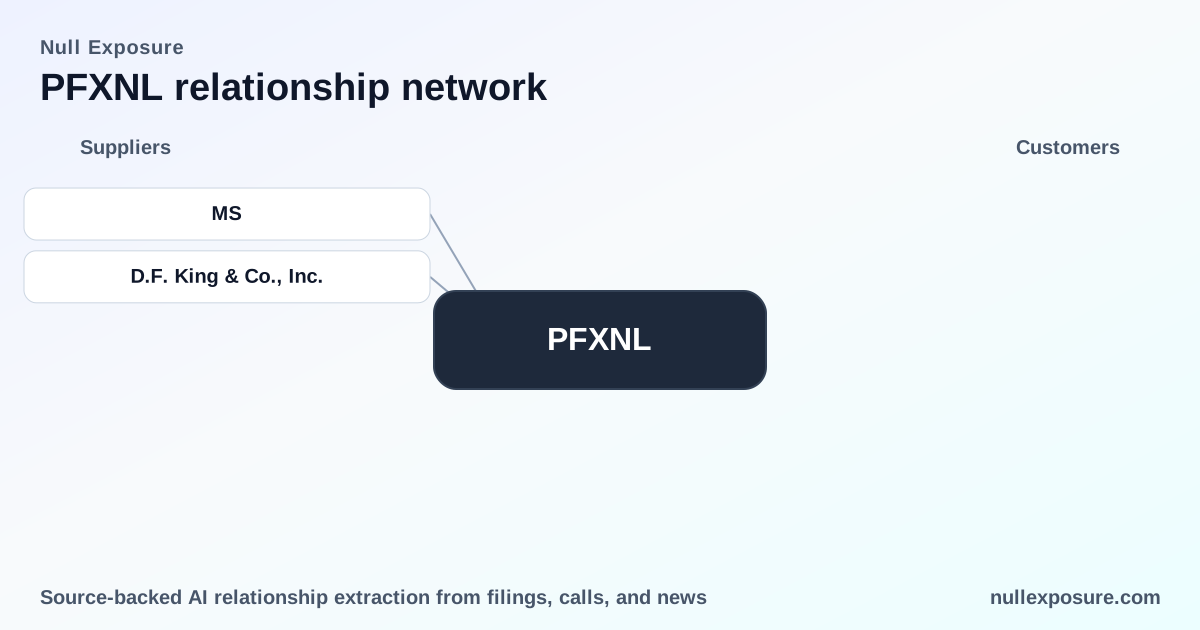
PFXNL supplier relationships: what investors need to know
PFXNL structures its capital and executes debt amendments through third‑party financial intermediaries, outsourcing event‑driven creditor engagement and vote/tabulation mechanics to specialists and large banks. The company monetizes by preserving financing flexibility and minimizing borrower disruption—engaging solicitation and tabulation agents to secure bondholder consents when amendments are needed, a routine but consequential cash‑management activity that affects leverage and covenant profiles.
For direct, evidence‑driven intelligence on supplier roles and contractual posture, see NullExposure’s supplier hub: https://nullexposure.com/
Why these vendor choices matter to returns and risk
PFXNL’s decision to hire established market participants for a consent solicitation is not peripheral — it is a deliberate operating choice with measurable impacts on deal cost, execution certainty, and timeline.
- Contracting posture is event‑driven and transactional. Using a bank as Solicitation Agent and a specialist as Information and Tabulation Agent signals that PFXNL treats bond amendments as discrete projects, not ongoing managed services. This reduces standing vendor lock‑in but increases the tactical importance of each vendor selection.
- Concentration is low but critical in execution windows. The set of counterparties is small when an amendment is underway; failure or delay by any single supplier at that moment materially affects outcomes (consent rate, timing, pricing).
- Supplier maturity and credibility matter more than long‑term dependency. Large banks and established tabulation firms provide reputational and operational capital that speeds acceptance among bondholders and limits litigation risk.
- Cost vs. certainty trade‑off. Paying for recognized solicitation and tabulation capabilities buys execution certainty; the direct fees are routine, but the downstream impact on covenant structure and refinancing options is significant.
Explore more supplier analytics for investor decision‑making: https://nullexposure.com/
All disclosed relationships and what they do for PFXNL
Below are the relationships recorded in the supplied results, each summarized in plain English with the cited source.
- Morgan Stanley & Co. LLC — Morgan Stanley served as Solicitation Agent for Phoenix’s bond consent solicitation, coordinating outreach to bondholders and facilitating the consent process; bondholders were to receive $0.0625 per $25 principal for consenting (fiscal period cited FY2013). Source: Benzinga news report (published March 10, 2026) describing the consent solicitation mechanics and agent roles.
- D.F. King & Co., Inc. — D.F. King was appointed Information and Tabulation Agent, responsible for processing consents and maintaining vote tallies for the same solicitation; the appointment is described alongside the Morgan Stanley engagement in the Benzinga item (FY2013). Source: Benzinga news report (published March 10, 2026) detailing the tabulation role and compensation terms for consenting bondholders.
These two entries are the complete set of supplier relationships returned in the results for PFXNL’s supplier scope.
What investors should infer about operating model and governance
Absent broader supplier disclosures, the observed engagements point to several company‑level signals:
- Operational playbook: PFXNL uses external, market‑standard vendors for debtholder engagement rather than insourcing creditor relations; this is consistent with firms that prioritize balance‑sheet flexibility and minimize internal overhead.
- Governance orientation: Recruiting a top‑tier bank and a specialist tabulation firm reflects a conservative governance stance—favoring credible intermediaries to manage legally sensitive creditor communications.
- Event concentration risk: While supplier roster is limited in these episodes, the reliance on a small set of providers during amendment events creates high short‑term criticality even if long‑term dependency is low.
- Maturity of supplier relationships: Partnering with established firms signals maturity in execution capability, reducing execution risk relative to using less experienced providers.
Note: No explicit constraints (contractual limits, exclusivity clauses, or service level excerpts) were provided in the source data; the points above are company‑level signals derived from the nature of the vendor roles disclosed.
Investor implications — risk, cost and monitoring priorities
For investors evaluating PFXNL, these supplier disclosures translate into actionable diligence items:
- Execution risk is concentrated around amendment windows. Vendors are inexpensive relative to the potential value preserved or created by a successful consent solicitation; track timelines and vendor responsiveness in active restructurings.
- Fee transparency and control. Confirm whether solicitation/tabulation fees are one‑off event costs or part of broader service arrangements; these fees can be immaterial to operating margins but important to net proceeds in distressed or amendment scenarios.
- Reputational and regulatory hygiene. Use of reputable firms reduces litigation risk and enhances bondholder confidence, which is particularly valuable in contested consent solicitations.
- Operational fallback planning. Verify that contracts include contingency provisions (alternate agents, expedited onboarding) to limit single‑point failures during critical votes.
If you need an executive summary of supplier exposure and event‑driven counterparty risk, NullExposure’s platform provides that in investor‑ready format: https://nullexposure.com/
Practical diligence checklist for buyers and portfolio managers
- Confirm the scope and duration of solicitation and tabulation engagements (one‑off vs. ongoing).
- Request underlying engagement letters to verify fees, termination rights, and liability limits.
- Review historical performance: how quickly did the selected agents deliver consents in prior events?
- Validate conflict‑of‑interest disclosures (banking firms often have multiple roles across creditor groups).
- Ensure vendor oversight mechanisms: escalation triggers, audit rights, and post‑event reporting.
Bottom line
The disclosed PFXNL supplier relationships are surgical and execution‑focused: large bank as Solicitation Agent and a specialist tabulation firm for the same consent solicitation. For investors, that translates to highly concentrated short‑term vendor criticality, low structural dependency, and a preference for established counterparty credibility. Monitoring these episodic relationships is essential because their execution determines the effective outcome of debt amendments and, by extension, capital structure and shareholder value.
For further supplier intelligence and to map counterparty exposure across events, start here: https://nullexposure.com/