Peapack-Gladstone Financial (PGC): Supplier relationships that underpin liquidity and operations
Peapack-Gladstone Financial operates as a regional bank and private-wealth manager whose primary revenue comes from net interest margin on loans and deposit spreads, supplemented by wealth-management fees and select commercial banking services. The company monetizes balance-sheet scale through lending and liquidity management, relying on secured borrowing facilities and short-term credit lines to smooth funding and support asset growth. For investors assessing supplier and counterparty risk, the bank’s disclosed relationships with government-backed liquidity providers and its mix of long- and short-term third‑party contracts are the most material operational signals. Learn more about coverage and supplier intelligence at the Null Exposure homepage: https://nullexposure.com/
Why the Federal Home Loan Bank and Fed access matter to a regional bank
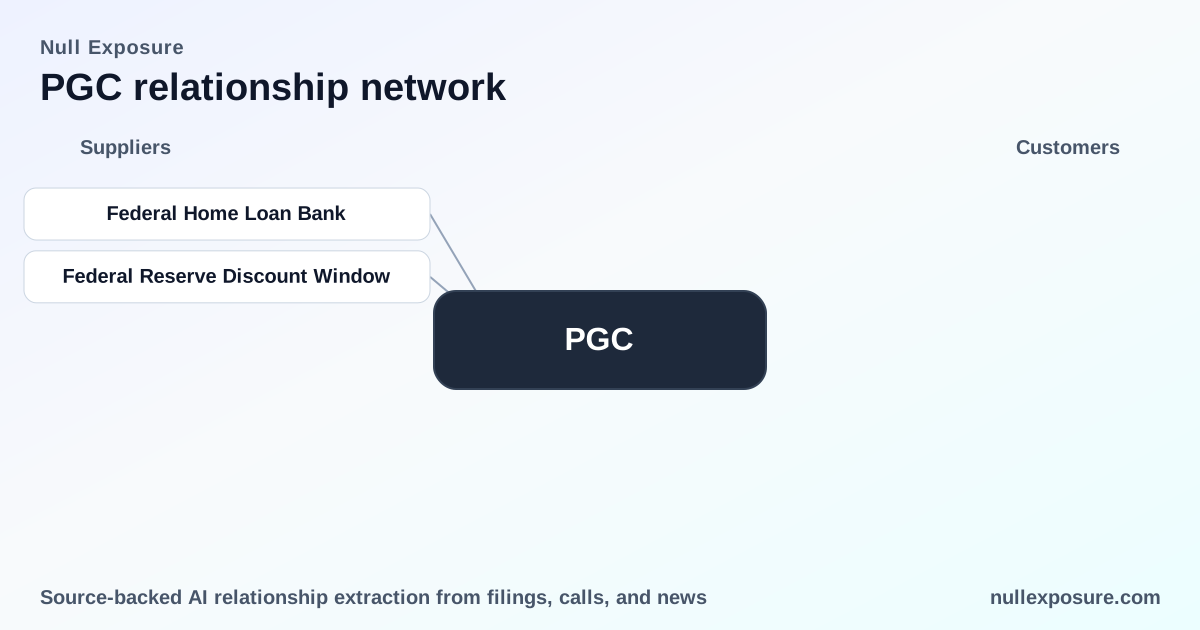
Peapack-Gladstone reports explicit, secured borrowing lines with the Federal Home Loan Bank (FHLB) and access to the Federal Reserve Discount Window, which together form the backbone of its contingency liquidity plan. These facilities function as low-cost, stable sources of secured funding that reduce rollover risk and provide optionality if deposit flows tighten.
-
Federal Home Loan Bank — Peapack-Gladstone discloses secured borrowing facilities with the FHLB that contribute to the company’s total available liquidity; this is a traditional source of collateralized funding for regional banks. According to the company’s FY2026 fourth‑quarter release reported on TradingView (March 10, 2026), the bank lists the FHLB among its secured borrowing sources that help produce approximately $3.6 billion of additional liquidity resources.
Source: TradingView coverage of Peapack-Gladstone’s FY2026 fourth-quarter results (Mar 10, 2026). -
Federal Reserve Discount Window — The company also identifies the Federal Reserve Discount Window as an available borrowing source within the same $3.6 billion of contingency liquidity, reflecting an explicit backstop in stressed funding scenarios. According to the same FY2026 disclosure cited by TradingView, access to the Discount Window is a component of Peapack-Gladstone’s secured borrowing facilities.
Source: TradingView coverage of Peapack-Gladstone’s FY2026 fourth-quarter results (Mar 10, 2026).
Because the company’s public filing notes unused short‑term commitments of $1.8 billion from the FHLB and $2.0 billion from the Federal Reserve Bank (reported at December 31, 2024), investors should treat these counterparties as government‑backed, high‑availability liquidity providers for PGC. This explicit naming in the filing confirms the counterparty type and scale of unused capacity.
All counterparties found in the record — concise readouts
-
Federal Home Loan Bank — Peapack-Gladstone lists the FHLB among secured counterparties that provide collateralized borrowing capacity; the company reported the FHLB as a named source of unused short-term commitments as of December 31, 2024. Source: company filing disclosure referenced in the FY2026 Q4 release and TradingView coverage (Mar 10, 2026).
-
Federal Reserve Discount Window — The bank identifies the Discount Window as an available funding source and reports a material unused commitment from the Federal Reserve Bank as of December 31, 2024, signaling an explicit central-bank backstop. Source: company filing disclosure referenced in the FY2026 Q4 release and TradingView coverage (Mar 10, 2026).
These two relationships are the only supplier-style counterparties surfaced in the supplier search results; both are liquidity counterparties with government affiliation, which substantially lowers counterparty credit risk while improving funding optionality.
What the contract and vendor constraints reveal about the operating model
Peapack-Gladstone’s disclosed contract patterns provide a clear picture of how the bank runs its operations:
-
Contracting posture mixes long-term real-estate commitments with short-term operational contracts. The company has a lease arrangement requiring monthly payments through 2036, indicating long-dated occupancy obligations that create fixed operating leverage. At the same time, routine rental and maintenance contracts for facilities and equipment are generally one year, reflecting an inclination toward short-term vendor commitments for non-core services.
-
Service-provider relationships are operationally important but not concentrated in the supplied results. The filing explicitly references legally binding purchase obligations under data processing service agreements, which identifies technology and processing suppliers as necessary service providers rather than speculative vendors.
-
Counterparty profile is partially government-laden and therefore low credit-risk for liquidity lines. The filing’s explicit call-out of unused commitments from the FHLB and the Federal Reserve Bank is a company-level signal that Peapack-Gladstone uses government-affiliated lenders for contingency funding.
Taken together, these signals show a bank with structured liquidity redundancy, fixed long-term occupancy costs, and a pragmatic use of short-term service contracts for day-to-day operations.
For investors tracking supplier exposure and operational risk, Null Exposure provides structured supplier intelligence and relationship mapping at https://nullexposure.com/ — see how this supplier view integrates into broader counterparty risk analysis.
Risk implications for investors and operators
-
Liquidity risk is mitigated but not eliminated. The presence of sizeable unused commitments from the FHLB and the Fed reduces immediate rollover vulnerability, but reliance on secured borrowing requires adequate collateral and can be constrained under systemic stress. Monitor collateral availability and loan-to-deposit dynamics as the primary follow-up metrics.
-
Fixed‑cost real‑estate exposure increases operating leverage over the next decade. A lease through 2036 anchors occupancy costs and raises sensitivity to local market conditions and interest-rate cycles.
-
Operational dependency on data-processing vendors is critical. The company’s legally binding purchase obligations for data services indicate a non-discretionary relationship; continuity and vendor resilience should be part of counterparty due diligence.
If you want a concise supplier risk brief or to monitor how these relationships evolve across filings and press releases, visit Null Exposure for ongoing coverage: https://nullexposure.com/
Practical next steps for investors
- Verify collateral schedules and pledged assets tied to FHLB lines to understand how much of the loan book is encumbered.
- Track lease obligations and potential off‑balance-sheet items tied to facilities through 2036.
- Request or model stress scenarios that remove access to unsecured market funding but preserve FHLB/Fed availability to see liquidity runway.
For tailored supplier and counterparty analysis that maps disclosures into investable risk signals, explore our platform at https://nullexposure.com/
Peapack-Gladstone’s disclosed supplier relationships are concentrated in high-quality, government‑linked liquidity providers and a set of operational vendors governed by a mix of long- and short-term contracts. That structure supports current balance-sheet management while exposing investors to the usual regional-bank considerations: collateral availability, fixed real-estate commitments, and operational vendor continuity.