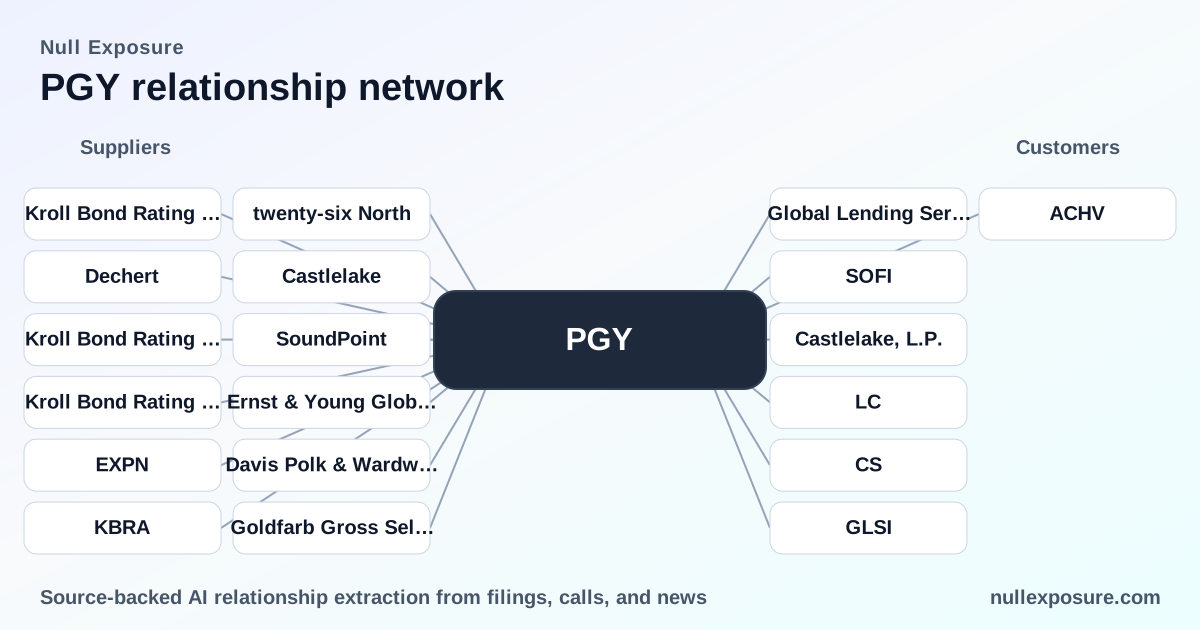
Pagaya Technologies (PGY): Supplier relationships that underwrite the financing engine
Pagaya operates as an AI-driven financial infrastructure company that sources, prices and packages consumer and auto receivables and monetizes by originating forward-flow loan pipelines and securitizations, structuring financing vehicles, and earning fees and spread capture through asset sales and trust servicing. The company’s revenue model is anchored in third-party capital partners, ABS issuance and recurring servicing arrangements — relationships that are both revenue-generating and operationally critical. For investor due diligence on counterparty risk and operational resilience, supplier relationships are the primary lens into Pagaya’s funding construct and execution capacity. Visit https://nullexposure.com/ for further supplier intelligence and comparative coverage.
How Pagaya monetizes and why suppliers matter
Pagaya builds predictive credit models and then packages originated loans into financing vehicles that are sold to institutional buyers or funded via ABS. The company captures value through loan origination margins, structuring and placement fees, and recurring servicing or analytics contracts tied to those financing vehicles. This business design makes capital providers, rating agencies, law firms, auditors and technology vendors not peripheral vendors but essential conduits of cash flow and market access.
- Capital partners and ABS investors determine Pagaya’s ability to scale originations.
- Rating agencies and legal/audit providers enable securitizations to clear the market.
- Data and platform partners expand distribution channels and the affiliate ecosystem.
If you want a supplier-level risk map for PGY counterparties, start with the financing and structuring partners that appear repeatedly in Pagaya disclosures. For curated supplier intelligence on PGY relationships, consult https://nullexposure.com/.
The supplier roster — who Pagaya is working with (each relationship summarized)
Below are every counterpart identified in the source material, with a concise relationship description and source note.
-
twenty-six North
Pagaya executed its inaugural point-of-sale ABS transaction and an inaugural paid-revolving ABS with twenty-six North, broadening financing options and providing greater consistency across market cycles. Source: Pagaya 2025 Q4 earnings call (2025Q4). -
Castlelake
Pagaya expanded forward-flow agreements into its auto asset class with an inaugural forward-flow relationship with Castlelake, and separately the company agreed to source up to US$1 billion in consumer loans to Castlelake, reflecting a material capital partnership. Sources: Pagaya 2025 Q4 earnings call (2025Q4); Dechert advisory note on agreement to source up to US$1 billion to Castlelake (FY2024). -
SoundPoint
Pagaya entered an inaugural forward-flow agreement with SoundPoint for point-of-sale assets, expanding its capital channels for that product vertical. Source: Pagaya 2025 Q4 earnings call (2025Q4). -
Kroll Bond Rating Agency, LLC (KBRA)
KBRA has repeatedly assigned preliminary and final ratings to multiple Pagaya securitizations across 2025–2026 including the PAID and RPM series (PAID 2025-2, 2025-7, 2025-R2/R3/REV1, 2026-R1, RPM 2025-5/6 and PAID 2025-8 / 2026-1). KBRA’s consistent engagement signals an active ABS issuance program dependent on external credit assessment. Sources: KBRA publications and press releases across FY2025–FY2026 (KBRA; multiple trust notices). -
Ernst & Young Global Limited
Ernst & Young provided consent as Pagaya’s independent registered public accounting firm in filings associated with FY2026, reflecting the auditor role that supports public disclosures and investor confidence. Source: Company filing consent noted in FY2026 SEC/press materials (Advfn link, FY2026). -
Davis Polk & Wardwell LLP
Davis Polk is listed in Pagaya’s FY2026 filing contact/copies, indicating its role as US counsel on corporate and transactional matters tied to financing and public company obligations. Source: Pagaya FY2026 filing (Advfn link, FY2026). -
Goldfarb Gross Seligman & Co.
Goldfarb Gross Seligman appears in company filings as Israeli counsel contact for Pagaya in FY2026, reflecting the dual-jurisdiction legal support required for cross-border operations and securities work. Source: Pagaya FY2026 filing (Advfn link, FY2026). -
Dechert
Dechert advised Pagaya on a transaction to source up to US$1 billion in consumer loans to Castlelake, demonstrating external legal counsel involvement in large directional capital agreements. Source: Dechert advisory press release (FY2024). -
Experian (EXPN)
Pagaya is expanding its affiliate optimizer engine to integrate Experian’s Activate platform and has onboarded the first partner, indicating a data and channel partnership intended to broaden affiliate distribution and partner-level credit signals. Source: Pagaya 2025 Q4 earnings call (2025Q4).
What the constraints reveal about Pagaya’s operating posture
Pagaya’s disclosures and the accompanying constraint signals outline a clear operational profile:
-
Critical third‑party dependency. The company states that its financing vehicles rely on a variety of third‑party service providers for a substantial portion of operations, which positions supplier continuity as mission-critical rather than supportive. This is a company-level signal from filings indicating materiality (critical) to operations.
-
Supplier role is operational, not discretionary. Many relationships function as service providers (custody, fund accounting, rating agencies, legal and audit), underscoring that supplier failure would directly impair financing and securitization. This is a company-level relationship-role signal.
-
Services segment concentration. Operational outsourcing centers on services — IT, portfolio management, custody, pricing and fund administration — which concentrates risk in a set of specialized vendors rather than a diversified goods supply chain. This is a company-level segment signal.
These constraints drive a supplier risk profile where counterparty credit, continuity planning, SLAs and contractual protections (indemnity, termination rights, transition services) are high priority for investors and operators.
Investment implications and risk considerations
-
Funding continuity is the principal operational risk. Pagaya’s ability to originate and distribute loans is tightly coupled to its capital partners and ABS market access (KBRA ratings, capital counterparties like Castlelake and twenty-six North). If counterparties withdraw or markets repricedize, loan flow and fee capture compress rapidly.
-
Legal and audit scaffolding reduces execution risk but creates concentration points. Strong, recognized counsel and auditors (Davis Polk, Goldfarb, EY) support transaction closing and public reporting, but also mean single-provider disruption has outsized effects on deal timelines.
-
Data and distribution partners accelerate growth but shift exposure to third‑party platforms. Integration with Experian’s Activate expands acquisition and affiliate reach, but introduces dependency on third‑party platform uptime and contractual terms tied to data usage.
For actionable supplier diligence, prioritize contract review of forward-flow agreements, indemnities, waterfall/servicing terms in ABS documents and the continuity clauses for financing vehicles. If you need supplier-level profiles and contract triggers mapped to materiality, see our supplier intelligence portal at https://nullexposure.com/.
What investors and operators should do next
- Conduct targeted counterparty stress tests for the largest capital providers and the ABS conduit ratings pipeline.
- Review legal schedules for termination and substitution provisions in forward-flow and trust servicing agreements.
- Demand transparency on operational SLAs for key service providers (custody, fund accounting, pricing engines) and a feasible transition plan.
For a comparative supplier-risk briefing and to track changes in Pagaya’s financing counterparties over time, visit https://nullexposure.com/. Align your exposure limits to the company’s concentration in service-provider relationships and prepare contingency playbooks tied to ABS market repricing.
Bottom line
Pagaya’s business model is fundamentally partner-dependent: capital providers and rating agencies enable scale and revenue realization, while legal, audit and data partners enable execution and market access. Investors should treat supplier relationships as core financial counterparties — not ancillary vendors — and underwrite PGY exposure accordingly. For deeper supplier mapping and ongoing monitoring, go to https://nullexposure.com/.