Pagaya Technologies Ltd. Warrants (PGYWW): A Supplier-Risk Map for Investors
Pagaya operates as an AI-first credit asset manager that monetizes by originating and managing loan portfolios through partner channels and selling financing to asset investors. The company underwrites and structures loans using proprietary models, places originations into financing vehicles and ABS structures, and earns fees and spread income from lifecycle management and capital markets transactions. Revenue TTM of $1.301B and a gross profit of $552M indicate a sizeable platform business that depends on third‑party originators, distribution partners and capital providers to scale returns.
If you are evaluating counterparty exposure and supplier concentration for Pagaya, this note synthesizes the 2025 Q4 disclosures and company filings into clear relationship takeaways and a vendor-risk posture. For a consolidated supplier-risk view, visit https://nullexposure.com/.
2025 Q4: The new partner rollouts that matter to operators and investors
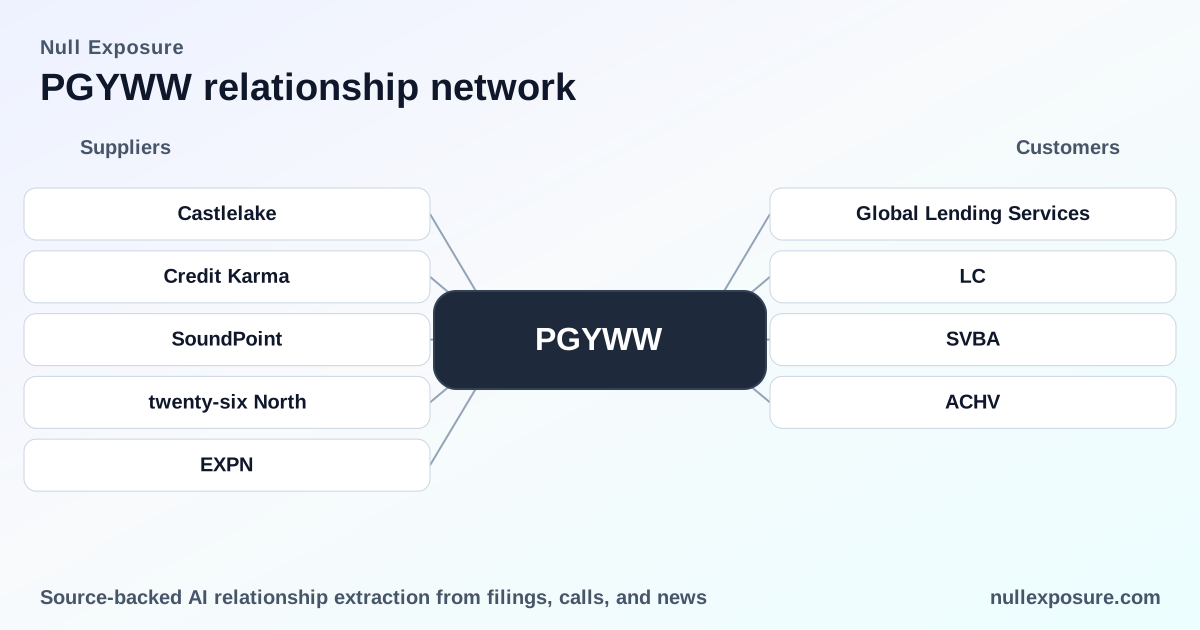
Pagaya’s 2025 Q4 earnings call disclosed several new and evolving supplier relationships that change both origination flow and distribution reach. Below are the five partner mentions from the call with concise takeaways and source references.
-
Castlelake — inaugural forward flow in auto. Pagaya confirmed in the 2025 Q4 earnings call that it expanded forward-flow agreements into auto, including an inaugural agreement with Castlelake, establishing a new asset-class supply line for vehicle loans. (Pagaya 2025 Q4 earnings call, March 2026)
-
SoundPoint — inaugural forward flow in point-of-sale. The company announced an inaugural point-of-sale forward-flow agreement with SoundPoint, diversifying originations beyond personal loans and auto. (Pagaya 2025 Q4 earnings call, March 2026)
-
twenty-six North — inaugural paid revolving ABS and POS ABS partner. Pagaya described executing its inaugural POS ABS and a paid revolving ABS with twenty-six North, creating additional financing and liquidity structures to smooth capital-market cyclicality. (Pagaya 2025 Q4 earnings call, March 2026)
-
Credit Karma — distribution integration for LendingClub offers. Pagaya reported onboarding LendingClub onto Credit Karma via its affiliate optimizer engine, enabling personal loan offers to present to consumers through Credit Karma’s channels in partnership with Pagaya. (Pagaya 2025 Q4 earnings call, March 2026)
-
Experian — expanding affiliate optimizer to Experian’s Activate platform. Pagaya is integrating Experian’s Activate platform into its affiliate optimizer engine, launching its first partner on that integration and queuing additional onboarding activity. (Pagaya 2025 Q4 earnings call, March 2026; Experian referenced as EXPN)
Each relationship expands Pagaya’s pipeline either on the supply side (originations and forward flow) or on the distribution side (channel presentation and lead placement), and the company explicitly tied these relationships to product and funding diversification on the call.
Why these partnerships matter to Pagaya’s operating model
Pagaya’s business model mixes origination partnerships, financing vehicles and distribution integrations. The company-level constraints from filings and risk disclosures frame how suppliers function inside that model:
-
Contracting posture is mixed: long-dated capital, short-term services. Company filings show long-term financing obligations — for example, $160 million of 6.125% exchangeable senior notes due in October 2029 — indicating multi-year capital commitments that support asset financing. Conversely, commercial agreements with loan aggregators and partners can include 30‑day termination rights, creating operational flexibility for counterparties and execution risk for Pagaya if flows reverse quickly. (Annual Report on Form 10‑K; company risk disclosures)
-
Supplier roles are operationally critical. Pagaya discloses reliance on third parties for customer support, collections, loan origination, data verification and servicing. These are core functions rather than peripheral vendors; failure or contract loss would materially disrupt operations. (Company 10‑K and risk statements)
-
Materiality and spend scale are non-trivial. Filings and capital structure notes position Pagaya’s financing and third-party spend in a material band — the exchangeable notes and Financing Vehicle structure indicate meaningful funding scale, and the company signals that the ability to raise capital from asset investors is vital to revenue generation. (10‑K; financing disclosures)
-
Contract maturity profile supports capital markets access but not guaranteed continuity of originations. The combination of long-term capital instruments and short-term supplier arrangements gives Pagaya financing stability but leaves origination flow volume susceptible to counterparty termination or market repricing.
These constraints create a classic fintech operating posture: capital‑intensive, dependent on third‑party origination and distribution, and exposed to counterparty behavioral risk.
For an investor-facing supplier-risk dashboard and scenario modelling, see https://nullexposure.com/.
Practical implications for investors and operators
Pagaya’s disclosed relationships have direct operational and valuation implications:
-
Diversification of asset classes reduces product-concentration risk. Bringing auto and POS forward-flow partners on board lowers dependence on personal loans as the sole supply channel, improving resilience across credit cycles.
-
Distribution integrations accelerate scale but shift control. Credit Karma and Experian integrations expand reach but place customer acquisition and presentation mechanics partially outside Pagaya’s direct control, increasing dependency on partner platforms’ commercial terms and compliance posture.
-
ABS & revolving structures improve capital agility but require active market access. The twenty-six North deals introduce revolving ABS and paid structures that smooth funding volatility; however, those instruments require continued investor appetite and repricing capacity in securitization markets.
-
Short-term termination clauses increase tail risk for originations. The 30‑day termination right in aggregator agreements is operationally meaningful: an aggregation partner significantly changing its stance could compress warehouse utilization and impair near-term ABS issuance.
Financial context strengthens these points: Revenue TTM of $1.301B, gross profit $552M, operating margin ~23.8%, and robust return metrics indicate the platform is profitable at scale, but a high beta (5.94) signals equity volatility tied to execution and funding risk (company financials).
What to watch next — catalysts and risk triggers
- Execution of the forward‐flow agreements with Castlelake and SoundPoint: scale, pricing, and duration will determine the sustainable lift to originations.
- Performance of the inaugural ABS deals with twenty-six North — seasoning, loss rates and investor demand will govern the cost of funding for revolving structures.
- Onboarding cadence on Experian Activate and Credit Karma: conversion rates and pooled performance by channel will reveal whether distribution integrations deliver incremental returns.
- Capital markets access indicators: spreads on exchangeable notes, ABS issuance windows and investor participation will signal whether Pagaya can maintain competitive funding costs.
For hands-on monitoring of supplier exposures and to model counterparties into valuation scenarios, check https://nullexposure.com/ for tools and reports.
Final assessment and investor action points
Pagaya’s recent partner disclosures show deliberate diversification across supply and distribution, supported by structured financing. The core risk profile is not the absence of diversification but the dependency on third‑party originators and platforms that can terminate or reprice with short notice. Investors should weigh the company’s solid revenue and margin profile against operational concentration and funding sensitivity.
Key actions:
- Review counterparties’ contractual tenors and termination rights when modelling downside scenarios.
- Monitor ABS issuance performance and investor appetite as a leading indicator of funding stability.
- Track conversion metrics from Experian and Credit Karma integrations to validate distribution value.
If you want an integrated supplier-risk report customized to portfolio stress cases, visit https://nullexposure.com/ to request a tailored analysis.