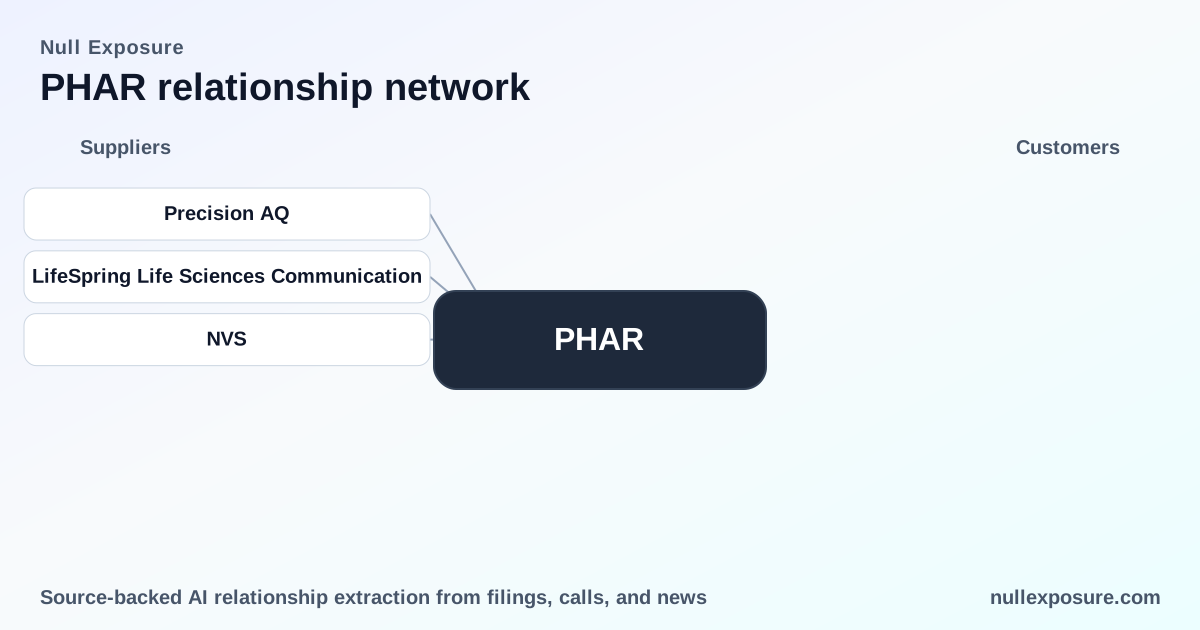
PHAR supplier relationships: who Pharming hires, who it pays, and why it matters to investors
Pharming Group NV builds a commercial rare-disease franchise by combining in‑licensed products with internal commercialization and outsourced corporate communications. The company monetizes through product sales and recognizes licensing-related cost obligations (royalties and milestone payments) that flow through cost of goods sold; externally contracted PR/IR partners handle investor and media engagement. For investors evaluating supplier risk, the mix of licensing economics, outsourced communications, and modest profit margins defines where operational leverage and counterparty concentration live. Visit https://nullexposure.com/ for deeper supplier intelligence and relationship mapping.
A compact commercial snapshot you need to keep front of mind
Pharming is a Nasdaq‑listed specialty pharmaceutical company with TTM revenue of $376.1 million and positive but modest operating margin (5.82%). Market capitalization is roughly $1.07 billion and the company shows low equity volatility (beta 0.157) alongside improving quarterly revenue growth. The business model hinges on marketed therapies and licensing economics: the firm records royalty and milestone obligations as cost of goods sold, which directly compresses gross margins when triggered. These are the structural levers that determine supplier and counterparty risk for operators and investors alike. Visit https://nullexposure.com/ to explore supplier-level detail for PHAR.
Who speaks for Pharming in the U.S. — Precision AQ
Precision AQ functions as Pharming's U.S. communications/IR contact. Multiple company releases list Ethan Metelenis of Precision AQ as the U.S. contact on behalf of Pharming, signaling an established outsourced investor‑relations and media relationship. A GlobeNewswire release on February 17, 2026 lists Ethan Metelenis (Precision AQ) as the U.S. contact for Pharming; a November 2025 financial release from the company repeats the same contact. (Sources: GlobeNewswire, Feb 17, 2026; GlobeNewswire, Nov 6, 2025.)
Who handles Netherlands / European communications — LifeSpring Life Sciences Communication
LifeSpring Life Sciences Communication is Pharming’s Netherlands/Europe media and communications partner. Company filings and press materials consistently show Leon Melens of LifeSpring listed as the Dutch contact for investor and press queries, indicating a dedicated regional communications engagement. (Sources: GlobeNewswire, Feb 17, 2026; GlobeNewswire, Nov 6, 2025.)
The licensing supplier that drives product economics — Novartis
Novartis is the licensor for Joenja (leniolisib), and that licensing relationship carries explicit royalty and milestone cashflows that impact COGS. Public commentary and investor‑day notes confirm Joenja was in‑licensed from Novartis, with Pharming booking a $5 million milestone in 2025 after Joenja revenue exceeded $50 million and expensing recurring royalty fees (US$2.4 million in H1 2025). These contractual payments are material to product-level profitability and are recorded as cost of goods sold. (Sources: Finviz summary noting Novartis license; Yahoo Finance investor‑day coverage, 2026; GlobeNewswire Q2 2025 results, July 31, 2025.)
What the relationship map tells you about operating posture and concentration
Pharming’s supplier footprint highlights several company-level operating signals that investors and operators must evaluate:
- Contracting posture — targeted outsourcing for communications and IR. The use of at least two dedicated PR/IR firms (one U.S., one Netherlands) indicates Pharming treats investor and media engagement as outsourced specialist functions rather than in‑house capabilities. This reduces fixed overhead but creates dependency on external agencies for narrative control and market access.
- Commercial model — in‑license and product revenue driven. The presence of explicit royalty and milestone flows is a core commercial feature: Pharming monetizes through product sales while honoring licensor economics that reduce gross margin when triggers occur.
- Concentration and criticality — moderate product concentration with quantifiable commercial triggers. Joenja exceeded $50 million in revenue in 2025 against Pharming’s TTM revenue of $376 million, representing a meaningful single‑product contribution and a specific licensing cost profile that can swing gross margins when milestones are hit.
- Maturity and margin profile — early commercial scale with positive but thin margins. Revenue growth and EBITDA are positive, but operating margin and profit margins remain modest; licensing costs booked in COGS will be key drivers of future margin expansion or compression.
- Market and ownership signals — limited analyst coverage and modest institutional ownership. Analyst coverage shows a small panel (three buy ratings) and institutions hold roughly 21% of shares, implying a shareholder base where material sponsor or institutional influence is limited.
These are company-level signals drawn from observable supplier relationships and financials rather than contractual verbatim constraints.
Operational risk factors investors should prioritize
- Licensing economics are cash‑flow drivers. Milestone and royalty payments booked to COGS directly reduce gross margins; investors must track sales thresholds that trigger payments and model their timing into margins and free cash flow.
- Communications dependency can affect market perception. Outsourced IR/PR concentration means a handful of firms control external messaging; turnover or misalignment there can materially affect investor access during product milestones or regulatory events.
- Concentration risk at the product level. Single product contributions above the low‑hundreds of millions create sensitivity to clinical, competitive, or supply disruptions.
- Margin sensitivity to revenue mix. As higher‑margin products scale, the net effect of licensing charges will determine sustainable operating leverage.
Actionable investor takeaways
- Track upcoming sales milestones and royalty triggers tied to marketed products and incorporate them into gross‑margin forecasts.
- Monitor any contract renewals or public changes in the Precision AQ and LifeSpring relationships as changes in communications coverage can precede shifts in investor sentiment.
- Model scenario impacts of recurring royalty flows and one‑time milestone payments on EBIDTA and free cash flow to stress‑test valuation assumptions.
- For due diligence on counterparties, use supplier‑level monitoring to detect shifts in contact points or repeated references that indicate deeper outsourcing commitments.
For a comprehensive supplier‑level report and alerts on PHAR’s communications and licensing counterparties, visit https://nullexposure.com/ — operator and investor access gives you relationship timelines and alerting.
Final read: what matters for portfolio positioning
Pharming’s operational profile is clear: commercial revenue growth paired with licensing economics and outsourced communications. The company is scaling revenue while accepting explicit licensing costs that materially affect reported gross profits; external PR/IR partners manage market engagement across jurisdictions. For investors, the hinge points are milestone timing, royalty expense cadence, and whether operating leverage through higher‑margin products outpaces these supplier‑driven cost items. For targeted supplier diligence and ongoing monitoring of these exact relationships, go to https://nullexposure.com/ and subscribe for relationship‑level intelligence and alerts.