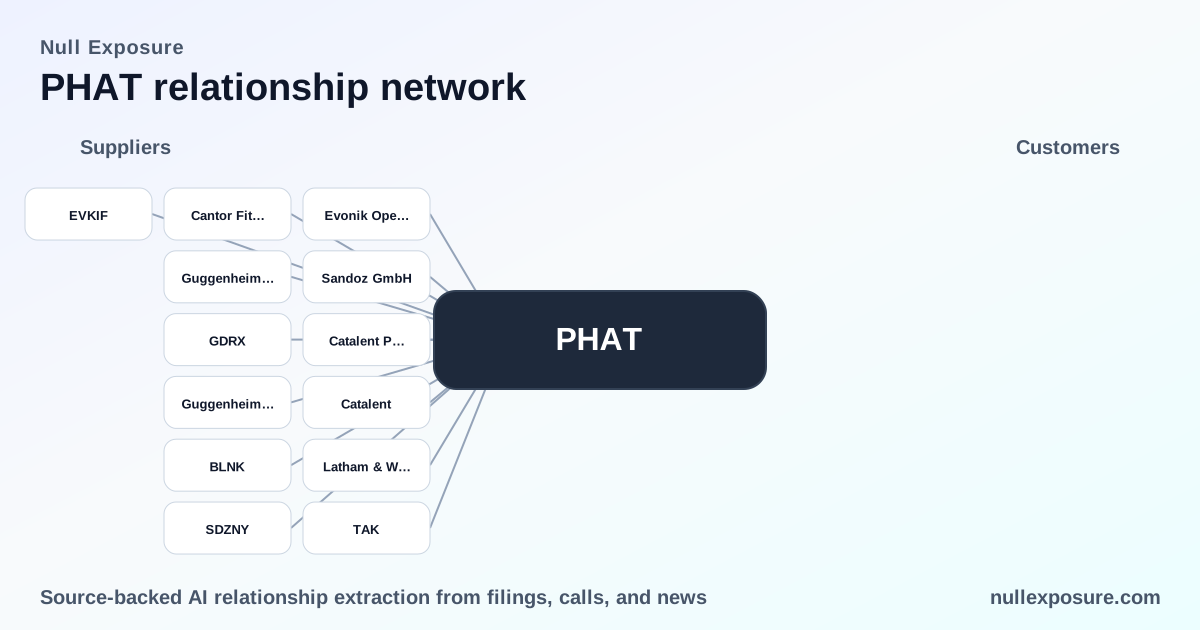
Phathom Pharmaceuticals (PHAT): the supplier map that underpins commercial rollout
Phathom Pharmaceuticals sells and will continue to monetize VOQUEZNA (vonoprazan) and bundled convenience packs through commercial product sales, funded by in‑license economics from Takeda and supported by a network of third‑party manufacturers, packagers and distribution/payment partners. Revenue today comes from product sales; the company’s operating model depends on long‑dated manufacturing and packaging contracts and distribution channels that translate prescriptions into retail fulfillment. For investors evaluating supplier risk, the critical variables are contract tenor, single‑source exposure, FDA facility approvals and the commercial routing agreements that determine patient access and payment flows. Learn more at the NullExposure homepage: https://nullexposure.com/.
Supply-chain structure in plain English
Phathom outsources core manufacturing and packaging functions. Key suppliers are contract manufacturers of API and finished tablets, and a single packager for the convenience packs that bundle vonoprazan with companion antibiotics. These partners operate under multi‑year commercial supply agreements that create stability but concentrate manufacturing risk in a small set of external facilities.
A mid‑cycle capital markets action and underwriting engagement in early 2026 illustrates the company’s dual focus on product commercialization and capital formation: see the underwriting syndicate and legal counsel entries below. For further investor materials, visit https://nullexposure.com/.
What contracts and constraints tell you about operational risk
- Long‑term contracting posture: Phathom’s tablet and API suppliers operate under multi‑year agreements—five‑year initial terms with automatic extensions or multi‑year initial terms for API—with explicit renewal mechanisms. These provisions create forecastable supply but lock the company into supplier relationships for the medium term (evidence: FY2024 10‑K).
- Material supplier dependence: The company relies on third‑party manufacturers for all clinical and commercial supplies; the loss of any single supplier is described as capable of materially harming operations. This is not a theoretical comment—Phathom acknowledges single‑source exposure in its disclosures.
- Manufacturer role and regulatory criticality: Catalent, Evonik and Sandoz facilities must be approved by FDA and other regulators to manufacture or package vonoprazan and companion antibiotics; regulatory approval of these facilities is a gating factor for production and launch volumes.
- Active commercial arrangements and exclusivity: Sandoz is contractually obliged to supply convenience packs and the companion antibiotics exclusively for a defined post‑launch period; the company also contracted to purchase set quantities at agreed prices—this creates predictability for gross margin but raises concentration risk.
These constraints are company‑level signals drawn from Phathom’s FY2024 disclosures and subsequent 2025–2026 releases; where the filings name a counterparty explicitly (Catalent, Evonik, Sandoz), the contractual term details above come directly from those excerpts.
Detailed partner map: who supplies what and why it matters
-
Evonik Operations GmbH — Evonik supplies vonoprazan drug substance (API) under a Commercial Supply Agreement entered August 1, 2022, with an initial term that extended from 2027 to 2029 after qualification of a second manufacturing facility in December 2024. According to Phathom’s FY2024 Form 10‑K, Evonik is the designated API manufacturer for commercial supply. (Source: FY2024 10‑K.)
-
Sandoz GmbH — Sandoz supplies commercial quantities of amoxicillin capsules and clarithromycin tablets and packages these antibiotics with vonoprazan into finished convenience packs under a Supply and Packaging Services Agreement dated December 30, 2020; Phathom agreed to purchase these packs and related antibiotics exclusively from Sandoz for a defined five‑year post‑launch period. (Source: FY2024 10‑K.)
-
Catalent Pharma Solutions, LLC — Catalent supplies commercial vonoprazan fumarate tablets under a Tablet Supply Agreement executed July 2, 2021; the agreement contains a five‑year initial term and automatic extension mechanics, making Catalent the primary finished‑product manufacturer. (Source: FY2024 10‑K.)
-
Catalent (facility approval) — Phathom discloses that the facilities used by Catalent and Evonik to manufacture vonoprazan must be FDA‑approved and acceptable to foreign regulators, creating a regulatory dependency on those manufacturing sites. (Source: FY2024 10‑K.)
-
Latham & Watkins LLP — Latham & Watkins served as legal counsel advising Phathom on a public offering of common stock and pre‑funded warrants in early 2026, providing transactional and securities counsel for capital markets activity. (Source: Latham & Watkins news release, January 2026.)
-
Takeda (licensor) — Phathom in‑licensed U.S., European and Canadian rights to vonoprazan from Takeda, which continues to market the product in Japan and other regions; Phathom’s license exposes the company to contractual termination remedies if licensing obligations are breached. (Sources: GlobeNewswire releases, Nov 2025–Jan 2026; FY2024 disclosures.)
-
Cantor Fitzgerald & Co. — Cantor Fitzgerald acted as a joint bookrunning manager for Phathom’s proposed offering in early 2026, handling capital markets placement responsibilities alongside Guggenheim. (Source: GlobeNewswire/press release, January 2026 and related prospectus notices.)
-
Guggenheim Securities, LLC — Guggenheim Securities joined as a joint bookrunner on the proposed offering, overseeing syndication and distribution for the equity raise. (Source: GlobeNewswire/press release, January 2026; QuiverQuant coverage.)
-
GoodRx — Phathom enabled a GoodRx offering in November 2025, establishing an alternative patient payment option that broadens access and provides a cash‑pay pathway for VOQUEZNA fills at retail pharmacies. (Source: Q4 2025 earnings call transcript covered by InsiderMonkey.)
-
Blink — Blink’s network now routes a majority share of Phathom prescriptions through its platform, either as covered scripts to retail pharmacies or as direct cash‑pay dispensations, reflecting Blink’s centrality to Phathom’s retail fulfillment strategy. (Source: Q4 2025 earnings call transcript covered by InsiderMonkey.)
For a consolidated assessment and granular supplier intelligence, see the NullExposure research hub: https://nullexposure.com/.
Investment implications — what to watch next
- Concentration is the core operational risk. The combination of single or limited‑source manufacturers for API (Evonik) and finished tablets (Catalent), plus an exclusive packaging arrangement with Sandoz, concentrates production risk into a handful of facilities and contractual relationships. Any production interruption or regulatory action at these sites will directly affect supply and revenue recognition.
- Contract tenor supports revenue visibility but limits flexibility. Multi‑year supply terms with renewal mechanics secure supply but constrain Phathom’s ability to rapidly switch providers if price or quality disputes emerge.
- Regulatory approvals are gating factors. FDA and foreign regulator approvals of manufacturing sites are explicit prerequisites for commercial supply; investors must monitor inspection outcomes, site qualifications and qualification of secondary facilities (an Evonik qualification extended API term to 2029).
- Commercial routing and patient access are being actively shaped. GoodRx and Blink relationships change payer mix and fulfillment pathways; these channels influence gross‑to‑net dynamics and patient out‑of‑pocket flows.
If you track supplier concentration and regulatory milestones as key leading indicators for Phathom’s revenue trajectory, you will understand which headline items will move the stock next. For ongoing monitoring and supplier signals, check NullExposure’s coverage: https://nullexposure.com/.
Bottom line
Phathom’s commercial model is functional and monetized through VOQUEZNA sales, but it is operationally levered to a small set of contract manufacturers and an exclusive packager; regulatory approvals and contract enforcement are the primary levers that will determine the motion from clinical‑stage to sustained commercial scale. Active investor diligence should prioritize supplier inspection reports, renewal/termination notices and commercial routing metrics from partners such as Blink and GoodRx. For a deeper supplier risk brief and ongoing alerts, visit NullExposure: https://nullexposure.com/.