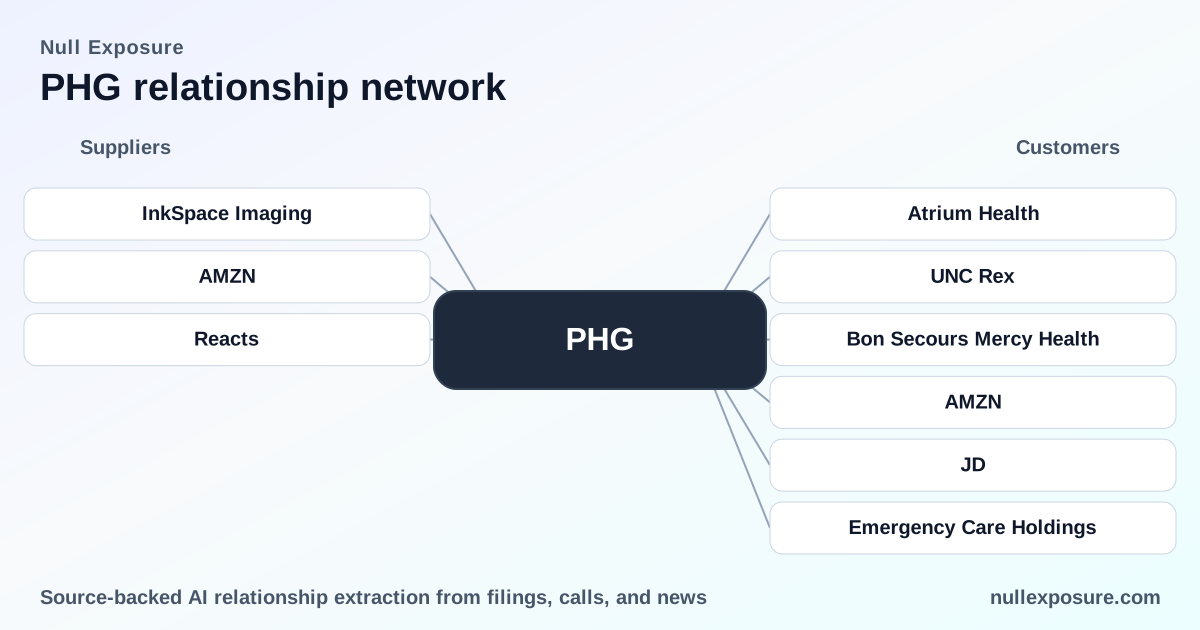
Philips (PHG) — supplier relationships that shape product reach and execution
Thesis: Koninklijke Philips NV generates revenue by selling integrated healthcare technology — hardware (imaging, monitoring), software (informatics platforms) and services — to hospitals and health systems, monetizing through product sales, recurring software and service contracts, and cloud-hosted enterprise deployments. Philips leverages strategic supplier and technology partnerships to accelerate time-to-market for specialized accessories and to outsource cloud infrastructure, which concentrates operational risk but extends commercial reach. If you evaluate Philips for procurement, risk management, or investment, focus on partner criticality, contracting posture, and how third parties affect service continuity and margins.
Explore supplier intelligence and relationship maps at https://nullexposure.com/ for deeper diligence.
How Philips runs the stack and where suppliers plug in
Philips is a global healthcare technology company with fiscal 2025 revenue of about $17.8 billion and an operating margin around 10.7%, selling into hospitals and health systems where reliability and regulatory compliance are essential. The firm combines proprietary systems (MRI, ultrasound) with third-party components and cloud services to deliver end-to-end solutions; this hybrid model accelerates product breadth while spreading technical and operational exposure across partners.
- Contracting posture: Philips follows strategic partnership contracts for software and cloud-hosting (long-term, enterprise-grade with SLAs) and transactional OEM/adjunct supply for accessories and coils; this means some suppliers are deeply embedded while others are low-touch.
- Concentration and ownership signal: Institutional ownership is relatively low (~5.3% institutional in the provided snapshot), which suggests a broader public float and the potential for retail-driven price dynamics; supplier concentration should be assessed by product line rather than by cap table alone.
- Criticality: Many suppliers are mission-critical where single-vendor failures would impact hospital uptime (notably cloud and imaging accessories that integrate directly with clinical workflows).
- Maturity: Philips is a long-established OEM with mature procurement processes but it still relies on specialist innovators for niche components and software integrations.
These characteristics shape negotiation leverage, warranty exposure, and contingency planning for operators integrating Philips equipment.
Relationship map: who Philips is working with (and what it means)
Below I summarize every supplier relationship surfaced in the review and provide a concise, sourced take on scope and significance.
InkSpace Imaging — pediatric MRI coil integration
Philips is distributing or supporting InkSpace Imaging’s Snuggle™ pediatric body array coil for Philips 3.0T MRI systems, a product-level collaboration that extends Philips’ MRI accessory portfolio and improves patient comfort and image quality in pediatric exams. According to multiple media reports and Philips press coverage (Finviz summaries and Philips press mentions dating to FY2025–FY2026 coverage), the Snuggle coil has been introduced for Philips 3.0T systems, signaling Philips’ openness to third-party specialized hardware that complements its core MRI platforms (news coverage in March 2026 and earlier FY2025 reporting).
Amazon Web Services — cloud hosting for Enterprise Informatics
Philips disclosed in its 2025 Q4 earnings commentary that it standardized a cloud-based imaging informatics platform hosted on Amazon Web Services across a 27-hospital health system, demonstrating Philips’ use of AWS as the backbone for enterprise imaging deployments and large health system rollouts. The 2025Q4 earnings call specifically references a “landmark radiology partnership” standardized on AWS, which indicates high operational criticality and reliance on a hyperscaler for Philips’ software delivery (PHG 2025Q4 earnings call).
Reacts — live collaboration for handheld ultrasound
Philips markets Lumify handheld ultrasound with Collaboration Live powered by Reacts, integrating a third-party clinical collaboration layer that enables real-time remote guidance and streaming for point-of-care ultrasound workflows. Philips’ corporate communications (a Philips press note originally published in 2022 and referenced in FY2026 talk) document the Lumify + Reacts collaboration, showing Philips’ strategy to bundle partner collaboration software with its handheld devices to increase clinical utility and adoption (Philips newsroom archive, 2022).
What these relationships tell investors and operators
Collectively, these partnerships show Philips pursuing a platform strategy: proprietary imaging and monitoring hardware paired with third-party accessories and cloud/collaboration software to create a differentiated customer proposition while minimizing internal development time for niche features.
- Risk profile: Cloud dependence on AWS raises single-provider operational risk for enterprise informatics; accessory suppliers like InkSpace increase product breadth but create upstream supply and warranty interfaces that require rigorous vendor management.
- Commercial signal: Bundling third-party software (Reacts) and hardware (InkSpace) supports cross-selling and recurring revenue opportunities around Philips’ installed base, which helps maintain stickiness in hospital contracts.
- Operational implication: Contract terms and SLAs for cloud hosting and integrated accessories will be material in procurement and contingency planning; operators should insist on clear escalation and failover provisions for hosted informatics environments.
For detailed operational mapping and vendor exposure scoring, see the research tools and supplier dashboards at https://nullexposure.com/.
Practical diligence checklist for procurement and risk teams
When evaluating Philips relationships from an operator or buyer perspective, focus on these items:
- Cloud SLAs and failover architecture for AWS-hosted informatics, including data residency and disaster recovery clauses.
- Warranty and service coverage for third-party accessories integrated into Philips systems (who handles field repairs and recalls).
- Regulatory and cybersecurity responsibilities across integrations, especially where patient data transits partner platforms.
- Commercial terms on software bundling and renewal mechanics that affect recurring revenue and total cost of ownership.
Mid-process due diligence often reveals execution risk concentrated not in headline suppliers but in how integration and escalation paths are contractually defined — learn more and map supplier impact using the tools at https://nullexposure.com/.
Bottom line and investor implications
Philips’ supplier relationships are deliberate: hyperscaler partnerships for scale, boutique hardware partners for feature differentiation, and collaboration software to lock in workflow adoption. For investors, this implies a hybrid margin profile where hardware sales deliver upfront revenue while cloud and software attachments create recurring, higher-margin opportunities that are contingent on partner performance.
Monitor three risk vectors closely: cloud dependence (operational continuity), accessory supply chain (warranty and replacement cost), and contract structure (who bears integration risk). These elements will determine whether Philips converts installed base strength into predictable, service-driven earnings growth. For ongoing monitoring and supplier intelligence tailored to PHG, visit https://nullexposure.com/ for subscription research and relationship visualizations.