PLDT (PHI) as a Supplier Partner: Commercial footprint, AI infrastructure, and strategic vendor exposure
PLDT Inc. (ADR: PHI) monetizes a diversified telecom platform in the Philippines through fixed and mobile connectivity, enterprise services, and increasingly, infrastructure and AI-enabled solutions for corporations and the public sector. The company converts scale — nationwide networks and enterprise sales channels — into recurring revenue and value-added services including cloud, satellite-backed connectivity, and on-premises AI infrastructure. PLDT’s supplier relationships show a deliberate pivot from pure telco to infrastructure and platform provider, sourcing OEM compute, satellite connectivity, and AI software partners to package higher-margin enterprise offerings. Learn more about supplier risk and coverage at https://nullexposure.com/.
Quick read: why supplier relationships matter to investors
PLDT’s vendor mix moves the company up the value chain: enterprise contracts that embed third-party compute and satellite services increase revenue per customer but raise third-party concentration and operational integration risk. PLDT’s profitability metrics and EV/EBITDA suggest room to fund capex for these initiatives, while its low beta and dividend yield position it as a yield-oriented telecom with strategic growth initiatives.
Explore supplier profiles and supplier-driven risk at https://nullexposure.com/.
Supplier relationships that shape PLDT’s strategy (FY2026 reporting)
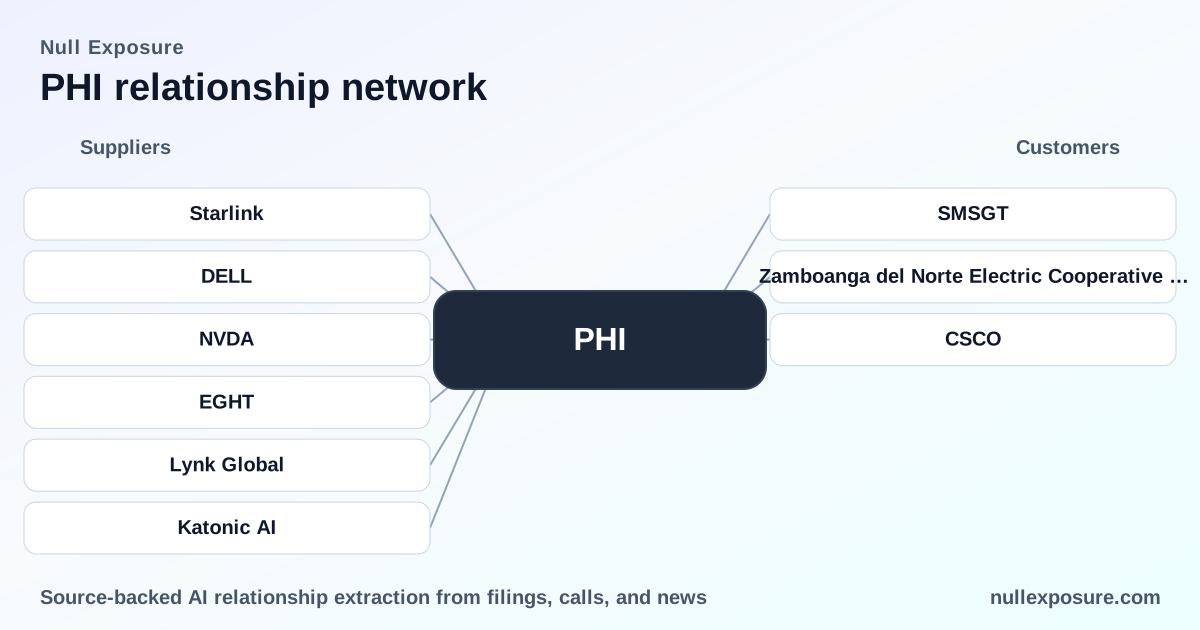
PLDT’s disclosed FY2026 media and industry notices identify six vendor relationships that illuminate strategic priorities: satellite connectivity (Starlink, Lynk Global), AI and compute infrastructure (NVIDIA, Dell, Katonic AI), and authentication/communications enhancements (8×8). Below are concise, plain-English summaries of each relationship with source context.
Starlink — LEO satellite reseller and integrated enterprise offering
PLDT Enterprise became an Authorized Starlink Reseller and has integrated Starlink’s low-Earth-orbit connectivity into its enterprise internet offerings, extending reach to remote and public-sector customers. According to a news item on backendnews.net published March 2026, PLDT is packaging Starlink as part of its enterprise connectivity products to serve remote enterprises and public sector use cases. (FY2026)
Dell Technologies Inc. — AI platform and facility partnership
PLDT hosts Pilipinas AI, a local AI facility developed with Dell Technologies and Katonic AI to build models for Philippine businesses, signaling a move to offer domestically governed AI infrastructure. The Philippine Star covered this initiative in February 2026, describing the facility as a collaboration to accelerate responsible AI and local model development. (FY2026)
NVIDIA — GPU infrastructure in new edge/AI sites
PLDT’s VITRO Santa Rosa site runs NVIDIA GPU servers and live AI workloads, positioning the company as an infrastructure partner for hyperscalers and public-sector AI projects; this was disclosed in PLDT’s earnings commentary referenced by The Globe and Mail in 2026. This relationship underpins PLDT’s strategy to host compute-intensive workloads close to customers. (FY2026)
8×8, Inc. — Silent mobile authentication for fraud reduction
PLDT Enterprise is integrating 8×8’s Silent Mobile Authentication with its SmartSafe SilentAccess product to reduce fraud and enhance user experience without OTPs, according to a Technology Inquirer report from 2026; the partnership targets enterprise security and customer friction reduction. (FY2026)
Lynk Global — direct-to-device satellite testing
Smart Communications, PLDT’s wireless unit, tested a direct-to-device satellite service in Catanduanes with Lynk Global, demonstrating a push to deliver basic connectivity where terrestrial networks are limited, as reported by Telecom Review Asia in 2026. This test validates alternative coverage approaches for remote islands and disaster-affected zones. (FY2026)
Katonic AI — local AI model development partner
Katonic AI co-developed Pilipinas AI with Dell and PLDT, focusing on building AI models for local businesses and promoting responsible AI deployment; the Philippine Star discussed the partnership in February 2026. This aligns PLDT with regional AI software expertise to complement its hardware investments. (FY2026)
What these relationships imply about PLDT’s operating model and constraints
There are no supplier-specific contractual constraints disclosed in the reporting set; as a company-level signal, this absence itself is meaningful. PLDT is executing a hybrid operating model:
- Contracting posture: PLDT pursues vendor partnerships rather than full vertical integration — it resells or hosts third-party hardware and services (Starlink, NVIDIA, Dell) while co-developing solutions (Pilipinas AI with Dell/Katonic). This reduces capex exposure for some services but increases reliance on supplier roadmaps and availability.
- Concentration: The vendor mix spans several global providers; there is no single-supplier concentration disclosed in FY2026 materials, but relationships with dominant hardware/software suppliers (NVIDIA, Dell) create strategic concentration risk around compute and AI capacity.
- Criticality: Partners supplying compute (NVIDIA, Dell) and satellite connectivity (Starlink, Lynk) are mission-critical for PLDT’s upgraded enterprise value proposition, meaning outages or supply constraints would directly affect high-value contracts.
- Maturity: The mix includes mature enterprise vendors (Dell, NVIDIA, 8×8) and emerging satellite/AI players (Starlink, Lynk, Katonic), reflecting a blend of stable operations and experimental, growth-stage initiatives.
Investment implications: risks, levers, and what to watch
PLDT leverages third-party technology to sell higher-margin services; that is the core growth thesis. Key implications:
- Upside levers: Monetizing hosted AI infrastructure, bundling LEO satellite connectivity for remote enterprise contracts, and securing public-sector cloud/AI work will expand services revenue and raise ARPU.
- Key risks: Supplier concentration in GPU and satellite providers risks pricing and availability shocks; integration complexity and contracting with multiple global suppliers increases execution risk.
- Governance and regulatory watch: Local data and AI governance are central to the Pilipinas AI pitch — investors should watch regulatory responses and contractual terms around data residency and public-sector procurement.
A focused list of monitoring points:
- Vendor supply chains and capacity availability for GPUs and satellite terminals.
- Contractual terms for reselling Starlink or Lynk services and revenue sharing.
- Uptake of Pilipinas AI across SMEs and public sector benchmarks.
For detailed supplier analytics and counterparty risk metrics, visit https://nullexposure.com/.
Bottom line and action items for investors
PLDT is transitioning from a pure connectivity utility to a platform that packages third-party compute and satellite services for enterprises and government. That shift increases revenue potential but introduces supplier-dependency and integration risk that investors must price into multiples and capital allocation decisions. Track uptake of hosted AI services, contractual resilience with NVIDIA/Dell, and operational rollout of Starlink/Lynk connectivity.
Explore in-depth supplier risk assessments and coverage at https://nullexposure.com/.
Key takeaways:
- PLDT is monetizing scale via enterprise and AI-enabled services.
- NVIDIA and Dell relationships are strategic for AI hosting; Starlink and Lynk multiply reach into remote markets.
- Third-party reliance elevates operational and counterparty risk but also accelerates revenue diversification.
For portfolio-level supplier risk analysis, vendor scoring, and scenario stress tests, return to https://nullexposure.com/ and review the PHI supplier profile.