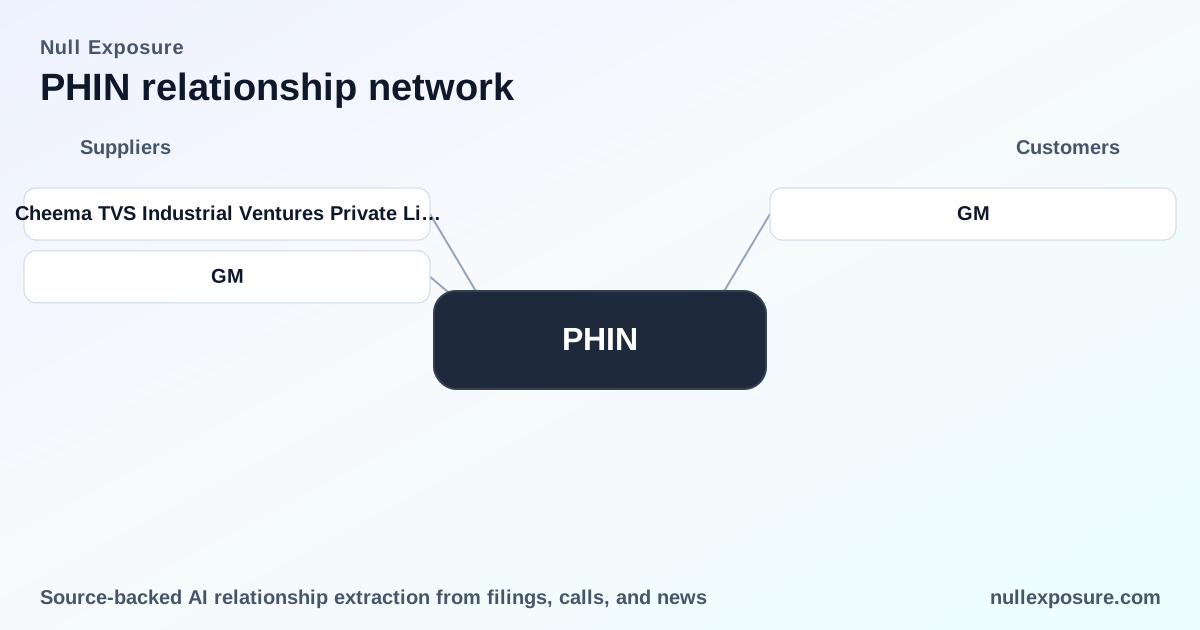
PHINIA Inc. (PHIN) — supplier relationships that shape margins and manufacturing footprint
PHINIA Inc. manufactures gasoline and diesel fuel injection components and systems and monetizes through OEM and aftermarket product sales plus selective licensing; the company captures value by combining in-house engineering, joint ventures in lower-cost geographies, and long-term commercial arrangements that stabilize raw‑material and production costs. For investors, the critical lenses are operational durability through partnerships, margin support from long-term contracting, and the revenue leverage that comes from branded licensing deals. Learn more about supplier exposure and partner signals at https://nullexposure.com/.
Why supplier relationships are a financial signal here
PHIN operates in automotive components where supplier ties directly affect cost volatility, capacity, and product qualification cycles. PHINIA reports $3.48 billion in trailing revenue and $474 million of EBITDA, giving partners outsized influence on manufacturing continuity and cost recovery. The company explicitly uses long‑term contracts, cost‑sharing and customer buy programs to control commodity and production cost exposure, which is a material operating posture and not a peripheral practice. According to PHINIA’s FY2025 Form 10‑K, these mechanisms are embedded in how the company manages supplier and customer economics.
This contracting posture implies:
- Lower short‑term commodity exposure through locked pricing or shared-cost structures.
- Higher revenue visibility where customer buy programs and long-term agreements smooth order volatility.
- Strategic dependence on joint ventures and licensing to extend manufacturing capacity and brand reach without proportionate capex.
If you evaluate PHIN as a supplier or a counterparty, prioritize contract tenure, buy‑program terms, and JV governance as primary risk/return levers. For a deeper look at partner-level exposure and operational signals, visit https://nullexposure.com/.
The two relationships investors should account for
Cheema TVS Industrial Ventures Private Limited — long-standing Indian joint venture partner
PHINIA reports an unconsolidated joint venture formed in 2001 with Delphi‑TVS Diesel Systems Ltd for diesel fuel injection equipment, where PHINIA owns 52.5% and the operation is located in India; the JV is identified as Cheema TVS Industrial Ventures Private Limited in the FY2025 10‑K. This structure provides PHIN with local production capacity and cost arbitrage for diesel injection products. According to PHINIA’s FY2025 Form 10‑K filing, the joint venture is an integral manufacturing partner organized in 2001 and majority‑owned by PHINIA.
General Motors LLC — trademark licensing for DELCO REMY
A public news item records that DELCO REMY is a registered trademark of General Motors LLC licensed to PHINIA Technologies Inc., signaling a brand‑level licensing relationship that supports aftermarket and branded component sales. The licensing reference appears in a March 2026 news post, indicating PHINIA leverages legacy automotive brand equity under license for certain products. A MEXC news report (March 2026) noted the DELCO REMY trademark licensing to PHINIA Technologies Inc.
How these relationships affect valuation and risk
The JV in India is a mature, capacity‑centric relationship that reduces PHINIA’s capital needs for geographic expansion while exposing the company to partner governance and regional execution risk; the JV’s 2001 origin is a sign of operational continuity rather than a transient contract. The GM trademark license is commercial leverage—it expands PHINIA’s addressable aftermarket with recognizable branding that supports pricing power without the expense of brand development.
Company‑level constraints reported by PHINIA reinforce a conservative procurement and contract strategy. PHINIA states it uses long‑term contracts, cost sharing arrangements, design changes, customer buy programs, and limited financial instruments to control raw material and production cost risk (FY2025 10‑K). This is a corporate policy signal: PHINIA’s supplier posture is oriented toward multi‑year stability and negotiated cost mitigation rather than spot purchases. That orientation materially supports EBITDA resilience—PHINIA’s EV/EBITDA of about 7.1 and forward P/E of 11.35 reflect the market pricing of that stability.
Operational and market implications:
- Concentration and criticality: The JV shows concentration of manufacturing capability in India for diesel components; investors should watch capacity utilization and JV governance provisions as potential performance drivers or constraints.
- Contract maturity: The company’s explicit reliance on long‑term arrangements increases earnings visibility but raises negotiation and renewal risk at contract expiration points.
- Revenue mix: Brand licensing to leverage DELCO REMY supports higher aftermarket margins and diversifies sales channels away from pure OEM pricing pressure.
Practical takeaways for investors and operators
- Assess contract tenor and renewal clauses: Long‑term contracting is a core risk mitigant; confirm the remaining life and renegotiation mechanics for major customer and supplier agreements.
- Monitor JV governance and performance metrics: The Cheema TVS JV is mature and material for diesel production capacity—track output, capital contributions, and any transfer‑pricing arrangements disclosed in periodic filings.
- Value branded licensing as margin optionality: The DELCO REMY license to PHINIA Technologies is a profitable lever for aftermarket expansion without large marketing outlays.
If you are evaluating PHIN as a supplier or counterparty, request contract schedules and JV governance documents where possible. For ongoing tracking of supplier exposure and relationship signals, consult our structured coverage at https://nullexposure.com/.
Final recommendation
PHINIA’s combination of long‑term contracting, mature joint ventures, and select brand licensing forms a defensible operational model that supports earnings stability and aftermarket margin expansion. For investors, the focus should be on the durability of long‑term agreements, JV execution in India, and how licensing contributes to recurring revenue. To review partner-level exposure across PHINIA’s supplier footprint and obtain sourcing diligence templates, visit https://nullexposure.com/ for actionable research and supplier intelligence.