PulteGroup (PHM) — what operators and investors need to know about supplier relationships
PulteGroup is a national homebuilder that acquires and prepares lots, contracts out construction to independent subcontractors, and recognizes revenue through the sale of completed homes and community lots. The company monetizes by delivering finished residential units across a diversified geographic footprint; margin and cash generation depend on land inventory management, build-cost control, and effective subcontractor execution. With a market capitalization near $23.5 billion and trailing revenue of $17.3 billion, supplier relationships are operationally critical to Pulte’s delivery model and to investor returns.
If you track builder-to-land partnerships and subcontractor exposure for investment or operational diligence, review PulteGroup’s supplier posture on the firm’s public profile at Null Exposure: https://nullexposure.com/.
A single new builder tie-up that matters — and why it’s relevant
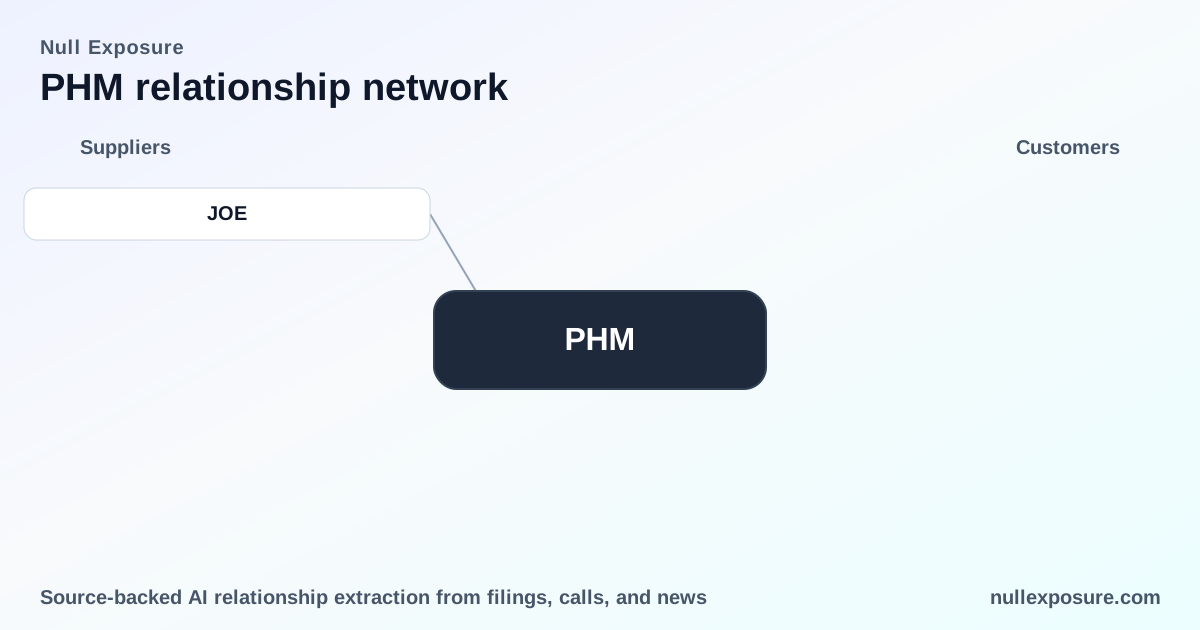
On March 10, 2026 PulteGroup was announced as a national builder partner for The St. Joe Company, a landowner and developer active in Florida markets. This is a commercial builder relationship where PulteGroup will develop and build homes on St. Joe’s land positions, expanding Pulte’s geographic pipeline in high-demand coastal markets. (Source: Finviz coverage of The St. Joe Company announcement, 2026-03-10. https://finviz.com/news/327208/pultegroup-phm-buy-sell-or-hold-post-q4-earnings)
This kind of builder-to-landowner tie-up is operationally meaningful because it converts a landowner’s inventory into sellable product while giving the builder scale in targeted communities. For investors, the financial impact of such relationships shows up in community lot sales, future revenue backlog and localized margins.
Visit Null Exposure’s homepage for more supplier and counterparty coverage: https://nullexposure.com/.
How Pulte contracts and what that implies for suppliers
PulteGroup runs a subcontractor-heavy construction model: substantially all construction work is performed by independent subcontractors under contracts that establish a specific scope of work at an agreed-upon price. The company also requires the majority of its subcontractors to maintain general liability insurance, including coverage for certain construction defects. These contractual signals are explicit in Pulte’s public disclosures and affect supplier risk, contract terms, and procurement strategy.
What this means in practice:
- Contracting posture: Pulte uses fixed-scope, price-agreed contracts with subcontractors rather than direct-employed labor for most activities, shifting execution and insurance obligations onto third parties.
- Concentration and scale: The model implies a large, distributed subcontractor base rather than a small number of captive suppliers; concentration risk is lower at a single-vendor level but operational dependency on many local trades is high.
- Criticality: Subcontractors are mission-critical — they deliver the finished product that generates revenue — so performance, compliance, and insurance are primary risk vectors.
- Maturity: The requirement for insurance coverage and structured scopes indicates a mature third-party management program aimed at standardizing liability and cost predictability.
These company-level constraints — the contracting model and insurance requirements — come from PulteGroup’s own filing language and should be treated as operating constants when evaluating supplier credit, performance guarantees, or integration timelines.
Relationship-by-relationship: the public record
- The St. Joe Company (JOE): PulteGroup entered a builder relationship to develop homes on St. Joe land, expanding Pulte’s community pipeline in strategic Florida markets; the announcement was reported on March 10, 2026. (Source: Finviz news coverage of The St. Joe Company announcement, 2026-03-10. https://finviz.com/news/327208/pultegroup-phm-buy-sell-or-hold-post-q4-earnings)
This list reflects the supplier-related relationships currently disclosed in the public record for the supplier scope; track updates to capture further landowner partnerships, subcontractor defaults, or master-planned community agreements.
Operational and investor implications — read this before you underwrite
Pulte’s subcontractor-centric model creates a distinct set of underwriting criteria for counterparties and investors:
- Counterparty diligence: Lenders and partners should verify subcontractor insurance, performance bonds where applicable, and contract scopes to ensure cost certainty and coverage for construction defects.
- Margin sensitivity: Pulte’s operating margin (about 18% TTM) and profit margin (roughly 12.8% TTM) are sensitive to build-cost inflation and labor availability; poorly performing subs or uninsured defects can compress margins quickly.
- Concentration risk vs. execution risk: While vendor concentration at the corporate level is low, local execution concentration can be acute — a small set of trade contractors in a region can represent a single point of failure for a community buildout.
- Contract leverage: Pulte’s standardized, price-agreed contracts give the company leverage to enforce performance and shift certain liabilities to subcontractors; however, the effectiveness of that leverage depends on local contractor capacity and insurance discipline.
Key risk items to monitor:
- Subcontractor insurance adequacy and claims history.
- Local labor market tightness and single-trade vendor dependencies.
- Timing and terms of builder-to-landowner agreements that alter land-sales cadence and backlog recognition.
For a supplier or operator negotiating with Pulte, these points define where to focus contractual protections and what metrics to monitor post-signing.
Explore Null Exposure’s supplier intelligence platform for deeper counterparty mapping and alerts: https://nullexposure.com/.
Bottom line for investors and operational partners
PulteGroup runs a scalable, subcontractor-driven construction model with explicit contractual governance and insurance requirements, and it continues to grow selectively through builder-to-landowner relationships like the recent tie-up with The St. Joe Company. The business model converts land positions into saleable inventory via outsourced labor, making supplier performance and liability coverage a direct determinant of near-term margin and cash flow. Investors should price in execution risk at the local level even as corporate-level metrics show robust profitability and cash generation.
To monitor new builder relationships, subcontractor disputes, and insurance exposures that affect Pulte’s delivery pipeline, check ongoing supplier coverage and alerts at Null Exposure: https://nullexposure.com/.