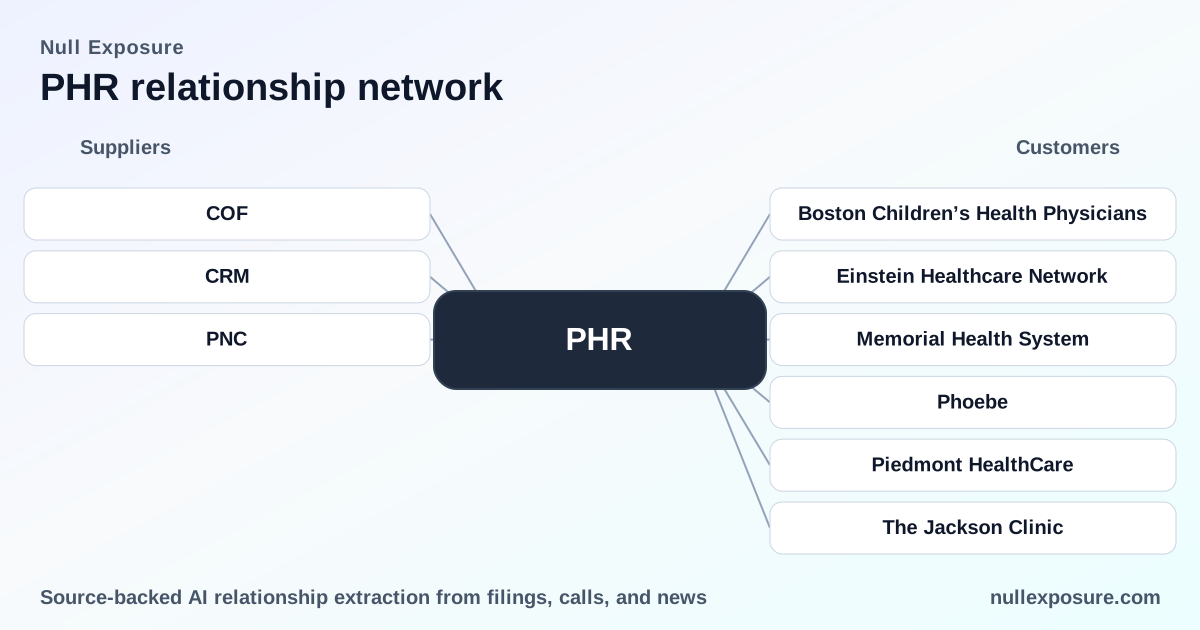
Phreesia (PHR) — Supplier Landscape, Payments Dependencies, and Operational Constraints
Phreesia operates an integrated SaaS and payments platform for outpatient healthcare workflows, monetizing through subscription software, transaction-processing fees, and hardware sales for on-site check-in. The firm captures recurring revenue from clinics and health systems while generating the bulk of its payments revenue through third‑party processing partners, a structure that concentrates operational and revenue risk around a small set of external providers. For a concise supplier-risk view and supplier mapping, see https://nullexposure.com/.
Why supplier relationships are an investor-level risk for Phreesia
Phreesia’s business model couples recurring software economics with transaction-dependent payments margins. That hybrid model produces three investor-relevant realities: revenue sensitivity to processor continuity, contracting complexity across hardware and payments supply chains, and operational exposure from international service providers and contractors. These characteristics shape capital allocation, go‑to‑market resilience, and downside scenarios.
- Contracting posture: Phreesia sources hardware components for kiosks and tablets and relies on external payment processors for authorization, settlement and routing. That arrangement creates multi-layer supplier agreements that are commercially critical to revenue capture and customer retention.
- Concentration and criticality: Payments revenues flow through third‑party processors and are described internally as generating “almost all” payments revenue, establishing processor continuity as a critical single point for cash flow.
- Maturity and scale signals: The company balances SaaS recurring revenue with transaction fees, using bank relationships and credit facilities to underwrite liquidity while scaling payments services through partners.
Learn more about supplier exposure and operational intelligence at https://nullexposure.com/.
Confirmed supplier and partner relationships (what the record shows)
Below are the relationships surfaced in public reports and media coverage, each summarized in plain English with the originating source.
Capital One — Phreesia’s credit facility provides committed borrowing capacity that management cites as part of the company’s near‑term liquidity plan. According to TradingView’s coverage of Phreesia’s FY2025 SEC filing, management stated that cash, operating cash flow, and the available Capital One credit facility will be sufficient to meet needs for at least the next 12 months. (TradingView summary of Phreesia 10‑Q, FY2025)
Salesforce — Phreesia was impacted by a third‑party security incident linked to Salesloft Drift, a tool operated by Salesforce, which exposed Phreesia to a vendor breach event. A breach notice reported in February 2026 documented Phreesia as among organizations affected by the Salesloft Drift incident. (StraussBorrelli reporting on vendor breach notice, Feb 2026)
PNC Bank — Phreesia distributes a “funded model” to clients through AccessOne’s relationship with PNC Bank, meaning some payment and receivables capabilities are delivered via a bank partnership rather than being fully retained in‑house. Phreesia noted this arrangement in its Q3 FY2026 earnings call transcript as covered by InsiderMonkey. (InsiderMonkey coverage of Phreesia Q3 FY2026 earnings call transcript)
How these relationships translate into investor risk and opportunity
Phreesia’s supplier map is compact but consequential. The Capital One facility is a liquidity backstop that reduces short‑term financial risk; investors should view it as part of the balance‑sheet cushion rather than an operational control. The PNC/AccessOne banking relationship is a distribution and funding mechanism that supports the “funded model” and implies dependence on bank counterparty operational stability and credit processes. The Salesforce‑linked breach highlights vendor security externalities and the operational risk of embedding third‑party tools into customer workflows.
Company-level constraints extracted from filings and reporting sharpen the picture:
- Geographical staffing and supplier footprint: Phreesia has substantial employee presence in Canada and India and supplements labor with contractors in international locations, including India and locations subject to geopolitical stress. This creates operational dependence on offshore resources for development and support.
- Critical payment processing partners: The company states that third‑party processors perform payment processing services that generate almost all payments revenue, which is a material and critical dependency to revenue and cash collection.
- Buyer and service provider roles: Phreesia functions as both a buyer of hardware/components (for PhreesiaPad and kiosks) and as a customer of payment processors and other service providers, confirming multi‑role supplier exposure across product and payments supply chains.
These signals combine into a straightforward investor checklist: assess processor redundancy and contractual termination terms, validate bank‑partner backstops, and audit vendor security controls and geographic concentration.
Explore how supplier intelligence informs investment workstreams at https://nullexposure.com/.
Practical steps for investors and operators
- Insist on redundant payment routing and contingency plans in third‑party processing agreements; verify failover testing and settlement timing under stress.
- Verify credit facility covenants and draw mechanics with Capital One to understand how quickly liquidity can be accessed under revenue stress.
- Require vendor risk attestations and breach response SLAs from providers in offshore locations; the Salesforce‑linked breach demonstrates how vendor tool compromises propagate.
- Monitor the economics of the funded model routed through PNC/AccessOne to confirm margins and counterparty credit risk are stable.
- Maintain an inventory of hardware suppliers and lead times to understand supply chain vulnerability for PhreesiaPad and Arrivals Kiosks.
Bottom line — what investors should act on now
Phreesia’s revenue engine is robustly tied to external processors and bank partners; that is both a growth enabler and a concentration risk. The criticality of payment processors and the use of offshore providers for software and services are the top supplier risks that will determine downside exposure and operational resilience. Active diligence on processor redundancy, bank counterparty health, and vendor security posture will materially de‑risk a position in PHR.
For detailed supplier scoring, contract insights, and continuous monitoring tools that help institutional teams operationalize these checks, visit https://nullexposure.com/ for vendor intelligence and exposure mapping.