Pharvaris (PHVS): Underwritten equity on the desk — what investors need to know about the supplier (bank) relationships
Pharvaris NV is a clinical-stage biopharmaceutical company that develops therapies for rare diseases and currently monetizes via equity financing rather than product revenue. The company finances its R&D runway through institutional capital raises underwritten by top-tier and specialist investment banks, which function as critical suppliers for market access and balance-sheet management. For an operator or investor, the underwriting syndicate represents both a distribution channel and a structural dependency on capital markets. Learn more about supplier risk and market signals at https://nullexposure.com/.
Capital markets as a core operating input
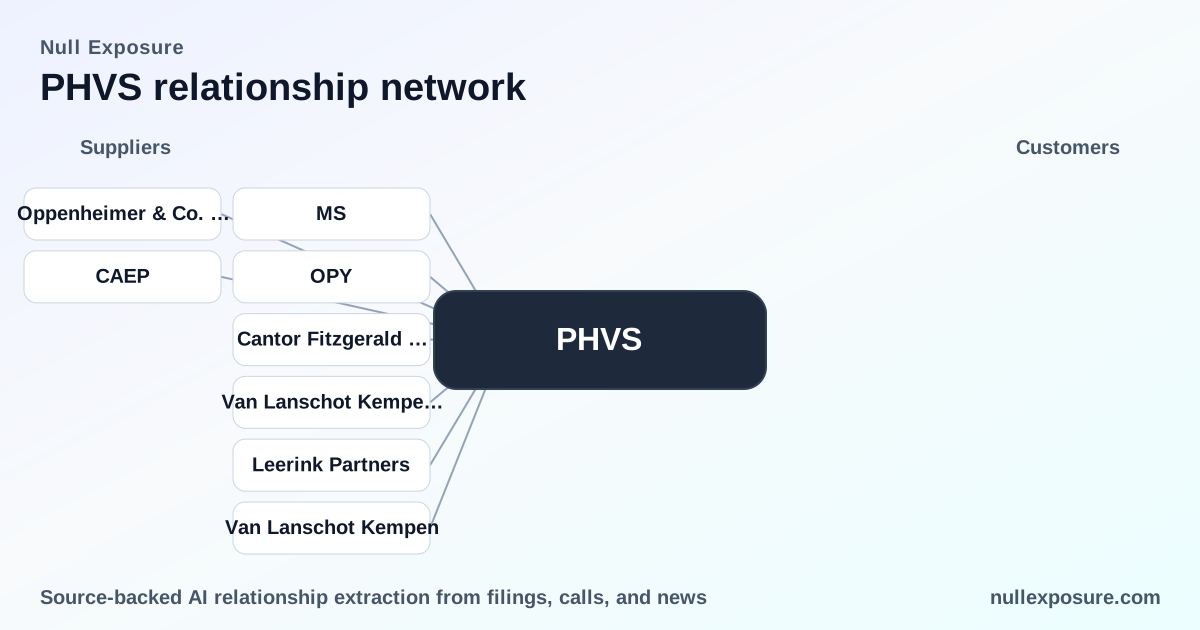
Pharvaris is pre-revenue and capital intensive: its balance sheet and clinical progress depend on periodic public offerings executed by an underwriting syndicate. The March 2026 activity — an initial announced $150 million underwritten offering and a subsequent upsized close at $201.2 million — underscores that equity issuance is the company’s primary short-term monetization mechanism. According to QuiverQuant news reports dated March 10, 2026, Morgan Stanley, Leerink Partners, Cantor, Oppenheimer & Co., and Van Lanschot Kempen served as joint book-running managers for these transactions, which directly supply the company with operating capital.
If you evaluate supplier concentration and counterparty risk for PHVS, start with the underwriting syndicate dynamics and institutional ownership: Pharvaris shows very high institutional ownership (~92.6%) and a relatively small float, making each capital event both highly visible and potentially dilutive to existing holders. For direct research on these relationships and market execution, visit https://nullexposure.com/.
Who executed the financing and what that implies
Below are the relationships recorded in the March 2026 press coverage. Each firm acted in an underwriting/distribution role for Pharvaris’s public offering; the language in the filings and press indicates joint book-running manager status across the syndicate.
Morgan Stanley
Morgan Stanley acted as a joint book-running manager on the announced $150 million offering and on the upsized $201.2 million close, providing top-tier distribution and underwriting capabilities for the placement. (QuiverQuant news, March 10, 2026: "Pharvaris N.V. Announces $150 Million Underwritten Public Offering"; "Closes $201.2 Million Upsized Public Offering".)
Oppenheimer & Co.
Oppenheimer & Co. served as a joint book-running manager on the offering, contributing middle‑market syndication and placement support for US investor demand. (QuiverQuant news, March 10, 2026.)
Cantor Fitzgerald & Co. (and Cantor / CAEP mentions)
Cantor Fitzgerald & Co. (listed variously as Cantor or with the inferred symbol CAEP in coverage) was named among the joint book-runners, supplying equity sales coverage and syndicate distribution. (QuiverQuant news, March 10, 2026.)
Leerink Partners
Leerink Partners was part of the book-running syndicate, bringing specialized healthcare capital markets expertise and targeted buy-side relationships in the life sciences sector. (QuiverQuant news, March 10, 2026.)
Van Lanschot Kempen (and Van Lanschot Kempen (USA) Inc.)
Van Lanschot Kempen, including its USA-incorporated broker unit, participated as a joint book-runner, indicating cross-border placement capability for European and U.S. institutional investors. (QuiverQuant news, March 10, 2026.)
Oppenheimer & Co. Inc.
Oppenheimer & Co. Inc. appears in coverage as the formal legal entity participating in the syndicate, reinforcing Oppenheimer’s underwriting role in the transaction. (QuiverQuant news, March 10, 2026.)
(Each of the above entries references the same March 10, 2026 press coverage describing the two related announcements: the $150 million underwritten offering and the $201.2 million upsized close. The press reports list the firms as joint book-running managers.)
What the underwriting roster signals about PHVS’s supplier posture
- Contracting posture: Underwritten public offerings indicate firm-side, underwritten commitments rather than at-the-market or best-efforts placement; this signals a transactional, high-certainty contracting posture when capital is required.
- Concentration and criticality: The syndicate is standard for biotech financings — a mix of global tier‑one (Morgan Stanley) and healthcare-specialist banks (Leerink, Cantor). These relationships are critical to execution and therefore operationally material even though they are episodic rather than continuous.
- Maturity and capability: The presence of major underwriters conveys execution maturity and investor access; this reduces friction in raising capital but increases dependence on market windows and underwriter allocations.
- Company-level constraint signal: The provided constraints list is empty, which itself is an informative signal: no supplier constraints were reported in the data payload, meaning there are no flagged vendor outages or contractual disputes evident in the available records.
Investment implications — clear wins and structural risks
The underwriting activity reduces near-term financing risk by delivering capital, but it also crystallizes key investor considerations:
- Dilution risk is tangible because Pharvaris is pre-revenue and relies on equity issuance to finance operations; the March 2026 upsized offering is an operative reminder.
- Execution dependency on the syndicate creates counterparty concentration risk during fundraising windows; losing access to top-tier book-runners would materially increase cost of capital.
- Reputational benefit: High-quality banks on the book lend credibility to institutional investors and improve distribution, which can reduce discount-to-market in future raises.
- Market timing sensitivity: The company’s operational runway and trial milestones will determine the frequency and size of future offerings; investors should treat underwriting announcements as leading indicators of cash needs.
Key takeaway: Pharvaris’s supplier risk is dominated by capital markets relationships, not manufacturing or raw-material vendors. Monitor underwriting appointments, syndicate composition, and offering sizes as proxies for both urgency and investor appetite.
For a closer look at how these supplier relationships affect counterparties and valuation scenarios, visit https://nullexposure.com/.
Practical next steps for investors and operators
- Track public filings and syndicate announcements for future offerings; syndicate composition and upsizing behavior provide actionable signals about liquidity and market access.
- Monitor insider and institutional ownership levels (institutional ~92.6% per latest data) and float dynamics when modeling dilution and post-offering share behavior.
- Evaluate operational plans against the cash runway implied by recent proceeds and projected clinical milestones; use underwriting cadence to infer funding cadence and potential dilution events.
Access deeper supplier-risk analysis and scenario modeling at https://nullexposure.com/.
Bold closing: Pharvaris’s current supplier risk is concentrated in capital markets; the underwriting syndicate both secures immediate runway and creates a structural dependency that investors must price into valuation and liquidity assumptions.