Impinj’s supplier map: what investors need to know about manufacturing exposure
Impinj operates a cloud-connected RFID and IoT semiconductors business that monetizes through the sale of ICs, readers and tags plus associated cloud services and software. The company outsources most hardware production and carries multi‑million dollar purchase commitments with upstream manufacturers; revenue depends on tightly coordinated external fabrication and contract manufacturing. For investors evaluating supplier risk, focus on manufacturing concentration, contract tenor (spot vs. long‑term), and the board-level relationships that can create governance and sourcing complexity. For a quick tour of how we analyze supplier posture, visit https://nullexposure.com/.
How Impinj structures manufacturing and monetization
Impinj designs semiconductor ICs and systems and sells hardware and cloud services to enterprise and channel customers. Revenue is driven by IC wafer production and downstream assembly of readers and tags produced to Impinj’s specifications, while margins and delivery performance depend on external manufacturers and foundries. The company’s operating model is a classic fabless/contract-manufacturer configuration: Impinj controls design and ecosystem, while third parties execute fabrication and assembly.
This structure produces a set of clear commercial dynamics: supplier concentration raises operational leverage, purchase commitments tie up balance sheet liquidity during build cycles, and a spot procurement posture for certain inputs raises short‑term supply risk. Learn more about supplier intelligence and governance at https://nullexposure.com/.
Suppliers that matter today — the public relationships
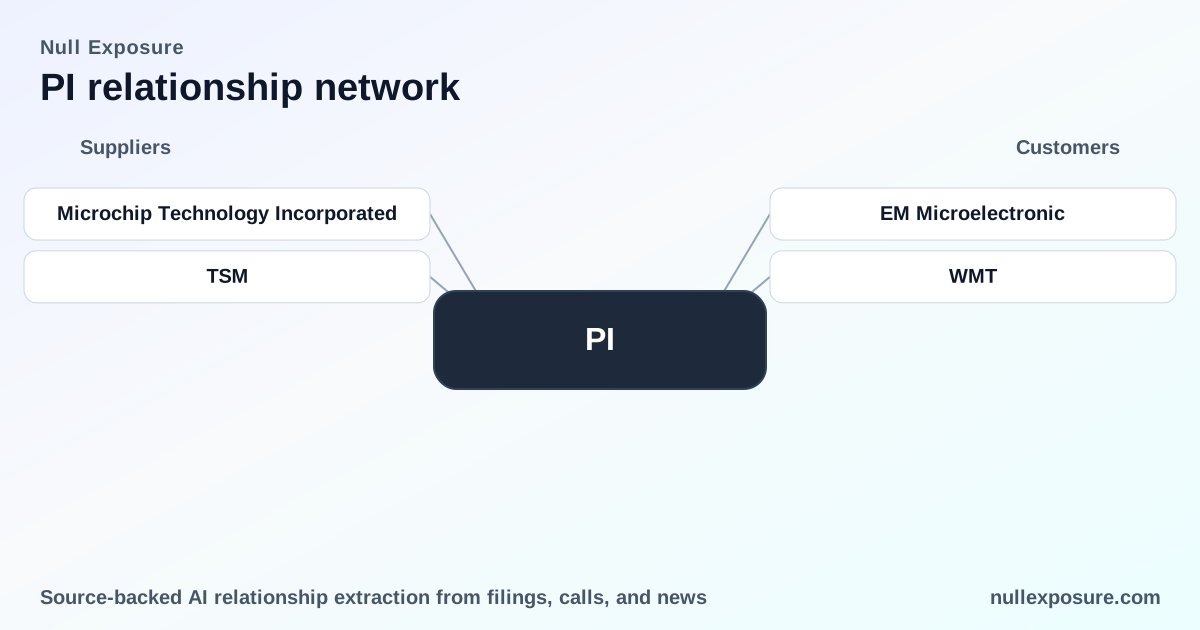
Microchip Technology Incorporated — a signed goods and services agreement with governance overlap
On December 22, 2025, Impinj signed a goods and services agreement with Microchip Technology Incorporated; a member of Impinj’s board also holds an executive leadership and board role at Microchip, creating a notable governance overlap that investors must monitor for related‑party risk and procurement transparency. (Source: Impinj FY2025 Form 10‑K, disclosed in 2026.)
TSMC — wafer fabrication for endpoint and reader ICs
Market reporting summarizes company disclosure that Impinj outsources most product manufacturing to third parties, with TSMC manufacturing endpoint and reader IC wafers. TSMC therefore occupies a critical node in Impinj’s value chain: wafer supply underpins product availability and cost, and any foundry disruption would transmit immediately to revenue delivery. (Source: TradingView news summarizing company disclosures, early 2026.)
Operating constraints and what they signal for investors
The company disclosures and extracted constraints generate a concise picture of Impinj’s supplier posture:
-
Contracting posture — predominantly spot purchase for wafers. Impinj orders endpoint IC wafers on a purchase‑order basis and does not maintain long‑term supply agreements for those wafers. This creates procurement flexibility but increases exposure to timing and pricing volatility; investors should treat wafer cost and availability as first‑order operating risks. (Evidence excerpt: “We order endpoint IC wafers on a purchase-order basis and do not have a long-term supply agreement.”)
-
Role and concentration — outsources manufacturing to a small number of third parties. Impinj outsources most hardware manufacturing, building products to its specifications while performing limited in‑house production. This is a concentrated supplier footprint: outsourcing reduces fixed costs but concentrates counterparty and operational risk. (Evidence excerpts: “We outsource most of our product manufacturing to third parties...”; “We outsource the manufacturing and production of our hardware products to a small number of suppliers.”)
-
Relationship stage and committed spend — active with mid‑tens of millions in purchase commitments. As of December 31, 2025, Impinj had $28.2 million of noncancelable purchase commitments for inventory, signaling active manufacturing engagements and meaningful near‑term spend. The quantified commitment places Impinj’s supplier spend in the $10M–$100M band, enough to be material to both supplier and buyer cash flows. (Evidence excerpts: “We are committed to purchase $28.2 million of inventory as of December 31, 2025.”; “Purchase commitments comprise primarily noncancelable commitments to purchase $28.2 million of inventory…”)
These constraints together describe a manufacturing model that is mature in terms of commercial activity (active commitments) but concentrated and partially spot‑priced, yielding a mix of flexibility and supply risk.
Why these relationships change the investment case
Impinj’s model produces concentrated operational exposures that have direct valuation implications:
-
Criticality: Foundry and contract manufacturers (notably TSMC and a small set of CM partners) are critical to revenue delivery. Any disruptions would compress revenue and margin quickly.
-
Concentration and counterparty risk: A small supplier base increases vendor leverage and the probability that a single supplier event becomes systemic for Impinj.
-
Procurement flexibility vs. price volatility: Spot wafer purchasing reduces stranded capacity risk but increases exposure to semiconductor cycle swings and lead‑time driven shortages.
-
Governance overlay: The Microchip agreement alongside a board member’s dual role is a governance flag; investors should seek clarity on procurement terms, pricing, and arm’s‑length protections.
Key takeaways for portfolio managers and operators:
- Monitor manufacturing cadence and lead times from TSMC and contract manufacturers; changes in foundry allocation or lead times directly affect quarterly shipments.
- Require disclosure on related‑party procurement terms where board overlaps exist to ensure recourse and fair pricing.
- Stress test balance sheet assumptions for committed spend during demand contractions, as $28.2M of noncancelable inventory commitments are a real near‑term cash obligation.
If you want a deeper supplier risk scorecard and monitoring playbook for Impinj, see our platform at https://nullexposure.com/.
Practical next steps for investors and procurement teams
- Request updated supplier schedules and lead‑time confirmations from management; prioritize full transparency on TSMC capacity and any long‑lead items.
- Get a written summary of the Microchip agreement and governance mitigations so the board overlap is clearly resolved in public filings.
- Model scenario sensitivity to wafer price increases and one‑quarter foundry capacity reduction; this is the highest‑probability operational shock.
For further analysis and continuous monitoring solutions that map supplier exposure to financial impact, visit https://nullexposure.com/.
Bottom line
Impinj runs a high‑leverage fabless manufacturing model where a small set of external manufacturers—including TSMC—and a recent services agreement with Microchip determine near‑term operational and financial outcomes. The mix of spot wafer procurement, concentrated supplier relationships, and active purchase commitments creates both operating flexibility and concentrated risk that investors must monitor through disclosure, contractual transparency, and scenario analysis.