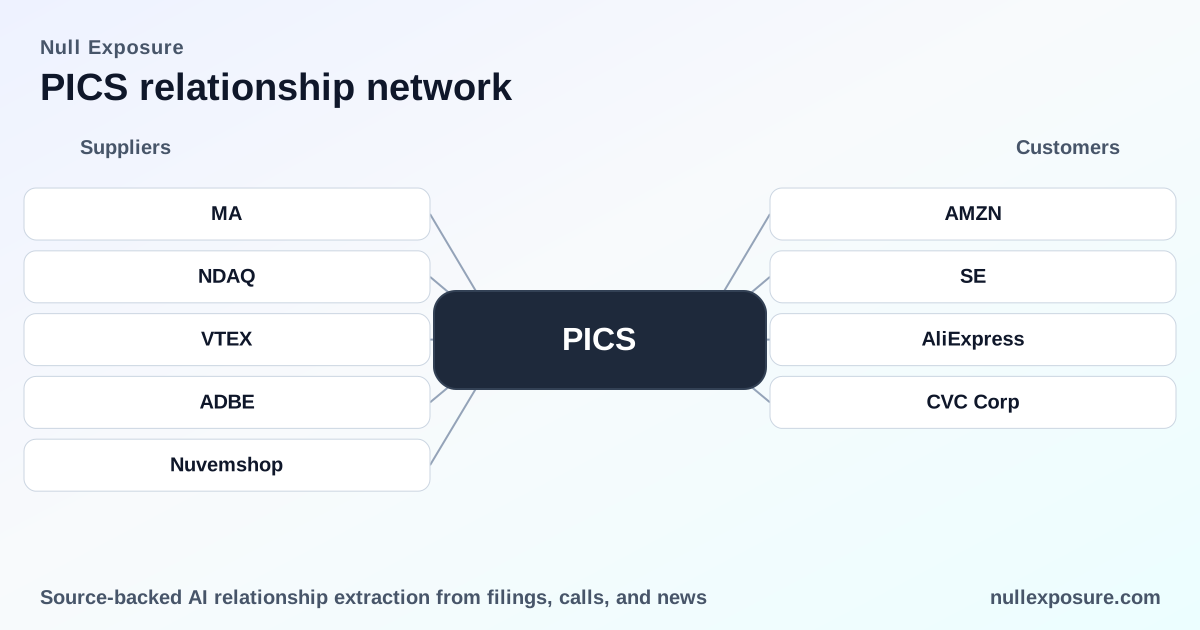
Picpay (PICS) supplier map: payments rails, e‑commerce integrations and public‑market plumbing
Picpay operates as a Brazilian digital payments platform and wallet that monetizes through transaction and merchant fees, interest and credit products, and cross‑sell of financial services inside a socially driven consumer app. The company leverages third‑party payment networks and e‑commerce integrations to scale acceptance and merchant distribution while relying on public markets infrastructure for capital and liquidity following its Nasdaq listing. For investors, the supplier picture frames where operational leverage sits — payments rails and commerce integrations are core to revenue throughput, while listing venue and partner concentration drive near‑term execution risk.
Explore deeper supplier intelligence on the NullExposure homepage.
Why supplier relationships matter for Picpay’s economics
Picpay’s platform is fundamentally a two‑sided network: consumers and merchants. Value capture comes from transaction volume and financial‑services monetization built on top of that volume. Supplier relationships that enable acceptance, card processing, and merchant onboarding therefore determine the ceiling on total addressable payment flows and speed to revenue.
Key operating characteristics to consider as company‑level signals:
- Contracting posture: Picpay sustains strategic partnerships with global payment networks and regional commerce platforms rather than owning full‑stack acquiring operations in all corridors; that creates dependence on partner SLAs and fee schedules.
- Concentration and criticality: Payment networks are critical transit points — any pricing or access change at that layer directly impacts margins and merchant economics.
- Integration maturity: Marketplace integrations with platforms like VTEX, Magento and Nuvemshop accelerate merchant adoption but require sustained engineering and product investment to preserve retention and conversion.
- Public‑market exposure: Nasdaq listing increases visibility and access to capital but also subjects Picpay to tighter disclosure and compliance regimes that affect supplier negotiations and strategic flexibility.
These signals frame how supplier disruptions or fee shifts translate into P&L volatility and where due diligence should focus.
Supplier relationships and what the public record shows
Mastercard
Picpay uses global card networks to route payments and access card rails. A TradingView article dated March 10, 2026 lists payment networks (e.g., Mastercard) among Picpay’s partnerships, indicating reliance on Mastercard for card acceptance and network services (TradingView, 2026-03-10: https://www.tradingview.com/news/tradingview:f760856e55fdc:0-picpay-brazilian-digital-wallet-and-banking-platform-files-for-nasdaq-global-select-market-ipo/).
Nasdaq Global Select Market
Picpay completed a public listing and began trading on the Nasdaq Global Select Market under the ticker PICS, establishing its primary capital market relationship and reporting obligations. A SahmCapital report covering early trading activity noted the company began trading on NasdaqGS:PICS (SahmCapital, 2026-02-27: https://www.sahmcapital.com/news/content/pics-ipo-opens-brazilian-listings-return-and-early-trading-test-2026-02-27).
VTEX
Picpay integrates with enterprise e‑commerce platforms such as VTEX to expand merchant reach and enable checkout acceptance inside online stores. A TradingView disclosure from March 2026 lists VTEX among Picpay’s integrations, supporting revenue growth through merchant channel partnerships (TradingView, 2026-03-10: https://www.tradingview.com/news/tradingview:f760856e55fdc:0-picpay-brazilian-digital-wallet-and-banking-platform-files-for-nasdaq-global-select-market-ipo/).
Magento (Adobe)
Magento is cited as another commerce integration partner enabling Picpay acceptance in merchant checkouts; this relationship exposes Picpay to large SMB and enterprise e‑commerce flows. The same TradingView article identifies Magento among Picpay’s integrations, signaling an emphasis on plug‑and‑play merchant adoption (TradingView, 2026-03-10: https://www.tradingview.com/news/tradingview:f760856e55fdc:0-picpay-brazilian-digital-wallet-and-banking-platform-files-for-nasdaq-global-select-market-ipo/).
Nuvemshop
Nuvemshop appears as a regional commerce integration that connects Picpay to Latin American merchants and marketplaces. TradingView’s March 10, 2026 article lists Nuvemshop with other integrations, highlighting a route to scale in the regional SMB segment (TradingView, 2026-03-10: https://www.tradingview.com/news/tradingview:f760856e55fdc:0-picpay-brazilian-digital-wallet-and-banking-platform-files-for-nasdaq-global-select-market-ipo/).
What these relationships mean for investors: upside and risk
Picpay’s supplier map shows a deliberate trade-off: leverage global rails and commerce platforms to accelerate volume while avoiding heavy capital intensity in acquiring and gateway infrastructure. This enables rapid go‑to‑market but concentrates operational dependency at a few integration and network touchpoints.
Key investment implications:
- Scalability driver: E‑commerce integrations (VTEX, Magento, Nuvemshop) are high‑leverage channels for merchant onboarding; success in these partnerships directly scales TPV and fee income.
- Margin sensitivity: Reliance on payment networks such as Mastercard means interchange and network fees are a persistent margin pressure point and negotiating lever for gross margin improvement.
- Regulatory and compliance tail risk: Public listing on the Nasdaq enforces disclosure and corporate governance standards that influence contractual transparency with suppliers and could change supplier negotiation dynamics.
- Execution risk: Integration maintenance, product stickiness, and settlement mechanics are operational exposures; any degradation in integration quality will reduce merchant conversion and retention.
For portfolio managers, these relationships argue for concentrated diligence on partner contracts, fee schedules, and SLAs rather than surface‑level volume growth metrics.
Review Picpay supplier signals and benchmarking on NullExposure.
Due diligence checklist and next steps
Investors should prioritize verification of:
- Contract terms and fee escalators with payment networks and e‑commerce platforms.
- Technical maturity and uptime/settlement performance for VTEX, Magento and Nuvemshop integrations.
- Governance and disclosure implications of the Nasdaq Global Select listing for supplier negotiations.
- Customer concentration among integrated commerce partners and merchant cohorts.
Bottom line: Picpay’s supplier ecosystem is strategically aligned to maximize acceptance and distribution with minimal capital intensity, but this model imports concentration and margin‑pressure risks tied to payment networks and commerce platforms. Investors should focus on contract economics and integration resilience when modeling revenue scalability and margin expansion.
For a structured supplier risk assessment and comparative benchmarks, visit NullExposure’s homepage.