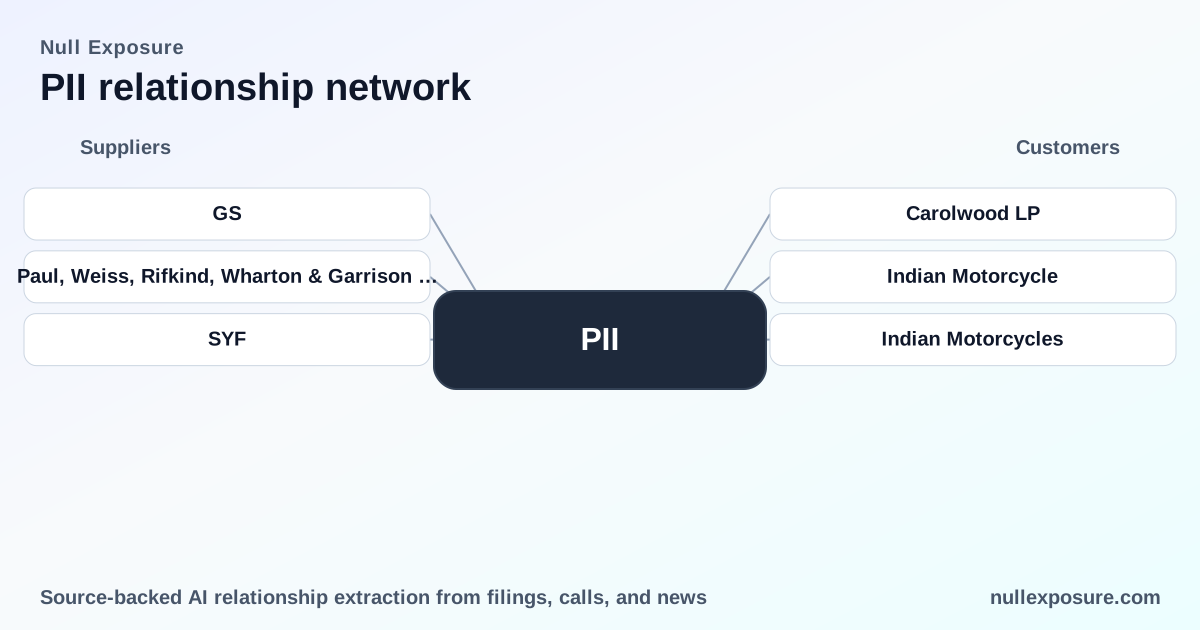
Polaris Industries (PII): Supplier relationships, strategic constraints, and investor implications
Polaris Industries designs, manufactures and markets powersports vehicles and related products, monetizing through vehicle and parts sales, dealer networks and third-party consumer financing arrangements that expand purchase accessibility. Revenue is driven by new-vehicle and aftermarket parts gross margins plus captive-style financing arrangements provided by partners — not Polaris directly — which supports higher-ticket sales and recurring parts/service demand. For an investor evaluating Polaris as a supplier partner or counterparty, the company combines manufacturing scale with outsourced financial services and intermittent high-profile advisory relationships that shape strategic transactions. Learn more at https://nullexposure.com/.
How Polaris operates and where supplier risk sits
Polaris is a product-focused manufacturer in the recreational vehicles sector with a FY2025 revenue base north of $7.2 billion and a market capitalization around $2.95 billion. The company sells through dealer channels and relies on third-party vendors for raw materials and component supply, contract carriers for logistics, and finance partners to underwrite consumer purchases — an operating model that concentrates execution risk on its supplier and service-provider ecosystem rather than an internal consumer finance arm.
Key business model characteristics:
- Contracting posture: Polaris operates with long-term supply contracts for at least some components, supporting volume predictability and negotiated pricing concessions that protect margins on core product lines.
- Concentration: The firm’s manufacturing and supplier relationships are critical; interruptions in supply or logistics have an outsized effect on production cadence given the product complexity.
- Criticality: Outsourced services — especially consumer financing and freight — are operationally critical because they materially affect unit demand and distribution velocity.
- Maturity: Polaris’ supplier network and dealer channels are mature, but the company is actively reshaping its portfolio (including separations and strategic transactions) that depend on external advisors and partners for execution.
For a deeper read on how Polaris maps supplier risk to strategic outcomes, visit https://nullexposure.com/.
Advisors and finance partners that matter today
Below are the current supplier/advisor relationships surfaced in public reporting and press coverage. Each entry is followed by a concise plain-English takeaway and a source note.
Goldman Sachs & Co. LLC — strategic financial advisor
Goldman Sachs served as Polaris’ financial advisor during the separation and sale of its Indian motorcycle business, signaling Polaris’ use of top-tier investment banking for transaction execution and valuation discovery. According to regional press coverage of the February 2026 transaction, Goldman advised on the divestiture that transferred a majority stake to Carolwood LP. (KVRR, Feb 2, 2026)
Paul, Weiss, Rifkind, Wharton & Garrison LLP — legal advisor on transactions
Polaris engaged Paul, Weiss as legal counsel on the same separation and sale, indicating reliance on elite transactional law firms for complex cross-border divestitures and regulatory diligence. The legal advisory role underwrites deal structure and compliance during portfolio reshapes. (KVRR, Feb 2, 2026)
Synchrony — consumer financing partner
Synchrony and Polaris renewed their consumer financing partnership to provide flexible payment options for powersports customers, reinforcing that Polaris outsources retail financing to a third-party lender to expand affordability and close rates. Multiple news items in early 2026 reported the renewal of this consumer finance arrangement. (Finviz news roundups and sector coverage, Q1–FY2026)
What these relationships imply for investors and operators
- High-caliber advisors for strategic moves. Engaging Goldman Sachs and Paul, Weiss signals that Polaris treats portfolio transactions as material corporate events and seeks top-tier external expertise to preserve value and manage legal risk. Transaction execution quality is a measurable lever for shareholder value in ongoing portfolio simplification.
- Consumer financing is outsourced and operationally important. The renewed Synchrony partnership illustrates Polaris’ strategic choice to avoid direct credit risk while still capturing sales lift from financed purchases; financing access is a demand accelerator that impacts unit growth and parts aftermarket revenue.
- Supplier and service-provider reliance is structural. The operating model places importance on supply contracts, logistics carriers and financing partners — making counterparty performance and contract design central to downside protection.
Company-level constraint signals that shape supplier behavior
Publicly surfaced constraint excerpts provide company-level signals about Polaris’ supplier posture and operational design:
- Polaris discloses long-term supply contracts with component manufacturers that include volume commitments and favorable pricing incentives, which creates volume predictability and embedded cost advantages over time.
- The company purchases raw materials and component parts from third-party vendors, confirming a manufacturing supply chain footprint that is externalized and therefore sensitive to supplier capacity and input-cost volatility.
- Polaris uses third-party providers for shipping and consumer financing, positioning these service providers as functionally mission-critical without incurring direct financing credit exposure.
These constraints together describe an operating model that is contract-heavy, externally dependent for both inputs and downstream financing, and structured to transfer certain fast-moving financial risks off the balance sheet while retaining product and parts revenue upside.
Investment risks and operational levers to watch
- Supply contract terms and supplier concentration: Long-term contracts reduce spot-price risk but create dependency; review supplier breadth and contingency arrangements for key components such as powertrains and specialized electronics.
- Financing partner performance: Consumer credit availability through Synchrony materially affects retail demand; changes to credit terms or underwriting practices will flow directly into near-term unit sales.
- Execution risk during portfolio reshaping: Use of top-tier advisors reduces execution risk in headline transactions, but divestitures can still create transitional supply or warranty obligations that affect margins.
Mid-cycle investors should evaluate dealer inventories, receivables dynamics tied to financed purchases, and the cadence of announced supplier agreements. For tools and operational intelligence to monitor these counterparty signals, visit https://nullexposure.com/.
Bottom line and actions for investors and procurement leaders
Polaris operates as a scale manufacturer that deliberately externalizes consumer credit and some logistics to specialist partners while negotiating long-term supply contracts to stabilize input costs. The company’s supplier relations and financing partnerships are high-impact levers for demand and margin resiliency; monitoring those relationships is essential for both equity investors and vendor managers.
If you evaluate supplier credit, contracting posture or transaction execution risk in manufacturing ecosystems, start tracking Polaris’ partner disclosures and transaction filings. For practical monitoring and supplier-risk insight, go to https://nullexposure.com/.
Important relationship takeaways: Goldman Sachs and Paul, Weiss indicate top-tier advisory engagement for strategic transactions; Synchrony is the active consumer financing partner driving retail affordability. These relationships, combined with the company-level constraint signals, define where Polaris’ operational and market risk are concentrated.