P3 Health Partners (PIII): Supplier relationships that shape a value-based care rollout
P3 Health Partners operates as a value-based primary care aggregator that monetizes by contracting with payors and managing payer-provider risk using analytics, telehealth and localized clinic networks. The company combines acquisitions of community clinics with partnerships and transaction advisors to scale membership and revenue, while carrying negative operating margins as it invests in network expansion. For investors evaluating supplier dependencies and execution risk, the supplier map highlights a mix of transaction advisors and local clinical operators that are critical to P3’s operating model. Learn more about how this supplier analysis informs diligence at https://nullexposure.com/.
What the supplier footprint says about how P3 runs the business
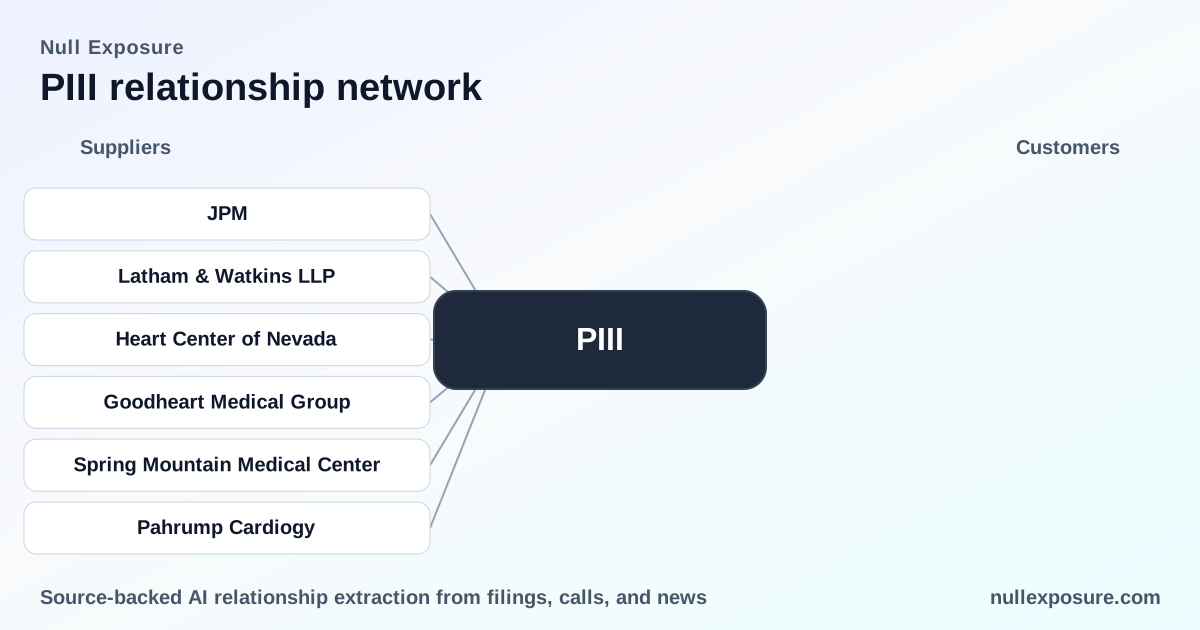
P3’s public supplier relationships indicate a two-track operating model: (1) capital markets and legal advisors for corporate transactions and market access, and (2) local clinical partners and acquired clinic operators that deliver patient care. The corporate advisor relationships are transactional and show sophistication in deal execution; the clinical partners are operationally critical and demonstrate concentration risk at the local level where P3 consolidates clinics. Financials reinforce this posture: P3 reports substantial TTM revenue (~$1.44 billion) but negative EBITDA and operating margins, which means the company is commercially scaled but still financially immature as it prioritizes growth and integration over near-term profitability.
No supplier-level contractual constraints were recorded in available relationship records; as a company-level signal, this absence indicates either public disclosures focus on strategic partnerships rather than granular contract terms, or that supplier constraints are managed at the local operating unit level. Investors should treat this as a governance signal: supplier terms are not visible in public filings, increasing the value of supplier diligence in M&A or partnership underwriting.
The relationships that matter — straight to the point
Below I cover every supplier relationship in the available results and what each implies for P3’s operating and execution risk.
J.P. Morgan Securities LLC — transaction advisor (FY2021)
J.P. Morgan acted as P3’s exclusive financial advisor for the business combination that brought P3 public via Foresight Acquisition Corp., establishing capital markets access and deal execution capability. According to the company press release announcing the closing, J.P. Morgan’s role was central to the transaction’s completion (GlobeNewswire, Dec 3, 2021).
Latham & Watkins LLP — legal advisor for the business combination (FY2021)
Latham & Watkins served as P3’s legal counsel on the same business combination, providing corporate and securities advice that enabled the NASDAQ listing and regulatory compliance around the deal. The GlobeNewswire announcement from December 2021 names Latham & Watkins as legal advisor to P3.
Heart Center of Nevada — operator engaged in local care delivery (FY2023)
Local lawsuit reporting states that some clinical duties previously associated with Calvada clinics were contracted to Heart Center of Nevada, indicating P3 relies on regional specialty operators to run services in the Las Vegas market. PV Times reporting on the Calvada clinics dispute identifies Heart Center of Nevada as an operator involved in those arrangements (PV Times, 2023).
Goodheart Medical Group — retained primary care partner in Pahrump (FY2023)
P3 retained a relationship with Goodheart Medical Group for primary care services in Pahrump, reflecting a reliance on established local primary care practices to maintain continuity of care after clinic consolidation. PV Times notes that P3 will retain partnerships with Goodheart Medical Group as part of its local footprint (PV Times, 2023).
Spring Mountain Medical Center — retained primary care partner in Pahrump (FY2023)
Spring Mountain Medical Center is listed alongside Goodheart as a continuing primary care partner in Pahrump, reinforcing the pattern that P3 keeps established community providers on-network when closing or consolidating clinics. This detail is described in the same PV Times coverage of the Calvada clinics matter (PV Times, 2023).
Pahrump Cardiogy — buyer in clinic buyout (FY2023)
P3 completed a multi-million dollar buyout with Pahrump Cardiogy when acquiring the Calvada clinics, paying more than $5 million upfront as part of the transaction, which signals P3’s willingness to use cash acquisitions to consolidate local assets. PV Times reports the buyout terms and the upfront payment in its coverage of the clinic closures and resulting litigation (PV Times, 2023).
What these relationships concretely mean for investors
- Execution capability: Engagement of J.P. Morgan and Latham & Watkins for the SPAC/business-combination process is a positive signal for transaction execution and capital markets access. Those advisor relationships reduce deal execution risk for strategic capital moves.
- Operational concentration and criticality: P3’s reliance on named local operators and retained primary care groups indicates high operational criticality at the local market level—if these partners face disputes or termination, P3’s network continuity could be disrupted. The Calvada clinic litigation reported in 2023 illustrates this vulnerability.
- Deal-driven consolidation: The Pahrump Cardiogy buyout shows the company uses acquisitions to acquire capacity quickly, which supports growth but increases integration and cash-flow risk while margins are negative.
- Visibility gap on supplier terms: The absence of supplier contract disclosures in the relationship records is a governance and diligence flag—investors should insist on supplier contract summaries and termination clauses when assessing downside scenarios.
If you want an investor-focused supplier risk scorecard for P3 or comparable rollups, start here: https://nullexposure.com/.
Practical investor takeaways and near-term monitoring items
- Monitor litigation and local operator disputes: the Calvada clinics issue is a real example of how local partner conflicts can force closures and reputational risk.
- Track integration economics from buyouts: the upfront payment detail from the Pahrump transaction underscores the need to quantify payback periods on clinic purchases and the effect on cash flow.
- Require supplier contract transparency in diligence: public reporting names advisors and partners but omits contract terms; investors should secure summaries of exclusivity, termination rights, and service-level commitments.
- Watch margins and cash runway: P3’s negative EBITDA and operating margin require close attention—supplier payments for acquisitions and retained operator fees will shape the path to operating leverage.
For tailored reporting on supplier relationships and counterparty risk across healthcare rollups, visit https://nullexposure.com/ to arrange a briefing.
Final assessment
P3 Health Partners combines transaction-grade advisory support with localized clinical partnerships to scale a value-based care network. That mix supports rapid expansion but concentrates operational risk in local partners and creates integration demands while the company works to convert top-line scale into profitable operations. Investors should treat the identified suppliers as both enablers (deal execution and clinic operations) and potential single-point failures in local markets, and should press for greater contract-level transparency as a condition of underwriting further investment.