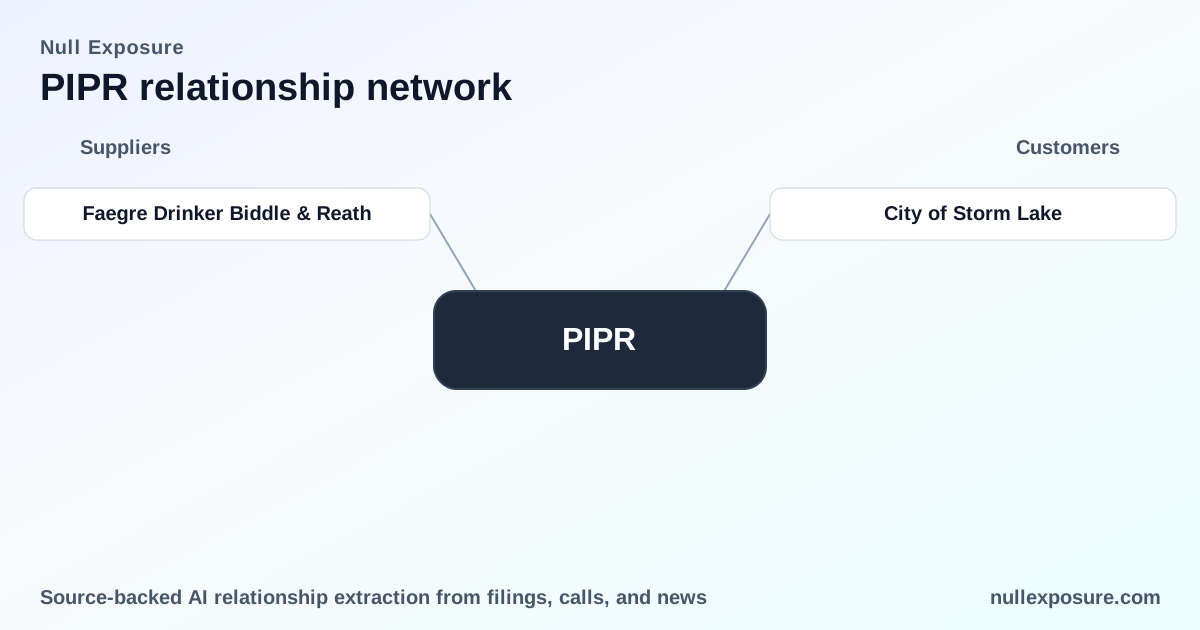
Piper Sandler (PIPR) — supplier relationships and what they mean for investors
Piper Sandler is a full‑service investment bank and institutional securities firm that monetizes through advisory fees, underwriting spreads, trading commissions and asset management fees across corporate, public and private markets. Revenue is transaction‑driven and concentrated in deal flow and capital markets activity, so supplier relationships are primarily episodic legal, advisory and technology contracts that support execution and regulatory compliance. For investors evaluating counterparty risk and operational resilience, the supplier footprint signals where interruptions would be transactional (low continuous spend) versus operationally critical (benefits, core trading platforms). Learn more about supplier risk analysis at https://nullexposure.com/.
Quick take: what to look for as an investor
Piper Sandler’s supplier posture reflects a capital‑markets operator with a network of professional services providers rather than long‑term manufacturing or logistics vendors. Legal and advisory firms are transactional but important for deal completion, while benefits and insurance suppliers carry operational continuity exposure. Key investor considerations are contracting concentration, the maturity of supplier relationships and whether suppliers deliver mission‑critical infrastructure versus episodic specialist services.
- Contracting posture: Supplier relationships are predominantly engagement‑based professional services rather than heavy long‑term lock‑ins.
- Concentration: Spend concentration is moderate; a handful of law and advisory firms will see recurring activity around M&A and capital markets work.
- Criticality: Benefits and technology platforms are more operationally critical than single‑deal legal counsel.
- Maturity: Supplier relationships are a mix of longstanding retained advisors and one‑off transactional firms.
Who Piper Sandler worked with recently (what the public record shows)
The available public reporting lists advisors used in an acquisition transaction concluded in FY2025. Each relationship below is summarized concisely with the source.
Faegre Drinker Biddle & Reath — legal advisor on an acquisition
Faegre Drinker served as legal counsel to Piper Sandler in connection with the acquisition announced in FY2025, providing standard transactional and regulatory advice necessary to complete the deal. According to a Yahoo Finance report from March 10, 2026, Piper Sandler was advised by Faegre Drinker Biddle & Reath on the transaction (FY2025 / reported March 2026).
Source: Yahoo Finance transaction notice, March 10, 2026 — https://finance.yahoo.com/news/piper-sandler-completes-acquisition-g-124500903.html
(That transaction note also identified Holland & Knight as counsel to the counterparty, G Squared Capital Partners, which is relevant as context for counterparty counsel choices.)
What the single reported relationship implies for investors
The public record shows transactional legal support rather than strategic vendor lock‑ins. A law firm engaged on an acquisition provides essential advice for deal structure, regulatory filings and integration legal work, but it does not represent a continuous operational dependency. This pattern is consistent with an investment bank that scales legal spend around transactions, reducing the danger of a single legal supplier outage disrupting ongoing trading or client servicing.
Company‑level constraints that affect supplier risk
Piper Sandler’s corporate disclosures establish an important supplier and risk posture for benefits and insurance: the company is self‑insured for employee health claims and purchases third‑party stop‑loss insurance on an individual plan basis. That structure changes the nature of its supplier relationships:
- It creates a direct financial exposure to healthcare claim volatility and makes stop‑loss carriers operationally important partners for loss control and claims administration.
- Stop‑loss arrangements are typically bespoke and can be sensitive to market pricing and capacity; therefore, benefits suppliers are operationally critical and functionally continuous rather than episodic.
Presenting this as a company‑level signal, investors should treat benefits and insurance counterparties as higher‑priority suppliers for operational continuity and credit assessment, separate from one‑off legal advisors reported in deal notices.
Risk and concentration considerations investors should weigh
Investors should synthesize supplier intelligence with the firm’s business model:
- Deal dependence: Revenue volatility is driven by capital markets cycles; transactional suppliers (legal, banking syndicates) scale with activity, limiting fixed‑cost drag but increasing episodic supplier spend.
- Operational criticality: Benefits and trading/clearing platforms are critical and deserve scrutiny for continuity, contractual terms and indemnities.
- Concentration risk: A small number of retained advisors can create reputational and execution risk during peak deal windows, but they are less likely to cause day‑to‑day operational outages.
- Supplier maturity and procurement posture: Professional services relationships are mature and standardized, while stop‑loss insurance is bespoke and sensitive to underwriting cycles.
Investors should prioritize monitoring the health and contractual terms of benefits insurers and core technology vendors while treating legal counsel relationships as managed, transaction‑specific dependencies.
Actionable investor checklist
- Verify continuity arrangements for benefits and stop‑loss carriers and review recent filings for claims trends and stop‑loss renewals.
- Confirm the diversity of legal and advisory partners to ensure no single firm dominates deal execution capability.
- Assess contractual protections and SLAs for core trading and clearing platforms.
Learn more about how supplier analysis integrates with financial and operational due diligence at https://nullexposure.com/.
Final read: what to conclude
Piper Sandler operates as a transaction‑driven capital markets firm with supplier risk concentrated in two buckets: episodic professional services (legal/advisory) and continuously critical benefits/insurance and technology providers. The recent, publicized relationship with Faegre Drinker illustrates the expected profile of transactional counsel supporting acquisitions; it does not indicate long‑term operational dependency. Company disclosures that Piper Sandler is self‑insured for health claims and uses third‑party stop‑loss arrangements elevate the importance of evaluating benefits and insurance counterparties as part of any supplier risk assessment.
For investors and operators who need an actionable supplier risk map for PIPR, start with benefits/insurance continuity checks and a review of retained advisor concentrations — and revisit transactional counsel exposure during peak deal activity. For a structured supplier risk assessment and benchmarking, visit https://nullexposure.com/ and request tailored research.