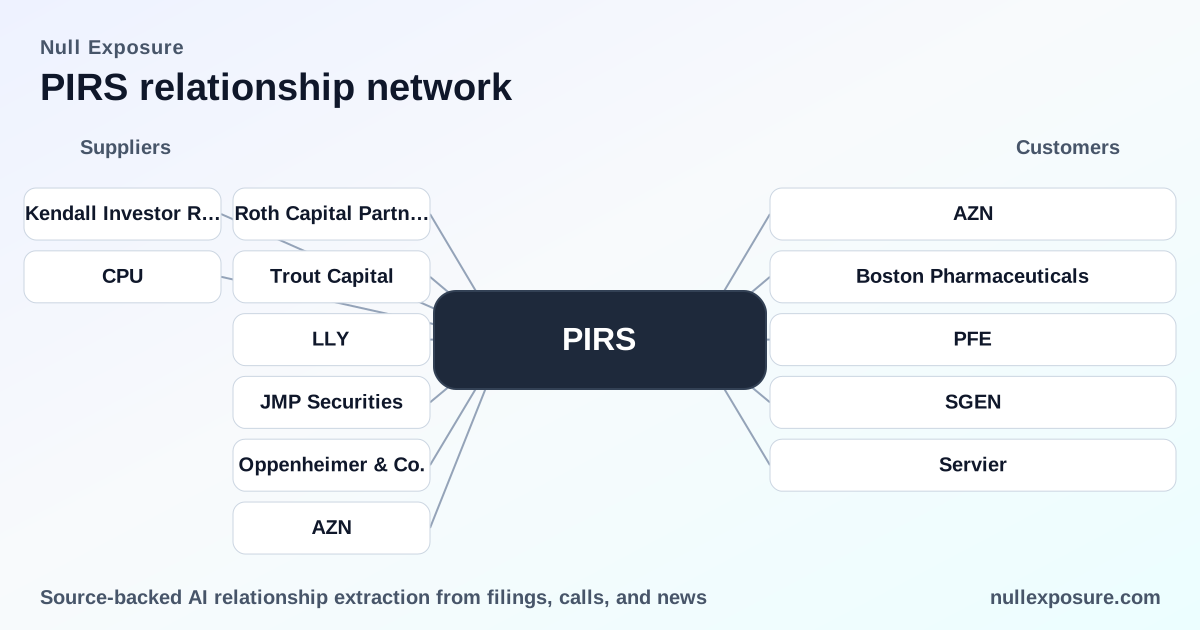
Pieris Pharmaceuticals (PIRS) — Supplier and Partner Map for Investors
Pieris Pharmaceuticals operates as a clinical-stage biotherapeutics company that advances therapeutics built on its Anticalin platform and monetizes through strategic collaborations, milestone and royalty economics with large pharmas, and capital markets activity to support development. Its commercial logic centers on outsourcing late-stage development and certain clinical assets to partners while retaining platform-level value and upside through licensing and milestone receipts. Investors should view Pieris as a partnership-driven clinical developer whose operating leverage and risk profile are defined by the strength and continuity of those external relationships.
Discover more on partner exposures and supplier insights at https://nullexposure.com/.
Why the partner list matters to valuation and risk
Pieris’s partner roster reveals a dual operating posture: outsourced clinical development and market-facing financing. Big-pharma collaborators supply clinical assets and trial resources, while investment banks and service providers support capital raises and corporate housekeeping. This structure produces high operational concentration on a small set of counterparties, creates binary clinical read-throughs tied to partner decisions, and raises counterparty risk when partners discontinue programs. There are no explicit supplier constraints captured in the provided record, which is itself a company-level signal about the public record available on contractual limitations.
Supplier-by-supplier read: what every relationship means
Below are plain-English summaries of each relationship identified in public coverage, with source references for direct follow-up.
-
Roth Capital Partners — Roth Capital acted as a co-manager on an equity offering for Pieris, signaling the company’s reliance on boutique investment banks for capital raises and distribution. Source: Zacks report (Nov 2015) — https://scr.zacks.com/news/news-details/2015/PIRS-Positive-Phase-1-Data-for-PRS-080-November/default.aspx.
-
Trout Capital — Trout Capital served alongside Roth as co-manager on the same offering, underscoring the use of multiple underwriters to syndicate financings and broaden distribution. Source: Zacks report (Nov 2015) — https://scr.zacks.com/news/news-details/2015/PIRS-Positive-Phase-1-Data-for-PRS-080-November/default.aspx.
-
JMP Securities — JMP Securities acted as a joint book-running manager for the offering, contributing to Pieris’s financing execution capacity and market access. Source: Zacks report (Nov 2015) — https://scr.zacks.com/news/news-details/2015/PIRS-Positive-Phase-1-Data-for-PRS-080-November/default.aspx.
-
Oppenheimer & Co. — Oppenheimer is listed as a joint book-running manager on the same transaction, indicating participation from national underwriters in capital market activity. Source: Zacks report (Nov 2015) — https://scr.zacks.com/news/news-details/2015/PIRS-Positive-Phase-1-Data-for-PRS-080-November/default.aspx.
-
Eli Lilly and Company (LLY) — Eli Lilly contributed ramucirumab (Cyramza) and paclitaxel to a Phase 2 HER2-positive gastric cancer study through a trial collaboration, demonstrating Pieris’s model of in-kind clinical collaborations with major pharma. Source: Yahoo Finance (reporting on collaboration; FY2022 context) — https://finance.yahoo.com/news/pieris-stops-cancer-med-tested-180326894.html.
-
AstraZeneca (AZN) — AstraZeneca communicated the discontinuation and cessation of dosing in Pieris’s inhaled IL-4 receptor alpha program (elarekibep), reflecting the binary, partner-controlled nature of certain clinical programs and the immediate material impact such decisions have on Pieris’s pipeline progress. Source: AccessNewswire / Yahoo Finance (FY2023) — https://www.accessnewswire.com/newsroom/en/biotechnology/pieris-pharmaceuticals-announces-astrazeneca-discontinuation-of-phase-2a-trial-of-elar-762604 and https://finance.yahoo.com/news/pieris-pharmaceuticals-announces-astrazeneca-discontinuation-110000600.html.
-
Kendall Investor Relations — Kendall Investor Relations is identified as an investor-relations contact for Pieris, indicating outsourced IR and corporate communications functions to maintain market visibility and investor engagement. Source: FinancialContent / Market release (FY2023) — https://markets.financialcontent.com/gatehouse.rrstar/article/accwirecq-2023-5-2-pieris-pharmaceuticals-to-host-first-quarter-2023-investor-call-and-provide-corporate-update-on-may-10-2023.
-
Computershare Trust Company, N.A. — Computershare was appointed as transfer agent and exchange agent for Pieris’s 1-for-80 reverse stock split, demonstrating the use of established transfer agents to execute capital structure actions and shareholder recordkeeping. Source: AccessNewswire (FY2024) — https://www.accessnewswire.com/newsroom/en/biotechnology/pieris-pharmaceuticals-announces-1-for-80-reverse-stock-split-854200.
Explore how these partner ties influence exposure and concentration at https://nullexposure.com/.
What these relationships imply about Pieris’s operating characteristics
- Contracting posture: Pieris operates a partnership-first model. Clinical development is frequently co-funded or conducted under collaboration agreements where partners control dosing and program continuation, transferring development risk away from Pieris but also ceding operational control.
- Concentration: A small number of large pharma partners (AstraZeneca, Eli Lilly) and a handful of financing intermediaries concentrate economic and operational risk; a single partner decision can materially alter program economics.
- Criticality: Partners fulfill critical functions — clinical reagent supply, trial conduct, and financing — meaning disruptions translate directly to pipeline and liquidity outcomes. AstraZeneca’s program termination is a concrete example.
- Maturity: The company remains clinical-stage; supplier relationships reflect developmental needs (trial collaborations) and corporate needs (underwriters, transfer agent), not commercial-scale manufacturing or distribution.
Key takeaway: partner decisions—not internal drug performance alone—drive near-term valuation volatility.
Investment implications and principal risks
- The AstraZeneca discontinuation is a direct, observable operational risk that reduces near-term pipeline optionality and demonstrates the company’s dependence on partner-driven development outcomes. (Source: AccessNewswire / Yahoo Finance, FY2023).
- Capital markets dependence is visible through repeated underwriter involvement and the use of a reverse split processed by Computershare; this elevates financing execution risk if market access tightens. (Sources: Zacks 2015; AccessNewswire FY2024).
- Outsourced IR and service providers support market communication and corporate actions, which improves execution bandwidth but creates vendor dependency for investor-facing functions. (Source: FinancialContent FY2023).
How to use this map in your diligence
- Prioritize documentary review of collaboration agreements with AstraZeneca and Eli Lilly to quantify milestone exposure, termination rights, and indemnities.
- Stress-test capital-raising scenarios against the record of underwriter syndication and the recent reverse split when modeling dilution and runway.
- Monitor public filings and partner press releases for operational triggers (trial pauses, dosing cessations) as they are likely to be immediate determinants of market reaction.
For a deeper partner exposure analysis and monitoring tools, visit https://nullexposure.com/.
Bottom line
Pieris’s business model is partnership-intensive: clinical progress and liquidity are both driven externally. Investors should weight partnership continuity and underwriting access as first-order drivers of value and treat partner announcements as primary catalysts. Effective diligence focuses on agreement terms, partner incentives, and the practical mechanisms through which partners can accelerate or halt programs.