PJT Partners: Supplier relationships and strategic signals investors should track
PJT Partners is a boutique advisory-focused investment bank that monetizes expertise through transaction fees and retainer arrangements—advising on mergers & acquisitions, restructurings, special situations and capital markets work. Its revenue is concentrated in high-value, episodic mandates driven by senior bankers; the firm converts intellectual capital and client relationships into outsized per-deal fees rather than scale-dependent trading or underwriting income. For investors and counterparties, that business model implies earnings volatility tied to deal flow, high margin potential when mandates cluster, and sensitivity to reputation and communications channels.
Explore further supplier and market signals at https://nullexposure.com/.
How PJT makes money and why suppliers matter for valuation
PJT operates as a high-touch advisory platform: senior partners source and execute mandates, the firm collects advisory and success fees, and operating leverage comes from leveraging a compact, highly compensated staff. The financial profile reinforces the model: Revenue TTM of $1.712 billion, operating margin around 23%, and return on equity north of 32% indicate a profitable, capital-light enterprise that trades on talent and relationships rather than balance-sheet intermediation. Valuation multiples (trailing PE ~19.5; forward PE ~16.3) reflect expectations for sustained deal-level earnings and premium margins.
Suppliers in this context are not just vendors of IT or data; they include communications firms, deal distribution channels and financial printers whose effectiveness directly impacts execution, market reception and the timing of disclosures. A disciplined supplier posture preserves deal confidentiality, optimizes announcement timing, and supports reputation—each important for a fee-driven franchise.
Operating constraints and company-level signals you should factor
While the supplied relationship data contains no explicit contractual constraints, the firm-level operating characteristics provide relevant signals for procurement and counterparty risk:
- Contracting posture: Advisory engagements are bespoke and episodic—contracts are client-specific, high-touch, and often feature success-based compensation, which reduces fixed supplier spend but requires reliable suppliers for discrete, time-sensitive execution.
- Concentration: Revenue and client outcomes depend heavily on a relatively small set of senior bankers and on the cadence of large transactions; supplier continuity for PR, distribution, and deal logistics is therefore strategically important.
- Criticality: External communications and disclosure channels are material to reputation and transaction outcomes, elevating the functional importance of PR agencies and wire services beyond standard vendor relationships.
- Maturity: PJT is a mature boutique with institutional backing and public market scrutiny; supplier relationships are professionalized, governed by standard corporate procurement practices and compliance oversight.
These are company-level signals—useful in diligence and contract design—rather than relationship-specific constraints since no constraint excerpts were provided.
Recent supplier-sourced coverage: what the public record shows
Below are every relationship captured in the available results and the practical takeaway for investors.
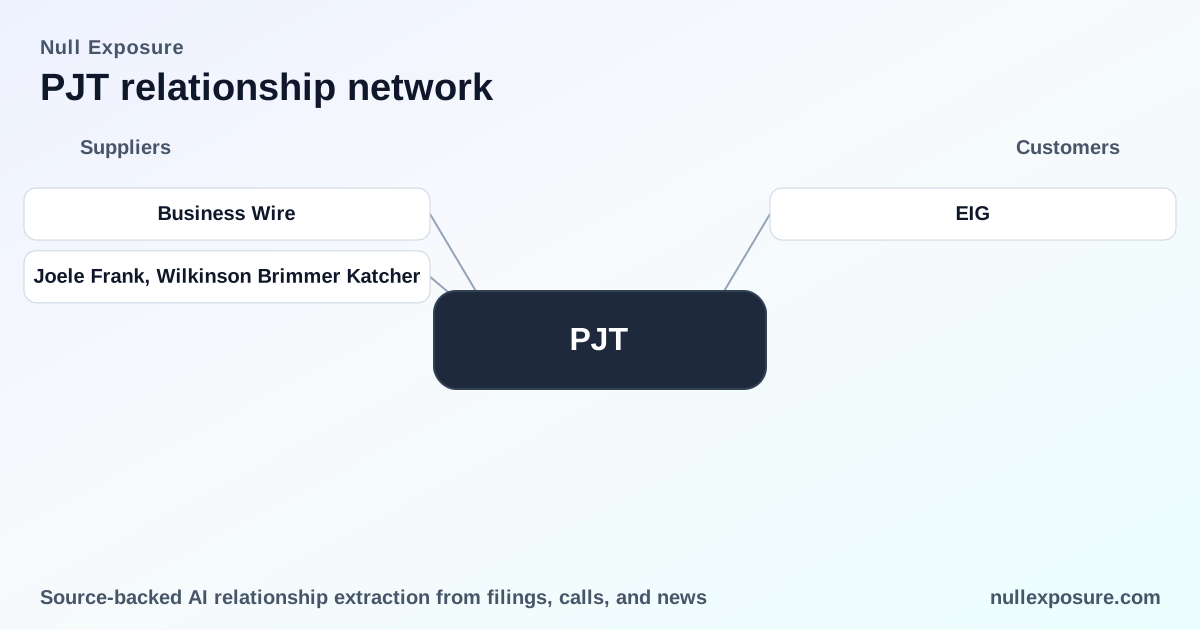
Business Wire — press release distribution
PJT used Business Wire to announce its expectation to release full-year and Q4 2025 financial results on February 3, 2026, signaling planned disclosure cadence and standard investor relations practice. According to a Business Wire press release dated January 27, 2026, PJT communicated the timing of its quarterly reporting through that channel.
Joele Frank, Wilkinson Brimmer Katcher — PR agency contact
The firm’s PR outreach for the earnings announcement was routed through Joele Frank, with Jon Keehner listed as the media contact and a provided telephone number and email (PJT-JF@joelefrank.com). That press strategy—using a specialized investor-relations/communications firm—indicates intentional media management and professional investor engagement, per Joele Frank communications published January 27, 2026.
(Those two items represent the full set of supplier-related entries returned in the review.)
Explore supplier profiles and appraisal tools on https://nullexposure.com/ for deeper diligence.
What these relationships mean in practice for operators and buyers
The recorded relationships are narrow but meaningful: Business Wire is a distribution channel for timely disclosures; Joele Frank is a retained communications advisor. Together they show a standard, institutional communications posture—PJT is not experimenting with informal channels; it uses established vendors to manage message control around material events. For operators assessing counterparty risk, that implies:
- Low operational vendor risk from press distribution and PR: these are replaceable, mature suppliers with predictable performance.
- High reputational sensitivity: the firm invests in professional PR, which underscores the value PJT places on narrative control around earnings and mandates.
- Execution timing matters: the use of wire services signals firm adherence to scheduled disclosures, useful for counterparties planning deal timelines.
Investment implications: risks, concentration, and where to focus diligence
For investors, the supplier signal set is limited but consistent with a broader investment thesis:
- Earnings volatility remains the primary risk, driven by deal flow; supplier relationships seen here do nothing to dampen that structural exposure.
- Reputational management is an explicit operational priority, reducing idiosyncratic communication risk but creating reliance on third-party PR and distribution channels for equal access to information.
- Procurement exposure is concentrated and low-dollar: PR and wire services are economically modest relative to revenue, but operationally critical at disclosure events.
Financially, the firm’s strength is clear: high operating margin and ROE, modest dividend yield, and a forward PE that prices in continued deal activity. Investors should stress-test revenue sensitivity to mandates and track announcements managed through these suppliers as leading indicators of near-term revenue realization.
How to act on this analysis
- If you are evaluating PJT as a counterparty, require standard vendor continuity clauses in communications and announcement playbooks to ensure redundancy around press distribution and PR.
- If you are an investor, monitor PR-distributed announcements and the retained PR firm’s activity as short-term indicators of deal cadence and potential revenue recognition.
- For a deeper supplier-risk profile, commission a focused review of disclosure vendors and communications retainer terms to confirm service levels ahead of major transactions.
For more supplier-focused intelligence and to download tailored diligence templates, visit https://nullexposure.com/.
Bottom line
PJT’s recent public-supplier footprint in the record is concentrated in investor communications—a confirmation of a disciplined, professional disclosure posture rather than a signal of material supplier concentration risk. The core investment case remains driven by deal flow and senior-bankers’ execution; supplier diligence should therefore emphasize continuity for time-sensitive communications and contingency planning around material announcements. For practical tools and ongoing monitoring of supplier signals, go to https://nullexposure.com/.