Park Hotels & Resorts (PK): How its Hilton ties shape value and risk
Park Hotels & Resorts operates as a real-estate investment company that owns upscale, predominantly branded hotels and monetizes through property-level cash flows, asset sales and capital recycling, and a steady distribution policy to shareholders. The company’s economics are tightly coupled to franchise and management contracts with major hotel operators—most materially the Hilton family of brands—which deliver brand affinity, distribution and operating expertise in exchange for long-term fees, management percentages and brand licensing. For investors, the core thesis is simple: Park is a cash-flow driven REIT whose upside depends on asset-level RevPAR recovery and strategic asset management while its downside is concentrated around brand/manager relationships and large, discrete capital commitments.
Read a structured supplier-risk briefing and relationship map at https://nullexposure.com/ for ongoing tracker updates.
What Park’s business model actually looks like in practice
Park owns properties and outsources day-to-day hotel operations to brand managers under long-term management and franchise agreements. These contracts grant Park the right to collect property-level net operating income while the manager and franchisor control reservations, pricing, marketing and staffing. That structure means Park benefits from brand distribution and operating scale but accepts counterparty concentration, contractual fee drag and limited operational control over guest-facing performance.
Key balance-sheet and valuation touchpoints: market capitalization ~$2.1B; revenue TTM ~$2.545B; reported EBITDA ~$566M; EV/EBITDA ~17.8; price-to-book ~0.67. These metrics place Park in a tactical position where asset-level improvement and management/brand execution materially move equity returns. Discover more on supplier risk and counterparty concentration at https://nullexposure.com/.
Supplier relationships: the Hilton connection, documented
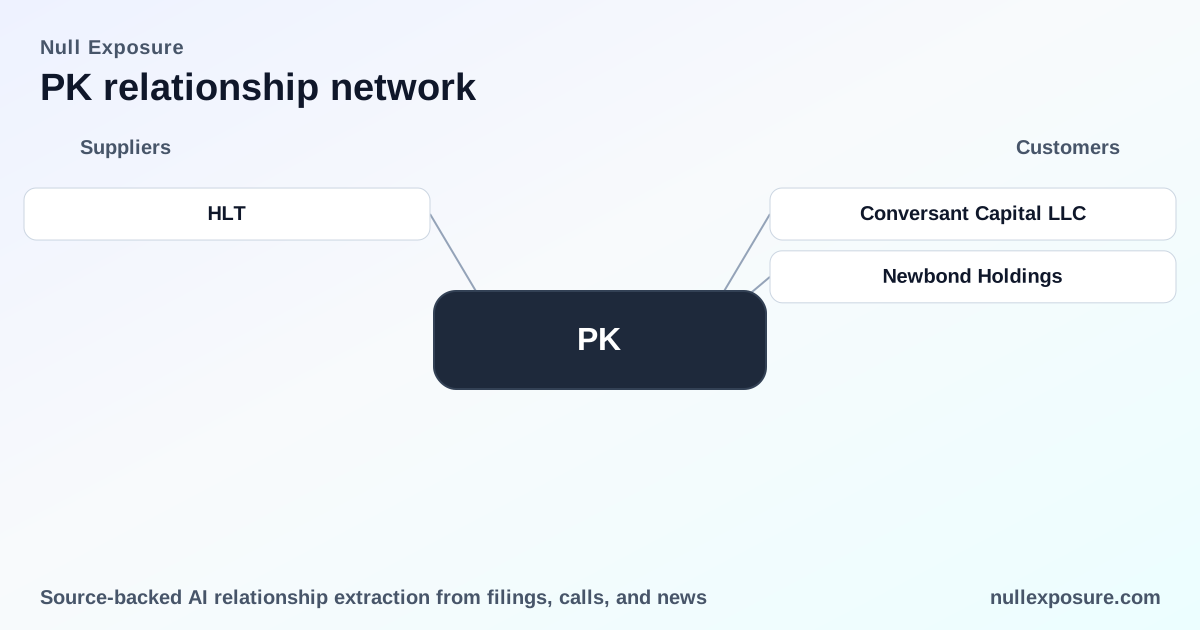
Park’s supplier universe in the provided results is dominated by entries referencing Hilton (HLT). Below are each of the captured mentions with plain-English summaries and source notes.
-
Park’s asset management team explicitly coordinates with Hilton operating partners when evaluating complex configurations such as a “hotel within a hotel,” indicating active collaboration on asset repositioning and brand strategy. This was stated on the company’s Q4 2025 earnings call transcript (reported Mar 10, 2026) and published by InsiderMonkey: https://www.insidermonkey.com/blog/park-hotels-resorts-inc-nysepk-q4-2025-earnings-call-transcript-1700299/.
-
The same language about coordination with Hilton operating partners was captured in a Globe and Mail summary of the Q4 2025 earnings discussion, underscoring that Park publicly frames Hilton as an operating partner in asset-level decisions (Globe and Mail, Mar 10, 2026): https://www.theglobeandmail.com/investing/markets/markets-news/motley/334462/park-hotels-pk-q4-2025-earnings-call-transcript/.
-
Park’s SEC commentary and analyst coverage call out concentration risk in the Hilton family of brands, noting that deterioration in Hilton’s reputation would materially impact Park’s portfolio performance; that point was highlighted in a TradingView write-up summarizing Park’s SEC filing themes (March 2026): https://www.tradingview.com/news/tradingview:35c741ac2157d:0-park-hotels-resorts-inc-sec-10-k-report/.
Each of these entries confirms Hilton is both an operational partner and a brand licensor for a meaningful portion of Park’s portfolio.
Contracting posture and relationship constraints — what rules the economics
Park’s public disclosures and the extracted contract excerpts reveal a contracting posture dominated by long-duration agreements and branded licensing:
-
Long-term orientation. Franchise agreements run 10–20 years and management agreements have initial terms of 5–30 years with renewal options that can extend economic ties to 70 years in aggregate. This is a company-level signal: the contracts create predictable fee streams and lock-in of brand exposure but reduce short-term flexibility.
-
Licensing and service split. Park holds limited, non-exclusive licensor rights to brand names and systems under franchise agreements, while hotel managers act as core service providers, controlling daily operations, staffing, pricing and reservations.
-
Active operating relationships. Most management agreements are active and the managers “generally have sole responsibility” for operations, which means Park’s asset-management playbook centers on oversight, capital allocation and repositioning rather than direct hotel operations.
-
Material concentration. Company commentary explicitly flags concentration in the Hilton family of brands as a material risk — a portfolio-level vulnerability that amplifies brand-related shocks.
-
Winding-down exception tied to Hilton San Francisco Hotels. In a specific legal and credit event disclosed by the company, the Hilton San Francisco Hotels were placed in receivership after debt-service defaults; the court-appointed receiver controlled operations and the company no longer held economic interest, with a contemplated non-judicial foreclosure timeline through mid-2025. This is a relationship-level winding-down event tied to Hilton-branded assets and reported in the company’s legal disclosures.
-
Capex commitments in the $10m–$100m band. Park disclosed outstanding third-party contractual commitments of approximately $95 million for property capital expenditures (examples: Hilton Hawaiian Village Waikiki, Hilton New Orleans Riverside, Hilton Waikoloa Village), indicating meaningful near-term capital exposure tied to branded property standards and renovations.
These constraints create a business model where Park’s upside is steady if managers execute and brands hold value; downside is concentrated, contractual, and capital-intensive.
Investment implications and operational levers
-
Concentration is the dominant risk factor. With a meaningful share of the portfolio in Hilton brands, any brand-level reputation or distribution shock has outsized earnings and valuation consequences. Institutional holders should treat brand concentration as a first-order sensitivity.
-
Contractual horizon is a structural strength and limit. Long-term franchise and management agreements stabilize cash flows but constrain Park’s ability to rebrand or switch operators quickly if performance deteriorates or fees become misaligned.
-
Capital commitments are a liquidity and execution lever. The disclosed ~$95M of contracted capex shows Park is investing to preserve or enhance brand standards—this is value-accretive if ADR/occupancy recover, but increases near-term capital intensity and refinancing risk if markets weaken.
-
Operational partnership is the primary governance channel. Since managers control day-to-day operations, Park’s returns depend on asset-level oversight, incentive structures in management agreements, and the company’s readiness to deploy capital or divest underperforming assets.
A practical investor action: review management agreement fee structures and termination provisions in filings to quantify flexibility and fee drag. Operators should prioritize enforcement of brand standards and track covenant timelines for assets under receivership.
Learn more and monitor counterparty dynamics at https://nullexposure.com/.
Bottom line and recommended next steps
Park Hotels & Resorts is a capital-intensive, branded-hotel REIT where Hilton is the dominant supplier partner—both a source of distribution and a concentration risk. The company’s long-term contracts and sizable capex commitments create stability but also limit tactical flexibility. From a risk-adjusted perspective, value hinges on management’s ability to extract premiums from brand affiliation, execute renovations efficiently, and manage concentrated supplier exposure.
If you are evaluating Park as an investment or counterparty: (1) stress-test cash flows under a brand-reputation shock; (2) scrutinize management agreement terms and capex timing; (3) monitor the outcome of receivership events tied to Hilton San Francisco Hotels for precedent on creditor and brand interactions.
For ongoing supplier-risk intelligence and rolling relationship maps, visit https://nullexposure.com/ and sign up for updates.