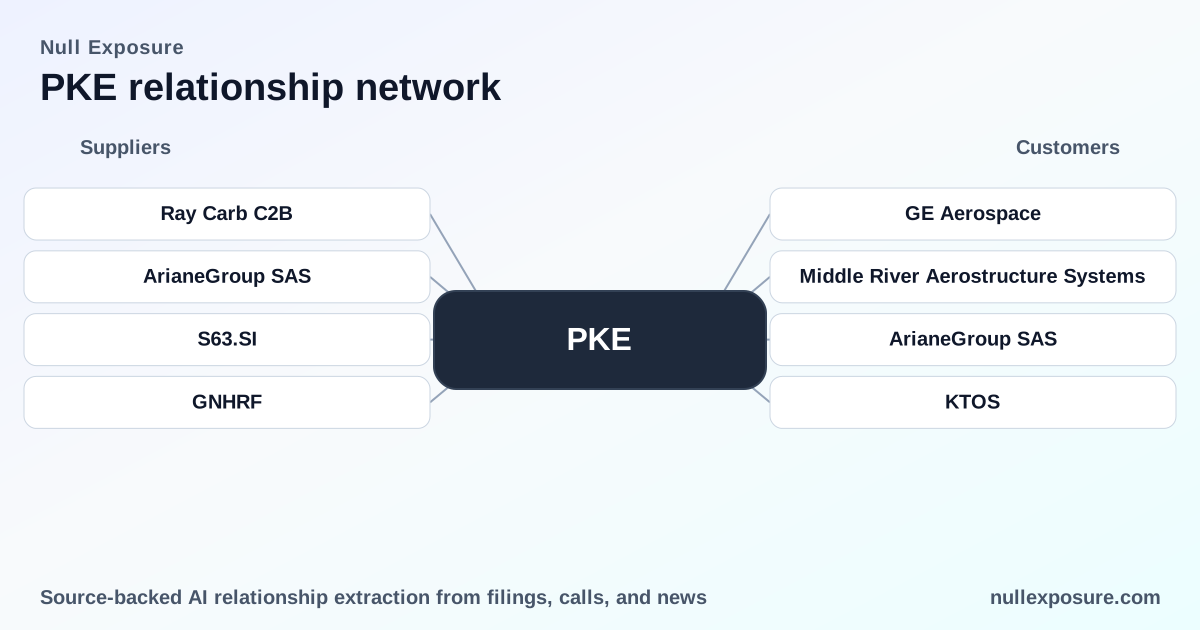
Park Aerospace (PKE) — supplier relationships that drive an aerospace specialty-materials niche
Park Aerospace manufactures and supplies engineered ablative and composite materials to aerospace and defense programs and monetizes through direct sales, exclusive distribution agreements, and structured advance funding tied to long-term purchase commitments. The firm’s commercial model captures technology margin on specialized inputs (for example RAYCARB products) while assuming counterparty and working-capital exposure through funding commitments to manufacturing partners. For investors, the core trade is high technical differentiation and embedded program criticality versus concentrated counterparty exposure and valuation premium.
Explore supplier profile details and related counterparty disclosures at https://nullexposure.com/.
How Park Aerospace makes money, in plain terms
Park Aerospace positions itself as both manufacturer and market gatekeeper for select ablative fabric and precursor materials used in rockets and missiles. Revenue flows from selling finished ablative systems and from exclusive-distribution arrangements that allow Park to set pricing and coordinate program deliveries. The company’s fiscal picture shows modest scale (Revenue TTM roughly $66M) and high institutional ownership (about 86% institutions), which supports a growth-at-a-premium valuation (trailing P/E ~62.7, forward P/E ~17.1). These financials underscore a high-margin, program-driven business that trades on scarcity of supply and program incumbency.
For a fuller overview of Park Aerospace’s public profile, visit https://nullexposure.com/.
Who Park works with — every supplier / partner listed in the record
Below I cover every counterparty mentioned in Park Aerospace’s recent disclosures and public remarks, with concise summaries and source context.
Ray Carb C2B
Park Aerospace serves as the exclusive distributor for Ray Carb C2B fabric, a material used in ablative composite systems for advanced missile programs; that exclusivity is cited as part of the company’s business partner agreement. This arrangement gives Park control over a critical input for its product line and positions the firm as a commercial gateway for RAYCARB C2B sales into defense programs — a direct revenue and margin lever. — Park Aerospace Q1 2026 earnings call (March 7, 2026).
ArianeGroup SAS
Park Aerospace maintains a long-term agreement with ArianeGroup SAS for exclusive distribution of RAYCARB C2®B NG, and the company has advanced funds to ArianeGroup to support production of this material, indicating a financial commitment to secure supply and ramp manufacturing. The deal ties Park directly into European rocket and missile supply chains and confirms the product’s programmatic criticality for space and defense customers. — TradingView coverage of Park Aerospace SEC reporting (FY2026 / March 2026).
Ariane (listed as “Arian” in disclosures)
Under a negotiated business partner arrangement, Park Aerospace has advanced €4,587,000 to Ariane against future purchases, reflecting an explicit working-capital exposure intended to secure prioritized production and delivery of critical material. That cash advance is a concrete example of Park’s willingness to finance supplier production to protect program continuity. — Park Aerospace Q1 2026 earnings call (March 7, 2026).
ST Engineering (S63.SI)
Park referenced ST Engineering in the context of asset ownership transfer: GE Aerospace sold MRAS to ST Engineering (Singapore), which provides context on program suppliers and ownership shifts relevant to Park’s broader supply chain and program relationships. The mention signals that Park monitors shifts in prime and Tier‑1 suppliers that can affect access, standards, and future contract flows. — Park Aerospace Q1 2026 earnings call (March 7, 2026).
Operational constraints and company-level signals investors should weigh
Even though the formal constraints dataset for these supplier relationships is empty, the public disclosures and financial profile reveal clear company-level operating characteristics:
- Contracting posture: Park operates with exclusive distribution agreements and bilateral partner arrangements that favor long-term, program-level commitments rather than open-market spot sales. That posture supports pricing power but increases tie‑in risk to individual technologies.
- Concentration & counterparty exposure: The need to advance funds to manufacturing partners (the €4.587M advance referenced publicly) creates direct balance-sheet exposure to a small set of counterparties and production lines. This is a company-level risk signal rather than an isolated contract stat.
- Criticality of products: The materials in question are used in rocket and missile systems, which means supply interruptions would have outsized program impact and therefore bring high buyer stickiness and defense-procurement sensitivity.
- Maturity of relationships: The language indicates multi-year agreements and funded production commitments rather than ad hoc purchases, suggesting these are mature, strategically aligned partnerships with embedded operational interdependence.
- Financial posture: At roughly $66M in revenue and with a market capitalization near $550M, Park runs a small-but-specialized business where valuation reflects future program value and not just current scale.
Investment implications — what to watch next
- Supply-side leverage is a strength and a risk. Exclusive distribution and funded production secure supply and margins, but create concentrated counterparty risk if a supplier underperforms or geopolitical/regulatory issues arise.
- Earnings sensitivity to program timing. Given program-driven demand for ablative materials, revenue and margin swings can be lumpy; monitor program awards and confirmed purchase schedules.
- Valuation and execution gap. Park trades at a premium on trailing multiples but a more moderate forward P/E, implying investor expectations for near-term revenue conversion; execution on those funded partner programs will determine whether the premium is justified.
- Governance and counterparty visibility. The public disclosures show active cash advances to suppliers — investors should demand continued transparency on the terms, collateral, and repayment mechanics of these advances.
If you want ongoing coverage and a consolidated view of Park Aerospace’s counterparty exposures, check https://nullexposure.com/ for updated supplier profiles and filings.
Bottom line
Park Aerospace’s commercial model is strategically focused: it monetizes scarcity and technical differentiation through exclusive distribution and funded-partner arrangements that secure program access. That model underwrites attractive margins and program stickiness but also concentrates credit and operational risk around a few supplier relationships. For investors evaluating PKE as an equity or partner, the decisive factors are continued execution on funded production commitments, contract visibility, and the company’s ability to convert exclusive access into predictable revenue. For the latest supplier relationship tracking and primary-source summaries, visit https://nullexposure.com/.
Explore supplier details and company disclosures at https://nullexposure.com/.