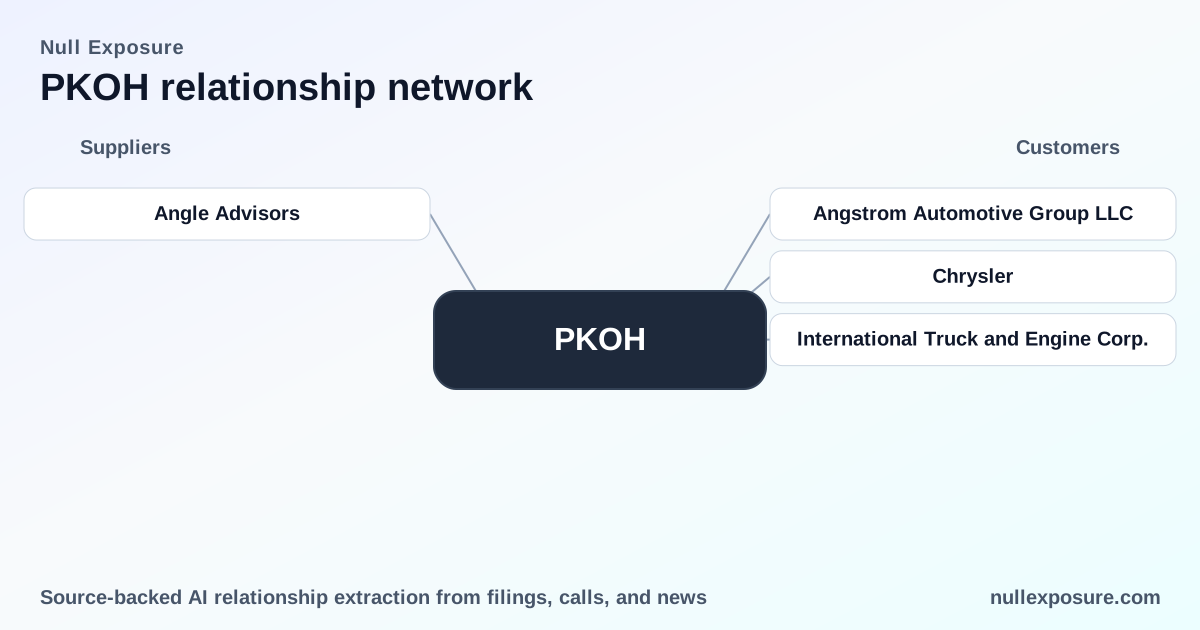
Park-Ohio (PKOH) — supplier posture, partners and what investors should act on
Park-Ohio is an industrial engineering and distribution group that monetizes through the manufacture and sale of engineered components, assemblies and aftermarket services, serving transportation, energy and industrial end markets. The company generates approximately $1.6 billion in trailing revenue with EBITDA of $121.6 million, and captures margin via a mix of in-house machining, outsourced component procurement and value-added assembly and distribution. For investors evaluating supplier counterparty risk, the critical frame is Park-Ohio’s hybrid model: some businesses source commodity inputs domestically while others rely on a broadly dispersed global supplier base, producing a mixed risk profile that affects cost pass-through, delivery resilience and margin stability. Visit https://nullexposure.com/ for more supplier intelligence on industrial names.
How Park-Ohio buys and why it matters to margins and continuity
Park-Ohio runs a multi-segment operating model where contracting posture and supplier dependence vary by business unit. That heterogeneity is the single most important investment signal for evaluating supplier risk.
-
Buyer posture and outsourcing: Supply Technologies is a clear buyer of third‑party production components — the division purchases substantially all of its production inputs externally. That places the company in a supplier-dependent position for this segment, where negotiating leverage, lead times and supplier credit terms materially influence working capital and margins. Company disclosures state that "Supply Technologies purchases substantially all of its production components from third‑party suppliers."
-
Domestic commodity sourcing for some businesses: For the Assembly Components and Engineered Products businesses, most raw materials are commodity products available from several domestic suppliers, which supports flexible sourcing and reduces single‑vendor concentration risk for these segments. This domestic commodity availability provides structural resilience to localized supply disruptions and lowers logistics complexity.
-
Global sourcing for other components: Conversely, the company reports that an increasing portion of Supply Technologies’ components is purchased from suppliers in Canada, Taiwan, China, South Korea, Singapore, India and multiple European countries, introducing multi‑jurisdictional supplier risk, longer lead times and FX exposure.
Taken together, these facts produce a mixed set of operating constraints: low supplier concentration in commodity-fed segments, higher external dependency and geographic complexity in advanced component segments, and buyer-driven procurement that leaves the company exposed to supplier performance on certain product families. Investors should price in uneven supply resiliency across business lines rather than a single, uniform supplier risk rating.
The one documented relationship in the record: Angle Advisors
Angle Advisors acted as exclusive investment banking advisor to Park‑Ohio Holdings Corp. in completing the sale of the General Aluminum business. According to an Angle Advisors post dated March 10, 2026, the firm served as Park‑Ohio’s exclusive advisor on that transaction, advising on process execution and deal close. (Angle Advisors, company post, March 10, 2026)
What that relationship signals for investors
The engagement of Angle Advisors for a divestiture is a strategic capital‑allocation signal with immediate supplier implications. Selling General Aluminum rationalizes Park‑Ohio’s asset base and reduces exposure to aluminum‑intensive commodity cycles, while freeing managerial bandwidth to focus on Supply Technologies and engineered products that rely on third‑party suppliers. The use of an exclusive advisor indicates a structured sale process designed to maximize valuation and transition risk management through a single coordinated counterparty.
What to monitor next — concrete supplier and contract metrics
Investors must track operational KPIs and disclosures that directly inform supplier risk and cash conversion:
- Supplier concentration metrics by BU (top 10 vendors as % of purchases). High concentration in Supply Technologies elevates single‑vendor risk.
- Geographic sourcing breakdown and change‑over time (domestic vs. foreign suppliers). Shifts toward Asia/Europe increase lead‑time and geopolitical risk.
- Days payable and inventory turns to spot supplier financing pressures or extended lead times.
- Terms and contingency clauses in major supply contracts (price escalation, force majeure, allocation rights). These govern cost pass‑through and continuity.
- Post‑divestiture supplier transition plans after the General Aluminum sale to ensure continuity for shared vendors and to avoid abrupt contract terminations.
For a deeper supplier risk profile and to track vendor concentration changes after portfolio moves, go to https://nullexposure.com/.
Strategic constraints and how they shape Park‑Ohio’s contracting posture
The company constraints noted in public material form a clear operating playbook:
- Concentration and maturity: The Assembly Components and Engineered Products businesses benefit from mature, commodity‑based supply channels with several domestic vendors, implying stable negotiating leverage and routine contract renewals.
- Criticality and complexity: Supply Technologies relies on critical components from a global vendor pool; the criticality of these inputs elevates operational risk and requires more active supplier management and redundancy planning.
- Contracting posture: As a buyer that outsources substantial production components, Park‑Ohio must invest in supplier qualification, multi‑sourcing and contractual protections to preserve margins and availability.
These company‑level signals are drawn from Park‑Ohio disclosures that describe domestic commodity sourcing for some units and broad international sourcing for Supply Technologies.
Bottom line — investor takeaways and immediate actions
- Positive: Park‑Ohio’s diversified sourcing approach reduces systemic concentration risk at the enterprise level; commodity-fed segments provide tactical resilience. The divestiture advised by Angle Advisors rationalizes the portfolio and reduces exposure to a commodities cycle.
- Watchlist: Track vendor concentration for Supply Technologies, post‑deal supplier transitions after the General Aluminum sale, and any shift in geographic sourcing that could increase lead times or FX exposure.
- Actionable steps: Request vendor concentration schedules in diligence, monitor days payable/inventory trends in quarterly reports, and evaluate contract language around escalation and allocation clauses in supply agreements.
For operational due diligence, transaction support or ongoing supplier monitoring, see additional resources at https://nullexposure.com/.
Investors evaluating Park‑Ohio should weight a hybrid procurement profile: domestic commodity strength balanced against global supplier dependency in engineered segments, and incorporate that asymmetry into valuation and operational risk scenarios.