POSCO Holdings (PKX) — strategic supplier map and what it means for investors
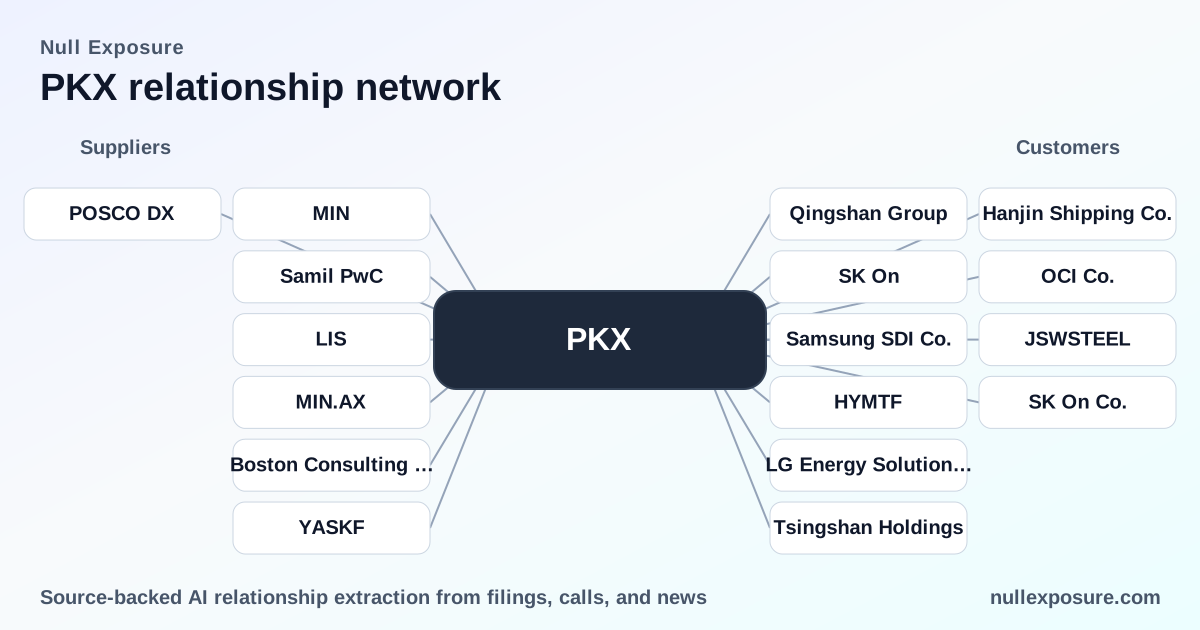
POSCO Holdings operates primarily as an integrated steel manufacturer and sells rolled products and plates globally, while increasingly monetizing a transition to energy materials and factory automation through equity investments, offtake arrangements and internal digital subsidiaries. The supplier relationships tracked here show a deliberate shift: equity and offtake deals to secure lithium feedstock, advisory engagements that support strategic M&A and logistics reviews, and automation partners that lower production cost and improve uptime — all of which change the risk profile and capital allocation strategy for POSCO. For a full supplier-by-supplier breakdown and operational implications, read on. If you want an aggregated supplier risk view, visit https://nullexposure.com/ for more coverage.
Why suppliers matter now: raw materials plus automation as profit levers
POSCO’s core steel margins are cyclical and exposed to commodity prices; the company is locking forward access to battery-grade inputs and investing in automation to build margin resilience. The supplier list shows two parallel strategies: secure low-cost, long-duration raw material supply and deploy technology to compress operating cost. These moves convert supplier relationships from episodic procurement to strategic assets that influence capital intensity, working-capital needs and partner concentration.
Relationship snapshots: who supplies what and why it matters
Mineral Resources / MinRes (Australia)
POSCO committed a substantial investment to secure access to lithium concentrate produced from the Wodgina and Mt. Marion mines, establishing an offtake proportional to its stake that guarantees 270,000 tonnes of annual concentrate for POSCO’s energy-materials push. This deal is presented as a multi-hundred-million-dollar upfront consideration and positions POSCO as a large, guaranteed offtaker (newsroom.posco.com; KED Global; TS2.tech, FY2025–2026).
Lithium South (LIS)
POSCO elected to acquire 100% of Lithium South’s Argentine subsidiary for USD 65 million, giving direct control over mining rights in the Hombre Muerto salar — a high-quality lithium source — and transferring early-stage resource risk to POSCO’s balance sheet. The purchase signals vertical integration into battery raw materials rather than simple contract procurement (newsroom.posco.com, FY2025).
Samil PwC (advisory)
POSCO engaged Samil PwC on an advisory mandate tied to strategic reviews and transaction assessment, reflecting an institutional approach to vendor selection and due diligence for major M&A or business assessments. This step points to professionalized deal execution and external validation of strategic moves (KED Global, FY2025).
Boston Consulting Group (advisory)
Boston Consulting Group was retained alongside other advisors to evaluate potential transactions and operational strategy, indicating POSCO is using top-tier consulting support to shape integration plans and commercial strategy for significant corporate actions. This elevates the seriousness and scale of the company’s strategic workstreams (KED Global, FY2025).
Yaskawa Electric (automation supplier)
POSCO DX contracted Yaskawa to supply high-precision industrial robots while POSCO DX handles system design and integration to ensure compatibility with existing lines, signaling a push to industrialize repetitive and hazardous tasks and reduce labor and downtime costs. The relationship converts supplier capability into measurable productivity improvement at steel operations (TradingView/Zacks report, FY2026).
POSCO DX (internal systems integrator and robotics lead)
POSCO DX is the internal engineering and systems arm deploying physical AI, humanoid and heavy-duty industrial robots across POSCO mills to control cranes, conveyors and unloading systems without human intervention — a supplier relationship that is internalized but functions as a critical provider of automation services. This internal supplier model increases control over IP and integration speed (POSCO newsroom, FY2025).
Operating-model signals and contracting posture
There are no explicit contractual constraint excerpts published in the feed, so the following are company-level signals derived from POSCO’s supplier behavior and disclosures:
- Contracting posture is proactive and equity-oriented. POSCO is securing resource access through investment and asset acquisition, not only short-term purchase contracts.
- Concentration is elevated in lithium sourcing but diversified by structure. POSCO’s exposure is large to specific lithium assets (Argentina, Western Australia) but the company allocates capital across multiple suppliers and ownership stakes to spread geological and counterparty risk.
- Supplier criticality is high. Lithium offtake and automation partners are strategic rather than transactional; their performance and continuity directly influence POSCO’s ability to scale energy-materials production and to reduce steel production costs.
- Maturity of relationships varies. Advisory and automation engagements leverage established global firms and internal capabilities, while some resource holdings (e.g., the Lithium South Argentine asset) are earlier-stage and therefore carry development execution risk.
- Visibility into contractual terms is limited. Public disclosures focus on strategic intent and headline investment amounts rather than granular legal covenants or termination mechanics.
Investment implications and risk checklist
POSCO’s supplier strategy improves long-term control over battery-feedstock economics and short-term operating leverage through automation. Investors should weigh the following:
- Upside: Secured concentrate volumes and in-house automation can convert into structural margin improvement and faster scale-up in energy materials revenue lines.
- Downside: Execution risk on mine development, price cyclicality of lithium concentrate, and capital allocation trade-offs against the steel business could compress returns.
- Balance-sheet and dilution risk: Equity purchases and upfront consideration affect leverage and cash flow flexibility; watch cash flow from operations and capex guidance closely.
Key monitoring items:
- Development milestones and capital schedules for newly acquired resource assets.
- Measured productivity gains from Yaskawa/POSCO DX deployments.
- Any disclosure of offtake pricing mechanics or termination provisions.
If you want to track supplier concentration and contract types across POSCO’s network, explore further at https://nullexposure.com/.
Bottom line and recommended actions for investors
POSCO is executing a clear strategy to control energy-material inputs and to industrialize production through automation — both moves are structural and capital-intensive. For investors, the new supplier relationships are value-relevant: they reduce variable input cost risk if executed well and increase execution and capital deployment risk if development timelines slip.
- Monitor milestone reporting from the Argentine asset and Australian offtake performance.
- Watch POSCO DX automation rollouts for measurable operating-margin impacts.
- Reassess valuation under scenarios that incorporate sustained lithium margin improvements and automation-driven cost declines.
For a consolidated supplier-risk dashboard and ongoing updates on PKX, visit https://nullexposure.com/ for continuous supplier intelligence.
Bold final takeaway: POSCO is transitioning supplier relationships from commodities procurement to strategic assets — the company that executes both resource development and automation integration will convert that strategy into durable earnings power.