Planet Labs PBC (PL): what its supplier book tells investors
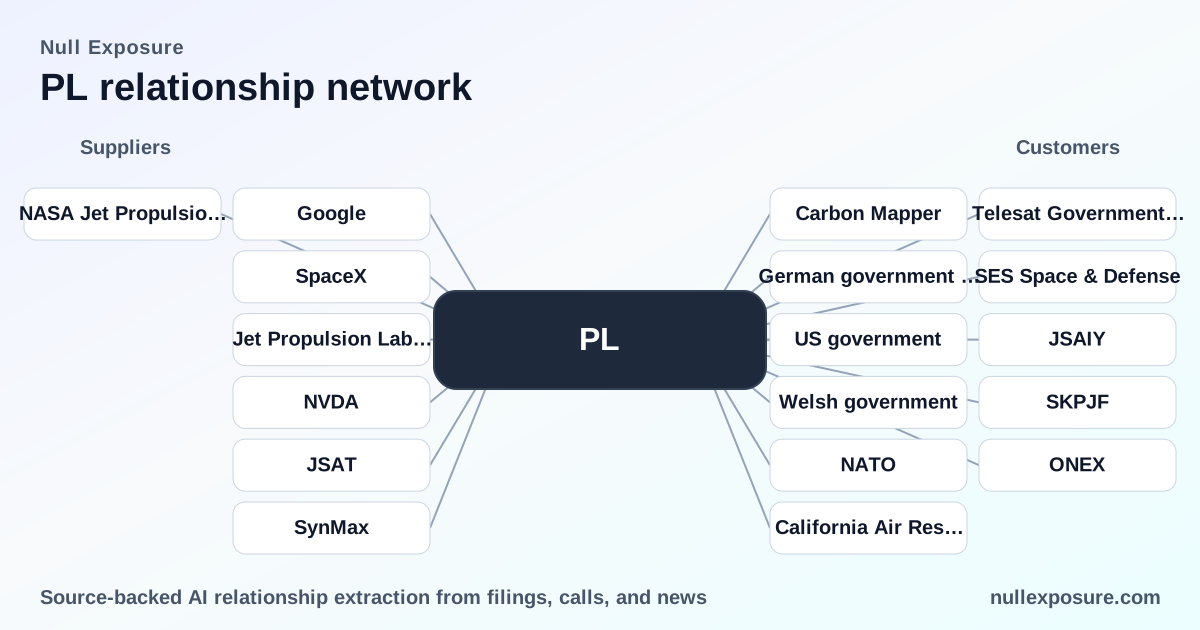
Planet Labs PBC operates a vertically integrated small-satellite constellation business that monetizes through subscription access to imagery, bespoke analytics, and mission services; revenue comes from recurring hosting and data contracts, higher‑margin analytics partnerships, and capitalized launches and hardware programs sold into government and commercial customers. Planet converts capital investment in satellites into recurring data and service revenue, while outsourcing critical hosting, launch and edge‑compute functions to a small set of specialized suppliers. For a quick view of supplier relationships and mapping tools, visit https://nullexposure.com/.
Why supplier relationships matter for Planet’s economics
Planet’s operating model is capital‑intensive and schedule‑driven: satellites are expensive to build and launch, and image availability is the product. That structure creates three supplier dynamics that determine valuation sensitivity: concentration (few qualified manufacturers and launch providers), contractual locking (multi‑year hosting and service commitments), and capability partnerships (on‑orbit compute and analytics partners that expand product scope). Those dynamics translate into predictable cost profiles on one hand, and single‑point operational risk on the other.
- Long‑term commercial commitments convert supplier relationships into multi‑year cash requirements rather than one‑off purchases, supporting predictable gross margin dynamics.
- Reliance on specialized manufacturers and limited launch providers creates operational concentration risk that can affect cadence and revenue recognition if a supplier slip occurs.
- Strategic partners that embed compute (NVIDIA) or invest capital (JSAT) are sources of product differentiation and potential upside without equivalent incremental CapEx.
Read the supplier map and deeper exposure analysis at https://nullexposure.com/.
Supplier relationships: what the filings and press disclose
Planet contracts hosting and other services with Google and reports deferred fees; the FY2025 10‑K discloses deferred amounts and non‑cancelable hosting commitments through January 31, 2028 totaling roughly $95.9 million, with annual minimums disclosed for 2026–2028. This is a material, long‑term commercial commitment captured in Note 13 of the FY2025 10‑K.
Source: According to Planet’s FY2025 10‑K (Note 13), hosting commitments and deferred hosting fees are disclosed for 2024–2025 with future minimum purchase commitments through 2028.
SpaceX
Planet uses SpaceX for rideshare and dedicated launch services; public reports show multiple launches (Pelican‑1 on a Falcon 9 in November 2023, Transporter‑12 rideshares and subsequent production Pelicans deployed from Falcon 9) and a new multi‑year rideshare agreement in 2026 for satellite launches. Launch cadence and cost are tied to SpaceX availability under multi‑launch arrangements.
Sources: Planet press and industry reports covering FY2024–FY2026 note Pelican‑1 launches, Transporter‑12 rideshares and a multi‑year rideshare agreement (Planet press releases, ExtremeTech coverage, TradingView idea posts and payload coverage).
Jet Propulsion Laboratory (JPL) / NASA JPL
Planet built and deployed Tanager‑1, which carries a NASA‑designed greenhouse‑gas imaging spectrometer developed by JPL; Planet and JPL are both members of the Carbon Mapper Coalition and plan follow‑on satellites. This is a capability partnership where Planet provides spacecraft and integration while JPL supplies scientific instruments.
Source: JPL and ExtremeTech coverage (FY2024) describe Tanager‑1’s JPL instrument and Planet’s role in building and deploying the satellite.
NVIDIA
Planet’s Pelican‑2 satellites are equipped with the NVIDIA Jetson platform for on‑orbit edge compute, intended to shorten time from capture to insight and enable real‑time analytics applications directly from space. Embedding Jetson on Pelican‑2 is a product architecture decision that raises gross‑margin potential by enabling higher‑value, lower‑latency services.
Sources: Planet product announcements and press (FY2024–FY2025) describe NVIDIA Jetson integration for Pelican‑2.
JSAT
Planet disclosed a strategic $230 million partnership with JSAT to expand Pelican capacity and global imaging availability, representing a capital and capacity arrangement that accelerates access to 30 cm class imagery. JSAT is a financing and capacity partner that reduces Planet’s standalone hardware burden while guaranteeing additional imaging reach.
Source: Planet announcements (FY2025) outlining the JSAT strategic partnership and capital commitments.
SynMax
Planet’s vessel detection and maritime analytics, including US Navy work, leverage AI technology from SynMax as an integrated analytics provider; press reports cite SynMax’s role in government contract renewals for maritime monitoring. SynMax is a specialized analytics supplier that augments Planet’s imagery with automated detections used in defense and maritime domains.
Source: News coverage of a FY2025 US Navy contract renewal references SynMax integration for vessel detections.
What the constraints in the record tell investors about risk and opportunity
Planet’s supplier constraints read like a corporate operating‑model playbook rather than a laundry list of vendors. From the constraint excerpts:
- Long‑term contracting posture: The company has explicit multi‑year hosting commitments with Google through January 31, 2028 and disclosed minimum purchase commitments, which lock in predictable hosting costs and support recurring revenue recognition mechanics (company‑level signal derived from the FY2025 10‑K).
- Supplier concentration for manufacturing and launches: The 10‑K states there are only a limited number of suppliers able to design and build required satellite components and to provide launch services, signaling high supplier concentration and operational criticality that impacts schedule risk and bargaining power (company‑level signal).
- Spend magnitude: The disclosed minimum purchase commitments with Google place hosting spend in the $10–$100 million band, indicating material, but not extraordinary, supplier expenditure tied to core platform operations.
These constraints imply that Planet’s margin trajectory and growth cadence are tightly coupled to its ability to manage a small set of high‑impact supplier relationships. Positive catalysts include JSAT’s capital infusion and NVIDIA’s on‑orbit compute capabilities; key risks are launch schedule slips, supplier failures in manufacturing, or contract re‑pricing at renewal.
Investor implications and near‑term monitoring
- Track launch cadence and SpaceX contract scheduling: schedule slips compress revenue timing and increase reinvestment needs.
- Monitor Google hosting renewals and the evolution of the disclosed minimum purchase commitments; changes will directly affect near‑term free cash flow.
- Evaluate commercial uptake of edge computing capabilities (NVIDIA) and revenue mix shift toward higher‑value analytics (partners like SynMax).
- Assess counterparty concentration: a small set of mission‑critical vendors implies non‑linear event risk to operations.
For a supplier exposure deep dive and monitoring feed, visit https://nullexposure.com/.
Actionable next steps
- Model scenario stress tests around a six‑to‑12 month launch delay from a major provider and the impact on bookings and cash burn.
- Treat JSAT and NVIDIA collaborations as strategic optionality that can drive margin expansion if commercial volumes follow.
- Watch the FY2026 contract notes and launch disclosures for renegotiation or expansion of supplier commitments.
For a consolidated supplier risk report and alerts for PL, go to https://nullexposure.com/ — the supplier map and alerts are oriented for investors and operators who need to translate vendor dynamics into valuation insights.
Bold takeaways: Planet’s revenue stream is underpinned by multi‑year supplier commitments and a small set of high‑impact partners; these relationships are both a defensive moat and a concentration risk.