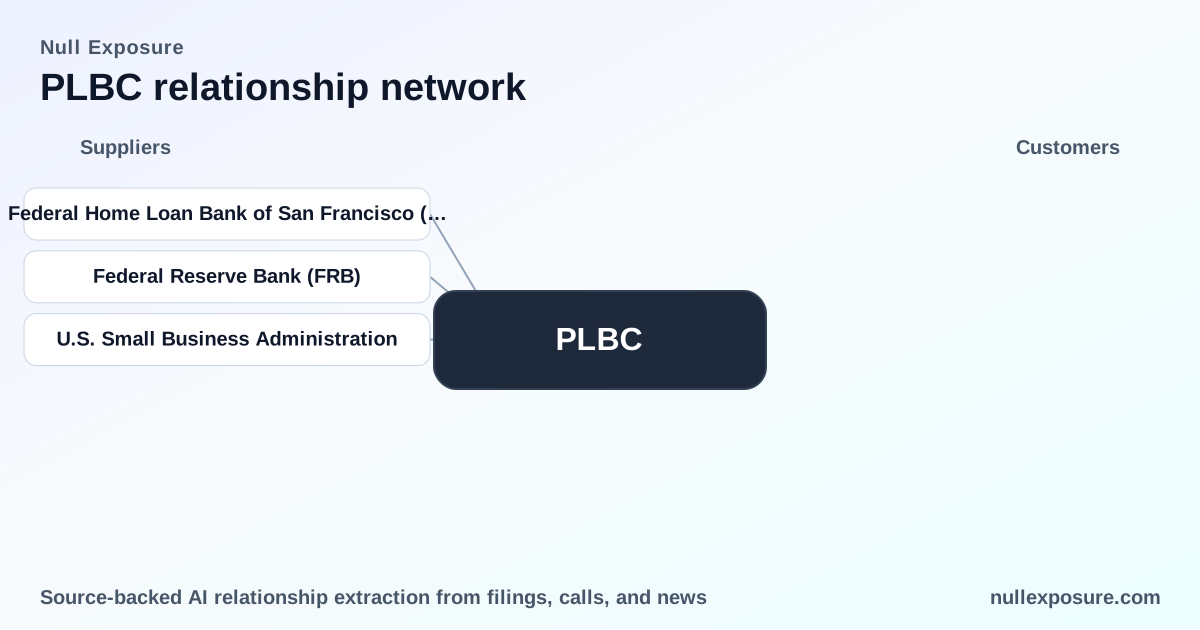
Plumas Bancorp (PLBC): Supplier relationships that shape liquidity and lending capacity
Plumas Bancorp operates as the holding company for Plumas Bank, a regional community bank focused on small and medium-sized businesses and individuals across Northeast California and Northwest Nevada. The company monetizes through net interest margin on a conservative loan book, fee income from commercial services, and targeted investment activity, while relying on external liquidity and federal relationships to manage balance-sheet flexibility. This note focuses on supplier and counterparty relationships that materially influence funding access, collateral channels, and SBA lending flow for investors and operators evaluating PLBC exposure.
For an at-a-glance vendor intelligence platform that tracks these relationships across filings and press releases, visit https://nullexposure.com/.
Why these counterparties matter to investors
Plumas is a small regional bank with $340.9M market capitalization, a tangible loan collateral base and meaningful membership in system liquidity providers. Counterparty arrangements underpin funding optionality, collateral pledging, and preferred-lender positioning for SBA-originations — all of which affect capital efficiency and earnings volatility. Below I catalog every relationship noted in public disclosures and summarize what each means for execution and risk.
Complete relationship inventory (each result from the record)
The following covers every relationship mention returned in the supplier-scope results.
Federal Home Loan Bank of San Francisco (FHLB) — entry 1
Plumas Bancorp is a member of the Federal Home Loan Bank of San Francisco and has borrowing capacity up to $400 million secured by mortgage loans with carrying values of $659 million, providing a large committed source of collateralized funding. This is drawn from the company’s FY2026 earnings release on GlobeNewswire (January 21, 2026).
Federal Reserve Bank (FRB) Discount Window — entry 2
The company is eligible to borrow at the Federal Reserve Bank Discount Window, giving Plumas an additional short-term liquidity backstop for stress events or intraday funding needs, as stated in the FY2026 GlobeNewswire earnings release (January 21, 2026).
Federal Home Loan Bank of San Francisco (FHLB) — entry 3 (duplicate disclosure)
The FY2026 press release repeats that Plumas is an FHLB member with up to $400 million borrowing capacity secured by commercial and residential mortgage loans totaling $659 million in carrying value (GlobeNewswire, January 2026). This duplicate mention underscores the prominence of the FHLB facility in the company’s funding narrative.
Federal Reserve Bank (FRB) Discount Window — entry 4 (duplicate disclosure)
A second citation in the FY2026 earnings communication restates Plumas’ eligibility at the FRB Discount Window (GlobeNewswire, January 2026), reinforcing that the bank highlights multiple formal liquidity channels in public reporting.
U.S. Small Business Administration — entry 5
Plumas Bank is designated as a Preferred Lender with the U.S. Small Business Administration, enabling more direct SBA loan approvals and faster credit adjudication across seven Western states, a point noted in a February 6, 2026 UtahBusiness profile announcing an executive appointment. This status supports fee income and origination volume for small-business lending.
How the operating model is constrained and structured
Investors should evaluate these supplier relationships alongside company-level constraints that shape contract posture, concentration and maturity.
- Contracting posture: Plumas shows a mixed posture — long-term structural commitments exist for real estate leases (evidence cites initial 15-year lease terms with renewal options), indicating capital allocation toward branch and fixed-location stability. At the same time, the bank makes use of short-term liquidity programs (e.g., BTFP-style one-year loan facilities as described) to manage interest-rate and balance-sheet timing mismatches.
- Criticality and concentration: FHLB membership and FHLB borrowing capacity are critical to Plumas’ liquidity management given the scale of secured borrowing relative to the institution. The FRB Discount Window is a secondary but important contingency facility. SBA Preferred Lender status is strategically critical for originations but less so for day-to-day liquidity.
- Maturity and tenor mix: The constraint excerpts show a blend of long-term real estate lease commitments and short-term liquidity instruments, indicating the bank runs a maturity ladder that balances fixed operational commitments with flexible funding tools.
- Relationship role: Company-level disclosures confirm Plumas acts as a buyer in securities markets (notably $120M purchased in late 2023–March 2024), signaling active portfolio management in the investment book that affects interest income and available collateral.
These operating characteristics point to a bank that relies on secured borrowing and federally backed facilities for optionality, while simultaneously investing and originating SBA business to diversify revenue.
For deeper supplier mapping and exposure overlays, see https://nullexposure.com/.
Risk and opportunity implications for operators and investors
- Liquidity resilience: The combination of $400M FHLB access and FRB Discount Window eligibility materially reduces tail liquidity risk for a bank of this size, lowering the probability of emergency funding scenarios that threaten operations.
- Collateral leverage and concentration: Because FHLB advances are secured by mortgage assets (carrying value cited at $659M), shifts in mortgage valuations or credit performance could constrain borrowing capacity and increase funding cost volatility.
- Earnings sensitivity: Active buying of investment securities and a concentrated regional loan book make NIM and asset-liability management the drivers of near-term earnings; quarterly revenue growth and profit margins are currently favorable, but investor attention should be on interest-rate path and prepayment/valuation dynamics.
- Operational flexibility vs. footprint lock-in: Fifteen-year lease terms signal commitment to branch infrastructure, which supports local customer relationships but limits rapid branch rationalization if deposit migration accelerates toward digital channels.
Practical recommendations for relationship monitoring
- Track FHLB borrowing utilization and pledged collateral mix quarterly; utilization trends are an early warning for funding stress.
- Monitor securities purchases and investment yields for indications of balance-sheet repositioning; the company disclosed $120M of purchases with a 5.25% tax-equivalent yield (transaction period Dec 2023–Mar 27, 2024).
- Verify ongoing SBA Preferred Lender activity and approval throughput to assess fee-income sustainability and credit quality across small-business portfolios.
Explore supplier relationship dashboards and historical disclosure timelines at https://nullexposure.com/ to automate monitoring and scenario signals.
Bottom line — what investors should take away
Plumas Bancorp operates with a prudent liquidity architecture anchored to FHLB and FRB access, while leveraging Preferred Lender status to generate originations. The bank’s business model is a balance of long-term operational commitments and short-term funding flexibility; FHLB capacity and SBA status are the two highest-impact external relationships for valuation and risk analysis. For active investors and bank operators, the priority is monitoring collateral values, borrowing utilization, and SBA loan performance to anticipate funding cost and credit-risk inflection points.
To compare these supplier relationships across regional banks and build exposure scenarios, visit https://nullexposure.com/.