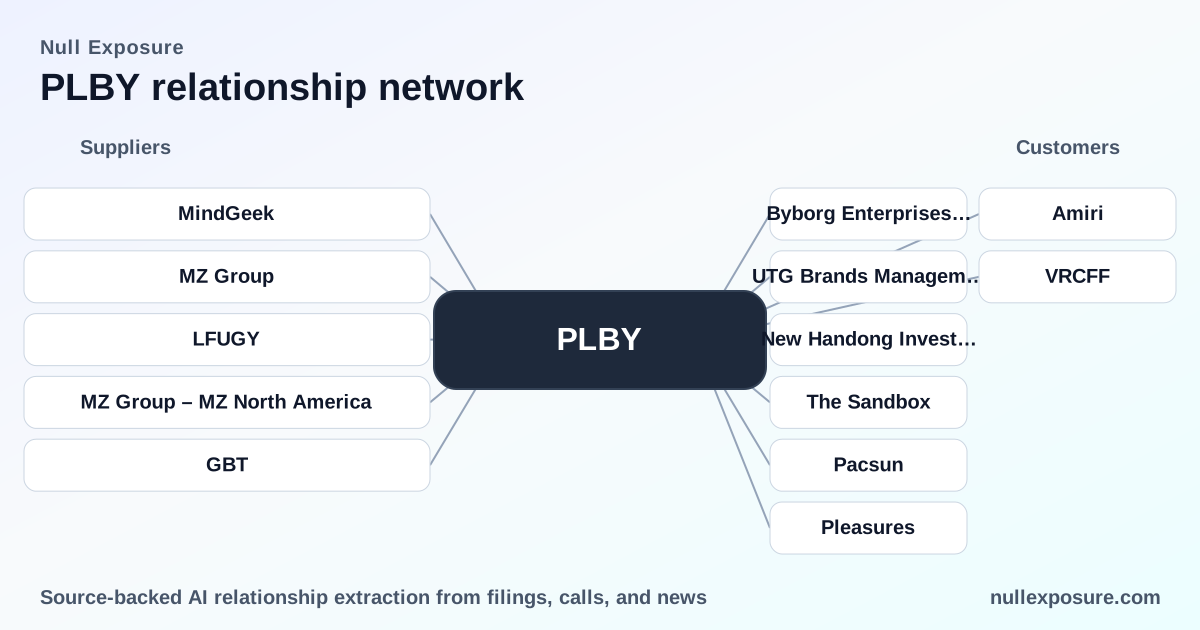
PLBY supplier map: who empowers Playboy’s brand and where investor risk concentrates
PLBY Group monetizes the Playboy brand through licensing, media distribution, subscriptions and strategic partnerships: the company licenses consumer products and content, operates branded media channels and sells subscription services via third parties, and uses third-party specialists for investor relations and regional merchandising. Revenue is partner-driven rather than vertically integrated; profitability depends on the economics of licensing and the performance of distribution partners. For investors and operators, the core takeaway is simple: PLBY is an asset-light brand owner whose margins and cash flow profile hinge on third-party execution and contract terms. Learn more about supplier intelligence and relationship risk at https://nullexposure.com/.
What this supplier list tells you in one line
PLBY runs a partner-first operating model: critical customer touchpoints and regional distribution are outsourced, while the company preserves brand control and takes a revenue-share or licensing fee upstream.
Direct supplier relationships you should track
MindGeek
Playboy’s digital assets and subscription TV channels are operated by MindGeek according to public advocacy reporting, making MindGeek a de facto digital-distribution operator for the brand; this places the company’s direct-to-consumer subscription economics and user experience in a partner’s hands. Source: Collective Shout investor memo referencing publicly available information on MindGeek’s operation of Playboy digital assets (FY2022) — https://www.collectiveshout.org/our_message_to_playboy_investors.
MZ Group
PLBY engaged MZ Group to lead strategic investor relations and financial communications across key markets, indicating a deliberate outsourcing of shareholder communications to a specialist firm to professionalize market-facing messaging. Source: GlobeNewswire press release announcing the engagement of MZ Group for investor relations (Feb 12, 2026) — https://www.globenewswire.com/news-release/2026/02/12/3237210/0/en/playboy-engages-mz-group-to-lead-strategic-investor-relations-and-shareholder-communications-program.html.
MZ Group – MZ North America
PLBY’s contact details for investor relations list MZ North America and a named Managing Director, confirming a North America operational footprint for the retained IR firm and a direct channel for investor outreach. Source: GlobeNewswire and Yahoo Finance references to MZ North America investor relations contact details (Feb 2026) — https://www.globenewswire.com/news-release/2026/02/26/3245609/0/en/Playboy-Appoints-David-Miller-as-President-Media-Brand.html and https://finance.yahoo.com/news/playboy-appoints-david-miller-president-133100563.html.
Li & Fung
PLBY disclosed a restructuring of its China partnership with a Li & Fung subsidiary to a revenue-based model, aligning incentives between the brand owner and the regional operator and shifting performance risk onto the partner’s ability to monetize local channels. Source: PLBY Q3 2025 earnings call commentary on the China partnership restructuring (2025Q3) — plby-2025q3-earnings-call.
Global Blockchain Technologies (GBT)
PLBY litigated against Global Blockchain Technologies over an NFT initiative, alleging fraud and contract breach—this episode signals operational and counterparty risk when PLBY ventures into nascent blockchain or crypto-enabled product lines. Source: reporting on the dispute and alleged losses related to the NFT program (FY2023) — https://protos.com/playboy-loses-5m-on-ethereum-earned-from-nft-sales/.
Company-level operating constraints and business-model signals
- Partner-dependent contracting posture. PLBY runs an asset-light, licensing-forward model that outsources significant customer-facing functions and regional execution to specialists and distributors. This lowers fixed cost but concentrates execution risk off-balance-sheet.
- Revenue concentration sensitivity. Given PLBY’s monetization through licensing and revenue-share arrangements, swings in partner performance or contract terms directly affect reported revenue and margins; investors should treat partner performance as a primary revenue driver.
- Contract maturity and renegotiation frequency. The move to revenue-based contracts (company-level signal) suggests PLBY actively re-contracts partners to shift risk or align incentives; that posture reduces short-term capex but increases contractual complexity.
- Operational criticality and reputational leverage. Outsourcing investor relations and digital distribution gives PLBY professional controls in some areas (IR) while ceding control in others (content delivery and blockchain initiatives). Expect reputational exposure when third parties operate core consumer touchpoints.
- Scale and capital posture. With modest market capitalization and negative EPS, PLBY relies on partner networks to scale internationally rather than heavy internal investment.
What investors and operators should watch next
- Contract terms and renewal cadence. Focus diligence on the length, termination rights, and revenue-sharing mechanics in major partner contracts; those terms drive cash-flow stability more than headline growth metrics.
- Geographic execution in China and other priority regions. The restructured China arrangement (revenue-based) is a bellwether—if the partner underperforms, revenue volatility will increase in PLBY’s regional P&L.
- Control over digital distribution. MindGeek’s operational role over digital assets concentrates subscriber economics outside PLBY. Monitor subscriber metrics and any service-level or commercial disputes that could disrupt DTC receipts.
- Non-core experiments and legal exposures. The dispute with Global Blockchain Technologies illustrates execution risk when PLBY tests new monetization channels; legal and reputational fallout can be material relative to PLBY’s scale.
For investors building supplier risk models or operators negotiating contracts, centralized intelligence on partner terms materially improves valuation accuracy—explore deeper supplier analytics at https://nullexposure.com/.
Practical implications for portfolio and procurement teams
- Treat major partners as quasi-subsidiaries for valuation: a large outsourcing partner that controls distribution is functionally equivalent to an operating division for cash-flow forecasting.
- Prioritize contract clauses that protect revenue (minimum guarantees, audit rights, termination triggers) when negotiating or re-negotiating relationships.
- Maintain active oversight of PR/IR and digital operations: outsourced investor relations reduces market miscommunication risk, but outsourced content distribution transfers operational risk.
If you manage capital exposed to PLBY or negotiate against the Playboy brand, the best next step is primary-source diligence on contract language and recent earnings commentary—Null Exposure provides that supplier-level intelligence and contract mapping at https://nullexposure.com/.
Bottom line
PLBY’s business model scales the Playboy brand through partners rather than internal heavy lifting. That structure preserves upside and low fixed costs but concentrates execution and reputational risk in a handful of suppliers. For investors, contract economics and partner performance are the primary drivers of value; for operators, negotiating protective commercial terms is the clearest way to reduce downside.