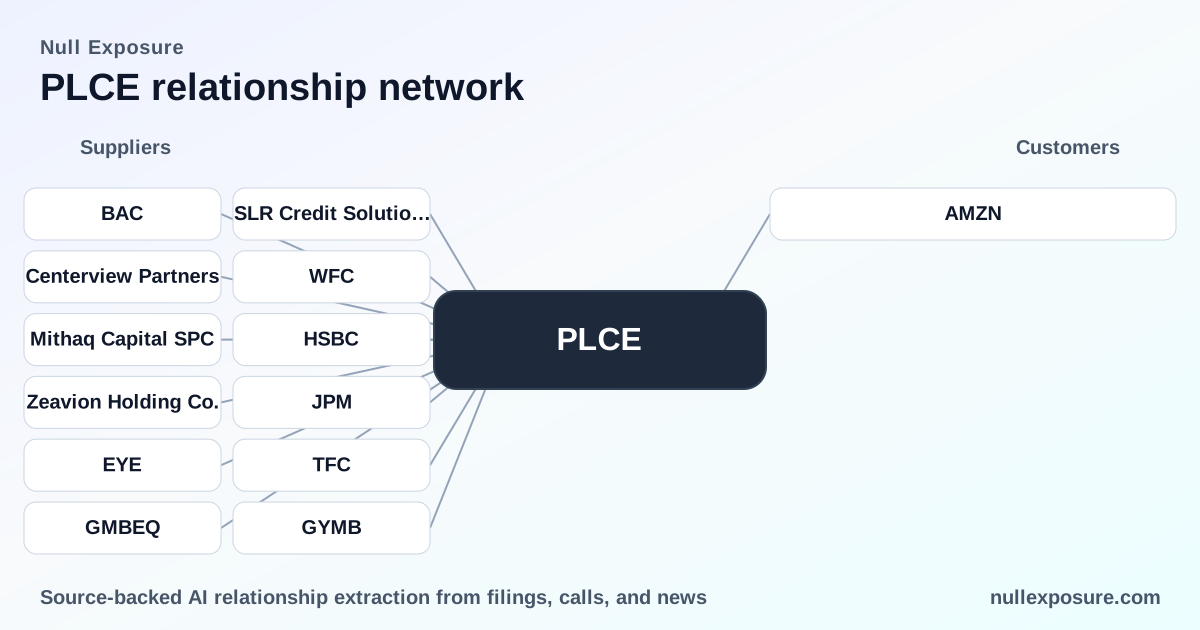
Children’s Place (PLCE): Lenders, Brands and the Supply Chain That Will Decide the Next Chapter
Thesis — Children’s Place operates as a specialty apparel retailer that designs proprietary children’s apparel, outsources manufacturing overseas, and monetizes through retail sales and brand licensing, with the balance sheet now underwritten by a concentrated set of lenders and short-term financing arrangements that determine liquidity and strategic optionality. For investors and operators, the company’s operational leverage is driven less by same-store retail execution and more by the stability of financing, vendor relationships in APAC, and the economics of its owned brands. For deeper counterparty intelligence, visit https://nullexposure.com/.
Why financing relationships are the immediate value driver
Children’s Place has restructured its capital structure several times in recent years; financing counterparties now represent the most material relationships for equity holders and suppliers. A $350 million asset-based lending facility and a $100 million FILO term loan together create the immediate liquidity runway, and those two arrangements change the company’s covenant profile and repayment priorities.
- According to the company’s Q3 2025 press release distributed in March 2026, Children’s Place completed a $350 million asset-based lending credit facility with Wells Fargo and a $100 million FILO term loan with SLR Credit Solutions, establishing the current secured credit profile. (Press release, March 2026)
- A contemporaneous news summary also reported SLR Credit Solutions as the provider of the $100 million senior secured term loan. (Financial news coverage, March 2026)
For tracking and scenario planning on counterparties and liquidity, see https://nullexposure.com/ for structured summaries.
Who the counterparties are — what each relationship means
Below are concise, plain-English descriptions of every counterparty mentioned in public reporting and filings, with source context.
Wells Fargo
Wells Fargo is the lead agent on a $350 million asset-based lending commitment that serves as the company’s primary working-capital facility, and the bank led the refinancing effort reported in late 2021 and updated in Q3 2025. According to an investor release, the facility is the centerpiece of the company’s secured financing. (Company press release/Globe and Mail, Q3 2025; GlobeNewswire refinancing announcement, Nov 2021)
SLR Credit Solutions
SLR Credit Solutions provided a $100 million FILO (first-in-last-out) term loan augmenting the ABL facility, creating structured priority in the capital stack and adding incremental liquidity. Market coverage noted the $100 million senior secured term loan in March 2026. (Financial news coverage, March 2026)
Mithaq Capital SPC
Mithaq Capital SPC provided an unsecured commitment letter that added $40 million of availability to increase total liquidity to approximately $93.4 million as disclosed in the Q3 2025 results. This is an unsecured backstop that supplements bank lenders. (Company press release/Globe and Mail, Q3 2025)
Centerview Partners
Centerview Partners is serving as a financial adviser in the company’s review of strategic alternatives and financing options, indicating management is actively engaging sell-side advisory resources to shore up liquidity or explore transactions. This engagement was reported in coverage of FY2024 funding efforts. (CoStar news report, 2024)
Bank of America
Bank of America participated as an affiliate in the multi-bank lending group that refinanced the company’s revolving credit facility and term loan in the 2021 refinancing. The bank is part of the institutional lender syndicate supporting secured facilities. (GlobeNewswire refinancing announcement, Nov 2021)
JP Morgan
JP Morgan was listed among the affiliates in the 2021 refinancing syndicate, indicating the company’s historical access to a diversified bank group for secured borrowings. (GlobeNewswire refinancing announcement, Nov 2021)
Truist
Truist Bank was also an affiliate in the 2021 refinancing lending group, reflecting multi-bank distribution of secured exposure at that time. (GlobeNewswire refinancing announcement, Nov 2021)
HSBC
HSBC was named as a participant in the 2021 lending group that refinanced the revolving credit facility and term loan, providing international banking exposure within the syndicate. (GlobeNewswire refinancing announcement, Nov 2021)
EY
EY served as the company’s adviser on the 2021 refinancing, pointing to use of large professional-services firms for transaction execution and due diligence on credit agreements. (GlobeNewswire refinancing announcement, Nov 2021)
Gymboree Group Inc. (and Gymboree brand relaunch)
Children’s Place acquired the Gymboree and Crazy 8 brands in 2019, buying the rights for $76 million and planning a relaunch via the retailer’s own channels and shop-in-shops in over 200 stores; Gymboree’s brand acquisition expanded Children’s Place’s product portfolio. (USA Today coverage and GlobeNewswire announcement, March–October 2019)
Zeavion Holding Co.
As part of the Gymboree purchase process, Children’s Place assumed a contract with Zeavion Holding Co., which had acquired Gymboree’s Play & Music business in 2016. This contractual assumption was disclosed in the bankruptcy sale filings at the time of acquisition. (USA Today/bankruptcy court filings, March 2019)
What the supplier constraints tell you about the operating model
Children’s Place presents several company-level operating characteristics that drive supplier and counterparty risk:
- Contracting posture: multi‑year vendor relationships. The company states it has strong, multi-year relationships with the substantial majority of vendors, signaling predictable procurement cycles and negotiation leverage with longstanding suppliers.
- Geographic concentration of supply: APAC sourcing exposure. The company imports a vast majority of merchandise from Bangladesh, Vietnam, India, Kenya, Ethiopia, China, and Indonesia, which creates geopolitical and logistics concentration risk under any global disruption.
- Role and supply model: contract manufacturer network. Children’s Place designs and contracts for manufacture rather than owning factories, indicating reliance on third-party manufacturers and the purchasing terms those vendors require.
- Service partnerships: third‑party warehousing used for international franchises. The firm uses third-party warehousing and logistics in Malaysia and China to support its international franchise business, which is material for fulfillment and franchise economics.
These company-level signals define supplier negotiation dynamics, logistics vulnerability and cost volatility — all of which are central to creditworthiness and margins.
For a concise, interactive map of these relationships, visit https://nullexposure.com/.
Investment implications — what to watch next
- Liquidity is the short‑term control variable. The ABL with Wells Fargo plus the FILO with SLR create the immediate runway; any deterioration in receivables or inventory advance rates will tighten availability and push the company to its advisers and stress scenarios.
- APAC sourcing and outsourced manufacturing are operational levers. Currency, freight, and tariff moves will flow directly to margins; vendors with multi‑year contracts reduce volatility but do not eliminate input risk.
- Brand assets and M&A optionality are directional. Acquisitions like Gymboree expand addressable categories, but brand turnarounds require sustained investment and stable financing.
If you are evaluating counterparty exposure or preparing a supplier/credit risk memo, start with the lender and brand relationships above and the company-level constraints that determine operational flexibility. For targeted counterparty profiles and scenario-based risk modeling, go to https://nullexposure.com/.
Bottom line: Children’s Place is a design-and-retail operator whose near-term value hinges on financier support and the stability of Asia-based manufacturing relationships. Lenders have the practical leverage; operators and suppliers should model outcomes under constrained liquidity and changing inventory dynamics.