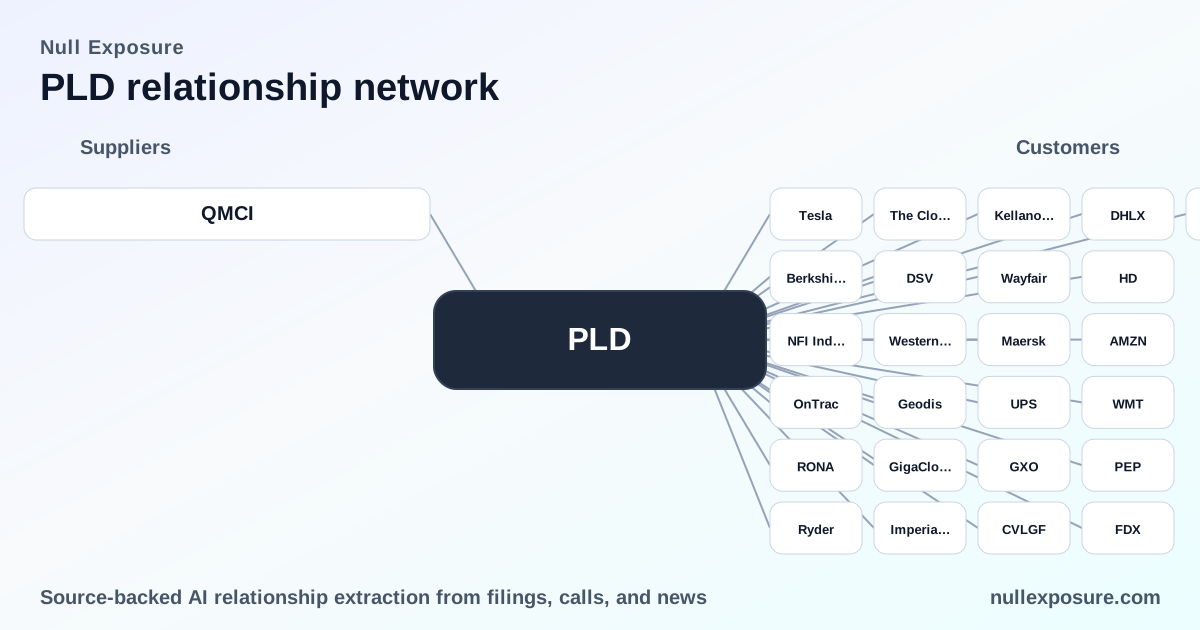
Prologis (PLD) — supplier relationships that shape capital access and operational resilience
Prologis monetizes logistics real estate by owning and leasing distribution and fulfillment properties to retailers, third-party logistics providers, and corporations global in scale, generating cash flow from rents and recurring fees and supporting that cash flow with active capital markets access through debt and equity financings. Investor focus should be on how Prologis wires its capital stack and secures critical services—underwriters, trustees, and market-data providers all play discrete roles in funding cost, covenant structure, and disclosure quality. For an institutional view of counterparty exposure and supplier health, review the documented partner list below and the firm-level controls that govern those interactions. Learn more at https://nullexposure.com/.
Why suppliers and capital partners matter for a REIT like Prologis
Prologis operates as an industrial REIT with high operating leverage and a capital-intensive balance sheet. Its ability to refinance debt, price new securities, and preserve liquidity depends on relationships with wholesale banks and trustees; its investor communications and market transparency are supported by market-data vendors. Underwriter depth and trustee reliability are not peripheral — they directly affect refinancing windows, interest cost, and legal enforceability of debt instruments. Prologis’s FY2026 financial profile shows robust profitability and scale, but the execution risk around capital-raising events and third-party service continuity remains a primary supplier-related focus.
Recent supplier relationships disclosed in filings and press coverage
The following relationships are drawn from Prologis disclosures and market reports in FY2026. Each entry is a concise, plain-English summary with the original source noted.
Major underwriting syndicate: BofA Securities, Inc.
BofA Securities is listed among the underwriters for Prologis LP’s recent notes offering, indicating the bank’s role in deal distribution and primary-market price discovery for the issuer. According to an Investing.com report on May 3, 2026, BofA was a named underwriter for the transaction.
Major underwriting syndicate: J.P. Morgan Securities LLC
J.P. Morgan Securities served as an underwriter on the same notes issuance, participating in bookrunning and placement functions that affect execution quality and investor reach. This participation is reported by Investing.com (May 3, 2026).
Major underwriting syndicate: HSBC Securities (USA) Inc.
HSBC Securities (USA) is included in the underwriting group for Prologis’s FY2026 notes, providing additional distribution channels, particularly for international institutional investors. The underwriting listing appears in Investing.com coverage dated May 3, 2026.
Major underwriting syndicate: ING Financial Markets LLC
ING Financial Markets is named as an underwriter on the offering, extending Prologis’s access to European and specialty fixed-income desks that support cross-border demand. This is reported by Investing.com on May 3, 2026.
Major underwriting syndicate: Scotia Capital (USA) Inc.
Scotia Capital (USA) joins the syndicate, further diversifying the underwriting base and helping stabilize pricing and liquidity for the note sale. The inclusion is captured in Investing.com reporting from May 3, 2026.
Major underwriting syndicate: TD Securities (USA) LLC
TD Securities is also a participating underwriter on the transaction, contributing to syndicate scale and retail/institutional placement capability. Investing.com lists TD Securities among the underwriters on May 3, 2026.
Trustee role: U.S. Bank Trust Company, National Association
U.S. Bank Trust Company, National Association is named as the trustee under the indenture governing the notes, a legally critical role for bond administration, covenant enforcement, and investor communications under the June 8, 2011 indenture. Investing.com referenced the trustee role in its May 3, 2026 report.
Market-data and disclosure provider: QuoteMedia / QMCI
Prologis’s investor relations materials reference QuoteMedia (QMCI) for market data and presentation of financial release content, supporting timely public disclosure and presentation formatting. A Prologis press release dated March 10, 2026 cites QuoteMedia and QMCI as market-data providers powering release content.
What these relationships imply about Prologis’s operating posture
The pattern of counterparties is informative for counterpart risk evaluation:
- Contracting posture: Prologis contracts with global, highly rated financial institutions for underwriting and a major trustee for indentures, indicating a formal, institutional approach to capital markets execution and legal safeguards.
- Concentration: The underwriting group is broad across several global banks, which reduces single-counterparty concentration risk for primary-market placements; the presence of a single named trustee is standard and creates a concentrated operational dependence on that institution for indenture administration.
- Criticality: Underwriters are critical at issuance windows; the trustee is critical on legal and administrative continuity for outstanding notes. Market-data providers are critical to disclosure mechanics and investor access to timely information.
- Maturity: These relationships reflect established capital-market practices and ongoing use of incumbent providers, signaling an operationally mature approach rather than ad-hoc sourcing.
Prologis also communicates that its integrated risk-management framework extends to third-party service providers with protocols to mitigate cybersecurity and supply-chain incident risks—a company-level control signal that strengthens governance of external relationships (evidence cited in Prologis disclosures in FY2026).
Investment implications and risk checklist
- Funding flexibility is supported by a diversified underwriting syndicate. That limits execution risk in normal market conditions and supports access to demand across investor segments.
- Operational dependency on a single trustee is standard but material. Trustee continuity and contract terms should be monitored around covenant amendments and complex indenture events.
- Third-party cyber and service risk is acknowledged and governed. Prologis’s formal protocols for service providers reduce the probability of service failures, but operational resilience requires ongoing verification and testing.
- Disclosure fidelity is supported by market-data providers. QuoteMedia’s role in investor releases preserves market transparency, which is important for liquidity and valuation discovery.
For a deeper, structured assessment of counterparty exposure across the capital stack and supplier roster, institutional users can review the original filings and press reports cited above and cross-check with trustee and underwriter engagement clauses.
Explore further analysis and supplier profiles at https://nullexposure.com/.
Final takeaways for investors and operators
- Capital execution is decentralized across several global underwriters, reducing placement risk at issuance.
- Legal and operational continuity concentrates on the trustee; verify contract terms for key-event triggers.
- Governance extends to third-party cyber controls, indicating Prologis treats supplier risk as material to enterprise risk management.
These supplier relationships do not merely support transactions; they shape cost of capital, covenant resilience, and disclosure reliability—three pillars that determine NAV trajectories and earnings durability for an industrial REIT of Prologis’s scale.