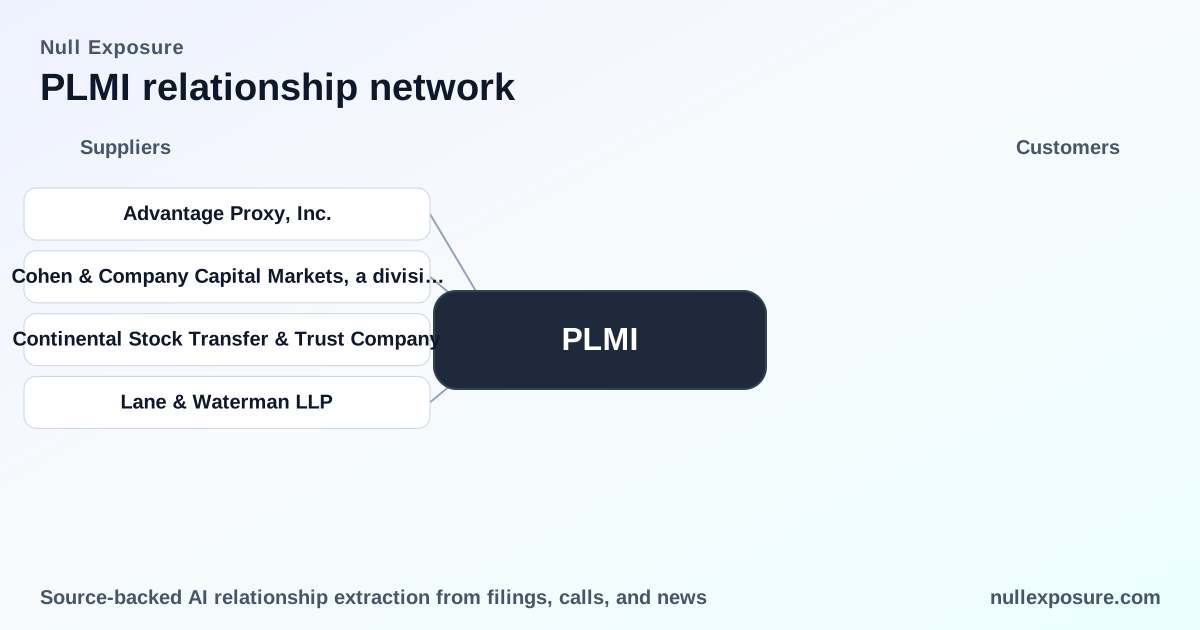
PLMI Supplier Map: What Plum Acquisition Relies On and How it Impacts Investors
Thesis — Plum Acquisition (PLMI) operates as a transaction-focused vehicle that generates value through sponsor activity, capital raised in public markets, and completed merger transactions; its economics are concentrated on deal execution rather than recurring operating revenue, which makes third-party advisors, transfer agents and legal counsels pivotal to value realization and investor outcomes. Understanding who PLMI contracts with, the role those suppliers play, and the contracting posture implied by their relationships is essential for underwriters, counterparties and buy-side analysts evaluating execution risk and sponsor alignment. For a deeper supplier-risk profile and monitoring, visit the NullExposure hub: NullExposure homepage.
Why supplier mapping matters to PLMI investors
PLMI’s business is event-driven: successful mergers or deal cancellations directly determine shareholder returns and sponsor compensation. Advisor and agent relationships are therefore operationally critical—they influence timing, disclosure quality, proxy mechanics and capital flow. A small set of specialized suppliers creates concentration risk and operational single points of failure; conversely, established providers signal a mature contracting posture and access to market expertise.
- Contracting posture: Use of well-known financial, legal and transfer agents indicates a conservative, market-standard approach to transaction execution.
- Concentration and criticality: The supplier list is short and targeted—each counterparty performs a high-leverage function in a finite time window.
- Maturity signal: Engaging recognized transfer agents and law firms suggests the sponsor is following standard SPAC governance and disclosure mechanics rather than bespoke structures.
If you want a structured supplier risk brief for portfolio decisions, see our analysis at NullExposure homepage.
The parties that executed PLMI’s FY2023 transaction work
Below are the supplier relationships identified in recent reporting for the FY2023 period associated with Plum’s transaction activity. Each relationship is summarized in plain English with the source cited.
Advantage Proxy, Inc.
Advantage Proxy served as the information agent to Plum in the referenced transaction, a role that centralizes dissemination of shareholder materials and vote solicitation logistics. According to a Marketscreener news report covering FY2023 transaction updates, Advantage Proxy was listed as the information agent to Plum (Marketscreener, March 10, 2026: https://www.marketscreener.com/quote/stock/PLUM-ACQU-122419583/news/Sakuu-Corporation-cancelled-the-acquisition-of-Plum-Acquisition-Corp-I-from-Plum-Partners-LLC-and-44136519/).
Cohen & Company Capital Markets (division of J.V.B. Financial Group, LLC)
Cohen & Company Capital Markets acted as Plum’s exclusive financial advisor for the transaction, positioning the firm as the lead arranger and advisor on valuation, deal structure and market-facing communications. The same Marketscreener article lists Cohen & Company Capital Markets as exclusive financial advisor for Plum in FY2023 (Marketscreener, March 10, 2026 — link above).
Continental Stock Transfer & Trust Company
Continental Stock Transfer & Trust Company functioned as the exchange agent, responsible for handling share exchanges, processing redemptions and managing the mechanics of shareholder transactions. Marketscreener identified Continental Stock Transfer & Trust as the exchange agent to Plum in the FY2023 transaction notice (Marketscreener, March 10, 2026 — link above).
Lane & Waterman LLP
Lane & Waterman LLP provided legal counsel—specifically, C. Dana Waterman III was noted as Plum’s legal advisor—covering regulatory filings, corporate governance and transactional documentation. The Marketscreener report for FY2023 names C. Dana Waterman III of Lane & Waterman LLP as Plum’s legal advisor (Marketscreener, March 10, 2026 — link above).
What these relationships collectively reveal about PLMI’s operating model
These supplier selections form a coherent picture: PLMI contracts established advisory, legal and transfer agents consistent with standard SPAC execution workflows, emphasizing predictable external expertise over in-house transaction capabilities. From an investor and operator perspective, the implications are:
- High operational dependency on a few firms for discrete functions—information/solicitations (Advantage Proxy), deal advisory (Cohen & Company), transfer mechanics (Continental), and legal/compliance (Lane & Waterman).
- This structure reflects a transactional contracting posture: suppliers are engaged for a clearly scoped deal lifecycle rather than ongoing platform services.
- The choice of recognized providers signals a maturity and governance alignment with public-market expectations; that reduces idiosyncratic execution risk but does not eliminate timing or regulatory risk inherent to SPAC deals.
- Concentration risk is non-trivial: failures or delays at any of these nodes would directly affect shareholder votes, redemption windows and closing logistics, with downstream effects on liquidity and valuation.
Constraints and company-level signals
No supplier-level constraints were reported in the available FY2023 disclosures. At the company level, the absence of explicit constraint excerpts is itself a signal: public reporting focused on role assignments rather than detailed contractual terms, so investors should assume standard commercial arrangements unless later filings disclose exclusivity, fee schedules, or special indemnities.
Practical considerations derived from this signal:
- Expect commercial-fee-based relationships (advisory, legal, transfer) rather than equity-compensated arrangements unless otherwise disclosed.
- Due diligence should prioritize contract terms affecting timeline control (termination rights, performance SLAs) because these govern critical path execution for SPAC closings.
- Monitor future filings for fee disclosures and related-party notes that could alter incentive alignment.
Investment implications and risk checklist
For underwriting and portfolio managers, the supplier map emphasizes two investment priorities:
- Execution risk monitoring: Track proxy timelines, exchange agent notices and advisor updates closely; these documents are leading indicators for transaction completion or cancellation.
- Counterparty health: Assess the operational capacity and reputations of the listed providers—transfer-agent backlogs or legal bottlenecks can cascade into shareholder redemption pressure.
If your team needs a tailored counterparty risk brief or portfolio scoring based on supplier concentration, start here: NullExposure homepage.
Bottom line
PLMI’s FY2023 supplier roster reads as a conventional SPAC execution team: financial advisor, legal counsel, exchange agent and information agent. That composition reduces novelty risk and signals adherence to market norms, but also concentrates critical operational functions into a small set of counterparties. Investors should treat supplier monitoring as an integral part of event-driven risk management—watch proxy solicitations, transfer-agent communications and advisor disclosures for the earliest signs of execution friction.
For direct access to investor-grade supplier analyses and continuous monitoring, visit the NullExposure research portal: NullExposure homepage.