PLMK (Plum Acquisition Corp. IV) — supplier relationships and what they mean for investors
Plum Acquisition Corp. IV is a special-purpose acquisition company that monetizes through sponsor economics, underwriting economics on its IPO units, and value creation when it completes a business combination with a target technology company. The company carries no operating revenue and derives value from cash held in trust, sponsor financing, deferred underwriting economics, and the success of an eventual merger that converts those trust dollars into operating cash flow for a combined entity. For investors and counterparties, the economics and execution hinge on short-term financing posture, underwriter arrangements, and the mechanics of unit separation and listing. Learn more at https://nullexposure.com/.
How supplier relationships reveal the SPAC operating model
Supplier and service-provider relationships in a SPAC are not peripheral — they are the plumbing that enables an IPO, a separation of units, and ultimately a deal close. For PLMK, the available records show a classic SPAC supplier stack: underwriters that took upfront and deferred economics, a transfer agent that administers the unit separation, and a public market (Nasdaq) that provides liquidity and a listing platform. These relationships underline three operating model characteristics:
- Contracting posture — short-term, transaction-focused. PLMK relies on short-dated obligations such as an unsecured promissory note to its Sponsor that is repayable on the earlier of a fixed date or the consummation of the IPO; as of December 31, 2024, $149,473 remained outstanding. This structure signals a working-capital posture driven by immediate execution needs rather than long-term operational contracts.
- Concentration and criticality — concentrated, high-criticality service providers. Underwriters and a transfer agent are central to PLMK’s ability to separate units, list shares, and realize deferred fees; without them, the SPAC cannot complete the mechanics that create tradable securities. These relationships are concentrated and operationally critical to transaction success.
- Maturity and compensation structures — fee-heavy and contingent. Underwriters received both cash and deferred fees that are payable from trust funds only upon completion of a business combination, and PLMK also discloses monthly consulting fees to management payable from working capital outside the trust. This compensation mix ties supplier economics to successful deal execution rather than recurring revenue.
These are company-level signals drawn from PLMK filings and press materials; they reflect a short-term, execution-intensive business model that depends on the timing and completion of a business combination rather than ongoing operating cash flows.
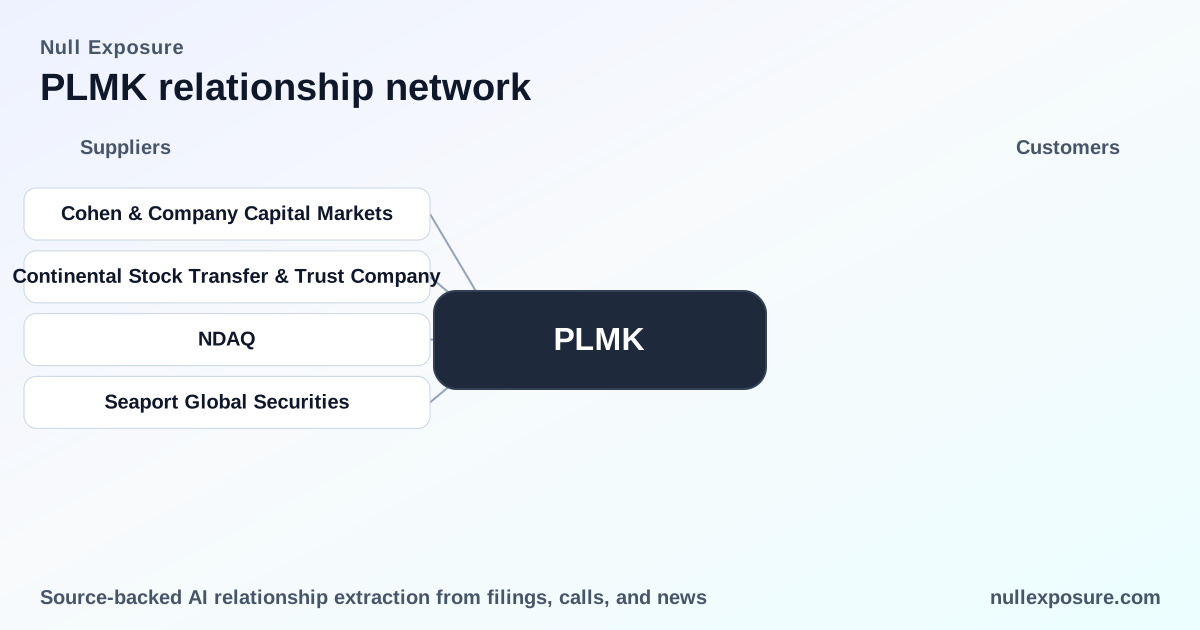
The four supplier relationships investors must track
Cohen & Company Capital Markets — lead book-running manager
Cohen & Company Capital Markets acted as the lead book-running manager for PLMK’s public offering, which establishes them as the primary distribution partner responsible for placing units with institutional and retail buyers. According to a GlobeNewswire press release distributed through The Globe and Mail in FY2025, Cohen & Company received cash underwriting discounts and participated in deferred underwriting economics linked to deal completion.
Seaport Global Securities — joint book runner
Seaport Global Securities served as a joint book runner on the offering and shared in the underwriting discounts and deferred fees alongside the lead manager. The same GlobeNewswire release in FY2025 lists Seaport as a joint book runner, making them a co-provider of distribution and underwriting services that are materially tied to PLMK’s capital formation.
Continental Stock Transfer & Trust Company — transfer agent
Continental Stock Transfer & Trust Company is PLMK’s transfer agent and is responsible for the mechanics of separating Units into Ordinary Shares and Warrants; brokers must contact Continental to effect the separation. The GlobeNewswire announcement in FY2025 explicitly instructs holders and brokers to use Continental to execute unit separation, reflecting a critical operational role in shareholder recordkeeping and settlement.
Nasdaq (Nasdaq Global Market) — listing venue
PLMK’s Ordinary Shares and Warrants trade on the Nasdaq Global Market under the symbols PLMK and PLMKW respectively, giving investors a recognized venue for liquidity and price discovery. The GlobeNewswire release (FY2025) confirms Nasdaq as the trading venue, which is material for investor exit options and market visibility.
What these relationships mean for risk and execution
Investors must treat these supplier ties as more than administrative notes; they drive cash flows, timing, and deal incentives.
- Execution risk is front and center. Deferred underwriting fees are payable from trust funds only upon closing a business combination, so underwriter alignment is contingent on consummation, not the IPO itself — this creates asymmetric incentives around deal cadence and target selection.
- Short-term financing increases fragility. The existence of an unsecured promissory note to the Sponsor (non-interest bearing and repayable by a fixed date or upon IPO) and explicit monthly consulting payments to officers are signals of near-term liquidity management rather than long-dated capital support. That elevates counterparty sensitivity to timing.
- Operational criticality of counterparties. The transfer agent and the listing venue are non-substitutable in the short-term without administrative frictions; disruptions to those relationships would directly delay unit separation and trading, impacting investor liquidity.
- Concentration of supplier economics. Underwriters and sponsor-affiliated services capture a meaningful portion of pre- and post-IPO economics via cash discounts and deferred fees; those economics dilute eventual sponsor upside and are payable from the same trust that secures redemptions.
Quick investor checklist
- Verify the schedule and mechanics for the deferred underwriting fees and where they rank in trust-account disbursement priority.
- Confirm transfer-agent processes and record cut-off dates for unit separation to avoid mismatch risk on redemptions.
- Monitor sponsor financing cadence and any additional short-term borrowings or fee arrangements that signal funding stress.
- Track Nasdaq listing status and ticker activity (PLMK and PLMKW) as leading indicators of market liquidity and investor sentiment.
Midway action: for a concise supplier-risk due diligence playbook and ongoing monitoring, visit https://nullexposure.com/.
Bottom line
PLMK operates as a classic SPAC: no operating revenue, concentrated supplier relationships, and fee structures tied to a single execution event — the business combination. For investors and operators evaluating PLMK-related counterparty exposures, the key signals are short-term financing posture, deferred underwriting economics, and the operational centrality of the transfer agent and exchange listing. These are predictable features of the SPAC model, but they place a premium on timing, execution discipline, and clear alignment between sponsor, underwriters, and public-market mechanics.
For ongoing supplier-risk monitoring and actionable summaries tailored to institutional review, go to https://nullexposure.com/.