Palomar Holdings (PLMR): Counterparty map and what suppliers tell investors
Palomar underwrites specialized property and casualty risks and monetizes through underwriting margins, investment income, and disciplined use of reinsurance and bank financing to scale via acquisitions. Recent activity shows the company is using a mix of long‑dated reinsurance, catastrophe bond capacity, and a syndicated credit facility to finance the acquisition of Gray Surety and to protect balance‑sheet volatility—an operating model that amplifies underwriting returns while introducing counterparty and funding dependencies. For a deeper supplier‑level read on counterparties and contractual posture, visit https://nullexposure.com/.
What Palomar’s recent deals reveal about supplier posture
Palomar completed the acquisition of Gray Surety and simultaneously closed a $450 million credit package composed of a $150 million revolving facility and a $300 million term loan, arranged and documented by a syndicate of regional and national banks. That capital structure shows Palomar is willing to lean on bank financing for M&A while preserving working liquidity via a revolver. According to company announcements and press reporting in March 2026, the syndicate included U.S. Bank and KeyBank as joint lead arrangers and book runners, with JPMorgan and several large regional banks participating.
At the same time, Palomar maintains multi‑year indemnity reinsurance and catastrophe bond protection for earthquake risk—an explicit long‑term contracting posture that reduces P&L volatility but creates reliance on reinsurance counterparties and specialty capital. The company cites extensive use of third‑party licensed software and cloud services, indicating operational dependence on external technology vendors as well.
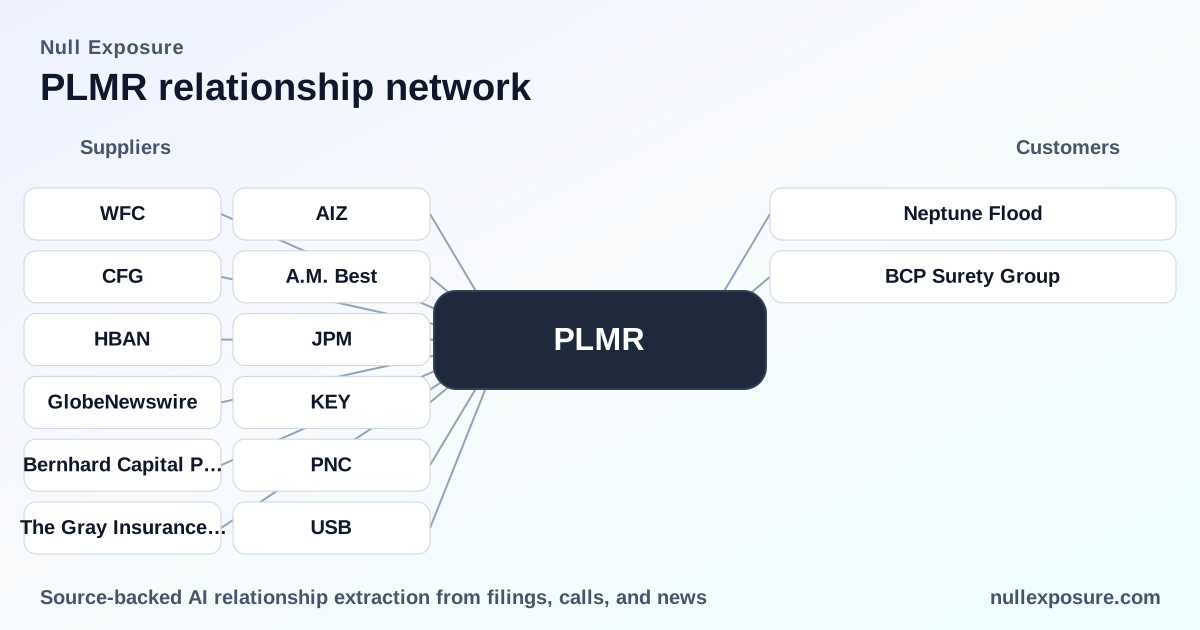
For an annotated map of counterparties and the reporting that links them to PLMR, see the relationship summaries below. If you want an enterprise‑grade supplier risk snapshot, check https://nullexposure.com/ for tailored reports.
The counterparties — concise, source‑backed takeaways
Assurant
Palomar renewed and placed an excess‑of‑loss (XOL) treaty with Assurant as part of its reinsurance program, reflecting continued use of market reinsurers for large‑loss protection; this was disclosed in the company’s FY2026 earnings call transcript reported March 10, 2026. (InsiderMonkey transcript, March 2026)
A.M. Best
Palomar’s insurance subsidiaries carry A or A‑ ratings from A.M. Best, which supports Palomar’s ability to access reinsurance and capital on market terms; this rating information was included in the company’s FY2026 earnings materials and investor presentations. (GlobeNewswire notice distributed March 2026)
JPMorgan Chase Bank
JPMorgan participated in Palomar’s term loan tranche for the $450 million credit package that financed the Gray Surety acquisition, signaling large‑bank participation in the deal. (Globe and Mail press release / GlobeNewswire, March 2026)
KeyBank National Association
KeyBank served as a joint lead arranger and joint book runner on the $150 million revolver and $300 million term loan, positioning it as a primary lender and syndication agent in the financing. (Globe and Mail press release / GlobeNewswire, March 2026)
PNC Bank, National Association
PNC acted as a co‑documentation agent in the syndicated credit facility, taking a documentation and administrative role rather than leading the syndicate. (Globe and Mail press release / GlobeNewswire, March 2026)
U.S. Bank National Association
U.S. Bank was the administrative agent and joint lead arranger on the financing and is repeatedly cited across press coverage as a principal banking counterparty in the deal. (Globe and Mail press release; Reinsurance News, March 2026)
Wells Fargo Bank, National Association
Wells Fargo served as a co‑documentation agent on the credit package, participating in the syndicate’s documentation and legal mechanics for the term loan and revolver. (Globe and Mail press release; Reinsurance News, March 2026)
Citizens Bank, N.A.
Citizens Bank participated as a co‑documentation agent on the financing, indicating regional bank exposure in the syndicate supporting the acquisition. (Globe and Mail press release, March 2026)
The Huntington National Bank
The Huntington is listed among the co‑documentation agents, further confirming a mixed roster of national and regional lenders backing the facility. (Globe and Mail press release, March 2026)
Bernhard Capital Partners
Palomar acquired Gray Surety from Bernhard Capital Partners, paying $300 million in cash consideration for the surety business—an acquisition disclosed in the company’s March 2026 announcements. (Reinsurance News, March 2026)
The Gray Insurance Company
The transaction was structured as an acquisition of Gray Surety from The Gray Insurance Company and Bernhard Capital Partners, integrating the target’s surety capabilities into Palomar’s specialty footprint. (Reinsurance News, March 2026)
GlobeNewswire
GlobeNewswire distributed Palomar’s official press releases and investor notices related to FY2025 results and the acquisition/financing package; multiple March 2026 investor communications were disseminated via GlobeNewswire. (Company press distribution, March 2026)
(Source aggregators / market outlets)
TradingView and other market outlets summarized the counterparty list and flagged U.S. Bank and other lenders as counterparties in the credit package; these summaries reinforce the core bank syndicate identified in Palomar’s filings. (TradingView summary, March 2026)
What the constraints tell investors about Palomar’s operating model
The disclosed constraints and company filings produce several firm‑level signals:
- Long‑term contracting posture: Palomar uses multi‑year indemnity reinsurance and a catastrophe bond that runs to mid‑2027, which indicates a deliberate, longer horizon risk transfer strategy to stabilize loss volatility.
- High spend and material counterparty exposure: Evidence of catastrophe bond issuance and multi‑hundred‑million reinsurance/financing arrangements places Palomar in the $100M+ spend band, implying material commercial leverage to reinsurers and lenders.
- Dual role with counterparties: Palomar operates both as a seller (ceding material premiums to reinsurers) and as a service consumer (buying cloud‑hosted systems and licensed software), so counterparty risk spans financial and operational vectors.
- Mature, active relationships: Multiple mentions of multi‑year instruments and active syndication in FY2026 demonstrate the company runs established, active relationships with reinsurers and banks rather than ad‑hoc arrangements.
- Technology reliance: Licensing and cloud hosting references signal operational dependency on third‑party software providers, which is a non‑insurance vector of supplier risk.
These characteristics imply Palomar’s risk management focuses on hedging underwriting volatility via long‑dated reinsurance and capital markets instruments while accepting concentration and criticality in selected bank and reinsurance relationships.
Investment implications and action points
- Counterparty concentration matters: Palomar’s reliance on large bank syndicates and a defined group of reinsurers means credit events at those counterparties could have outsized effects on liquidity and capital flexibility.
- Reinsurance is a strategic enabler: Long‑term indemnity structures and cat bond capacity reduce earnings volatility and support growth but increase dependency on secondary specialty capital markets.
- Operational risk is non‑trivial: Third‑party licensing and cloud hosting are business‑critical; disruptions would affect underwriting operations and financial reporting.
If you want a granular supplier risk report or a tailored counterparty exposure assessment for PLMR, start with a supplier mapping from https://nullexposure.com/. For institutional clients evaluating PLMR counterparties, a bespoke exposure and covenant review is available at https://nullexposure.com/.
Palomar’s mix of long‑dated reinsurance, syndicated bank financing, and targeted acquisitions creates a levered growth model that relies on a stable set of financial and specialty insurance counterparties; monitor bank syndicate composition, reinsurance renewal pricing, and any changes to A.M. Best ratings as leading indicators for balance‑sheet stress and funding cost shifts. For ongoing supplier intelligence and alerts on counterparties, visit https://nullexposure.com/ and request a briefing.