Pulse Biosciences (PLSE): supplier relationships and what they mean for investors
Pulse Biosciences develops and commercializes bioelectrical medicine devices built on its proprietary nPulse™ Nanosecond Pulsed Field Ablation (nsPFA™) technology, monetizing through device sales, clinical integrations with electrophysiology platforms, and strategic commercial partnerships. Revenue is currently negligible relative to market value, while shareholder control and outsourced manufacturing define the company’s operating profile. For closer supplier and partner intelligence, visit https://nullexposure.com/.
Why supplier and partner mapping matters for PLSE investors
Pulse’s business model rests on two interlocking characteristics: platform commercialization (selling a novel energy-delivery catheter and generator) and outsourced production and integration (third-party manufacturers and systems partners that enable clinical adoption). That structure creates a profile with high strategic upside if clinical adoption accelerates, but also concentrated operational risk because the company neither controls manufacturing nor maintains large recurring consumable revenues today. Investors should read partner announcements as signals about go-to-market progress and supply-chain exposure rather than immediate revenue transformation.
The headline relationships you need to know
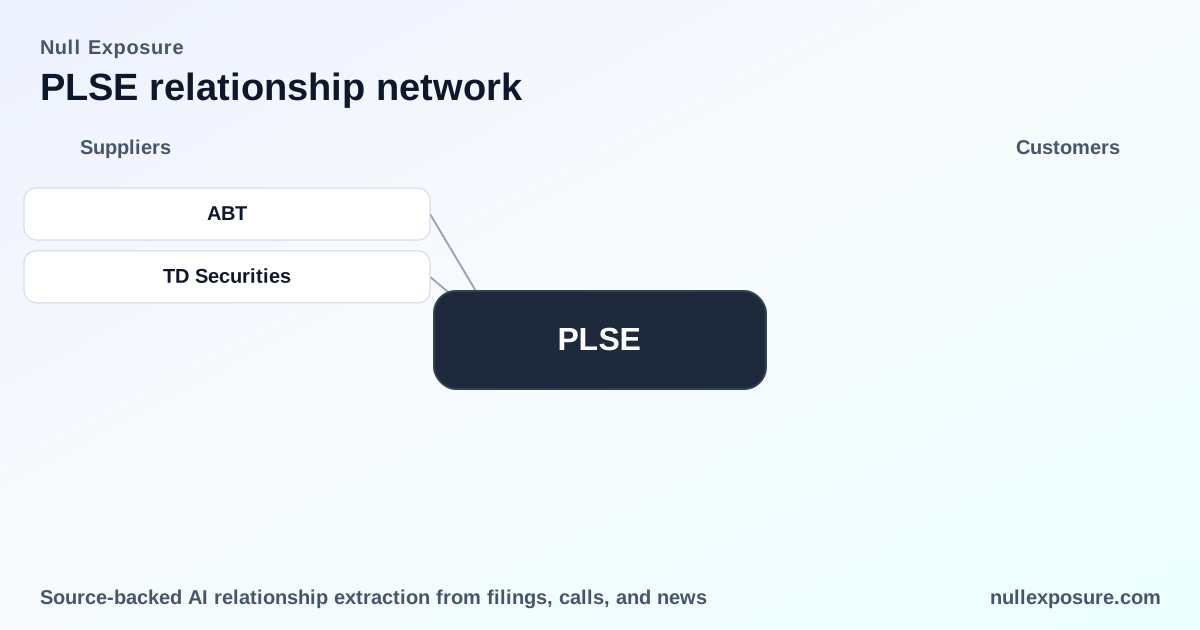
Below I cover every relationship referenced in the public signals set and summarize their relevance.
Abbott — clinical integration at AF Symposium 2026
Pulse announced that its nPulse Cardiac Catheter was featured in a late-breaking science session and a live case transmission integrated with Abbott’s EnSiteX™ 3D Mapping System at the 31st Annual AF Symposium in February 2026. This positions Pulse’s catheter within a leading electrophysiology mapping ecosystem and is a clear commercial and clinical visibility win. According to an InvestingNews release and a Biospace press announcement from March 2026, the integration was presented to clinicians as part of live data and scientific programming. (InvestingNews / Biospace, March 2026)
TD Securities — equity distribution agreement
Pulse entered an equity distribution agreement with TD Securities, a standard mechanism for opportunistic capital raises that gives the company a pathway to sell newly issued shares into the market. MarketScreener reported the disclosure in its March 2026 earnings coverage, which is consistent with Pulse’s capital-intensive development and the need to maintain liquidity while commercial rollout continues. (MarketScreener, March 2026)
How these relationships change the risk/reward calculus
- Abbott integration is strategic for adoption. Being demonstrated within a widely used mapping platform lowers clinical friction and increases the addressable user base for Pulse’s catheter if regulatory clearance and reimbursement align with clinical uptake. This is a high-value commercial signal without immediate material revenue.
- TD Securities agreement is capitalization work. The equity distribution arrangement reduces near-term fundraising friction but dilutes existing holders when executed; it is a tactical financing tool that reflects ongoing cash burn and the need to fund commercialization and regulatory activities.
- Together they show a classic early commercial phase: partnering for clinical credibility while building financing optionality.
(Second investor resource: for comparative supplier intelligence and partner tracking, visit https://nullexposure.com/.)
Company-level operating constraints investors must factor
Pulse’s public disclosures and filings reveal a set of operational constraints that shape supplier risk and contract posture:
- Contracting posture: mixed. Pulse maintains short-term purchase orders for components rather than long-term supplier contracts for most inputs, which increases supply flexibility but also increases exposure to spot-market shortages or price volatility. Simultaneously, the company has a long-term real estate lease (a 65-month lease commenced November 2024, extended through October 2029), which creates fixed overhead commitments.
- Manufacturing criticality and outsourcing. The company explicitly states it is completely dependent on contract manufacturing partners for compliant production; this makes supplier performance and regulatory adherence an operational lynchpin and a material risk factor for investors.
- Spend scale and maturity signals. Lease accounting shows a right-of-use asset of about $0.8 million at commencement and operating lease obligations totaling roughly $11.2 million, signaling modest fixed-asset scale consistent with a small commercial-stage medtech company rather than an integrated manufacturer.
- Counterparty mix includes individual financings. Pulse accepted a $65 million loan from majority stockholder Robert W. Duggan under a 2022 loan agreement, demonstrating reliance on insider capital alongside public market tools.
- Geographic concentration. Long-lived assets and operations are concentrated in the United States, which simplifies regulatory and logistics complexity but concentrates geopolitical and vendor risk domestically.
- Role diversity of suppliers. The company’s partners and vendors act as both manufacturers (critical to product realization) and service providers (including providers with access to confidential data and IT infrastructure), which expands the attack surface for quality and cybersecurity issues.
These constraints collectively describe a small-cap medical-device company with outsourced production, concentrated operational dependency, and active capital management.
Investment implications and risk checklist
- Clinical validation and partner integrations (Abbott) materially increase adoption probability but do not guarantee commercial revenue; investors must watch adoption metrics, ordering patterns, and procedural reimbursement.
- Supply and manufacturing execution are single points of failure. Given complete dependence on third-party manufacturers, operational continuity and regulatory audit readiness are critical KPIs to track.
- Capital strategy is active. The equity distribution agreement with TD Securities plus prior insider lending indicate the company will continue to use both public and private capital sources to fund growth; dilution is an explicit financing risk.
- Insider control is high. With a majority insider ownership stake, strategic direction and capital decisions will reflect a concentrated shareholder base.
(If you monitor supplier exposures across a medtech portfolio, get tailored visibility at https://nullexposure.com/.)
Bottom line for operators and investors
Pulse is a clinically focused device platform in early commercial ramp with significant execution dependencies. The Abbott integration is a meaningful commercial validation event, and the TD Securities arrangement is a pragmatic financing tool. However, outsourced manufacturing, short-term supply contracts for components, and concentrated fixed commitments create asymmetric operational risk that investors must price against the upside of broader clinical adoption.
For ongoing tracking of partner signals and supplier risk across PLSE and comparable medtech names, visit https://nullexposure.com/ for detailed supplier relationship coverage and alerts.