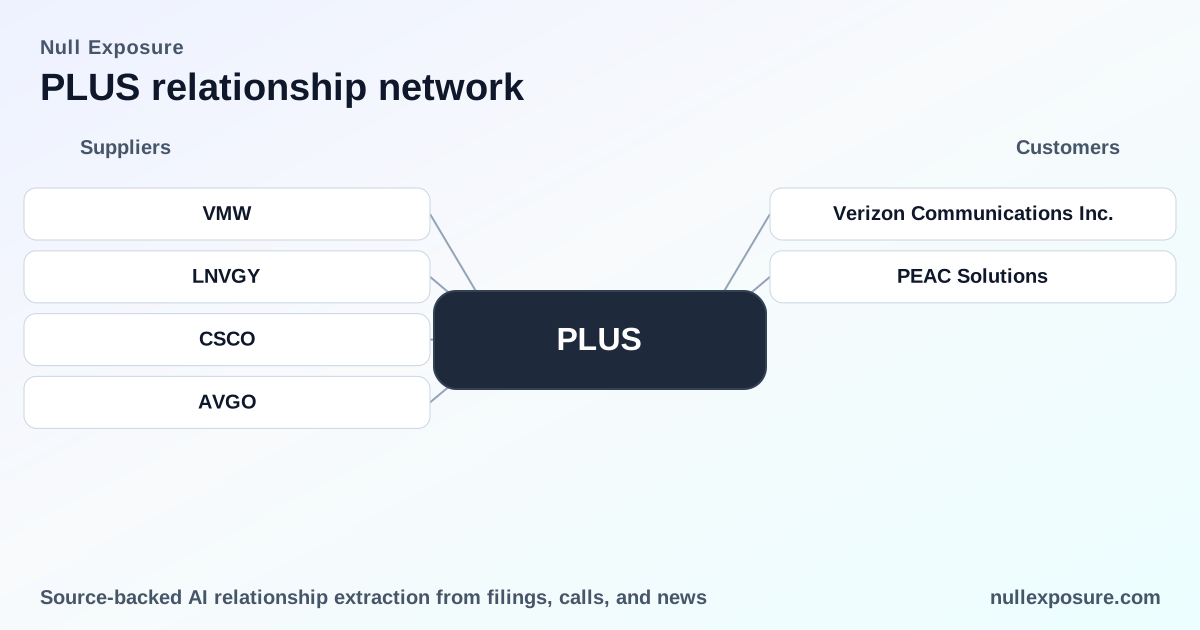
ePlus (PLUS) — Supplier relationships that define the delivery business
ePlus operates as a technology integrator and services company that monetizes through services-led systems integration, recurring maintenance and software resale, and product margin on hardware distribution. The company combines consulting and technical delivery with vendor relationships to sell and support on-premises and cloud-enabled infrastructure; its profitability is driven by high-margin services and scale in vendor resell. Investors should view PLUS as a channel-driven operator where supplier access and credit arrangements materially shape revenue mix and working capital needs.
Explore deeper supplier risk and partner exposure at https://nullexposure.com/.
Why suppliers matter more than the logo
ePlus is a channel-first business: it sources hardware, licenses, and OEM software from large infrastructure vendors and layers customer-specific services on top. That operating model produces four structural characteristics investors must price:
- Contracting posture: ePlus acts primarily as a buyer/reseller to acquire inventory and software rights, operating with vendor resell agreements and distribution relationships that determine margin pools and credit terms.
- Concentration: Vendor concentration is material and disclosed; single vendors can represent a large share of product revenue, making supplier performance and pricing pivotal to topline stability.
- Criticality: Supplier partnerships are not optional — for customers buying Cisco or Broadcom/VMware technology, ePlus is the channel integrator delivering architecture, licensing and managed services.
- Maturity: Awards and formal partner recognitions signal long-standing, formalized relationships (partner tiers, solution provider status) rather than ad hoc trading.
These characteristics together mean ePlus’s supplier ecosystem is both a revenue driver and a key operational risk vector.
Supplier snapshot — the relationships that matter right now
Below are the company’s disclosed partner relationships with concise takeaways and source context.
-
VMware — According to a PR Newswire release in March 2026, ePlus leverages VMware’s private cloud suite as a foundational platform and positions its consulting and engineering team to deliver customer outcomes on that stack; the release also notes Broadcom’s award recognizing ePlus’s growth role with VMware solutions. (PR Newswire, March 10, 2026.)
-
Lenovo — A March 2026 press release highlights that ePlus is recognized as Lenovo’s North American Infrastructure Partner of the Year and actively helps customers build modern infrastructures, including for AI applications, using Lenovo technology. (PR Newswire, March 2026.)
-
Cisco Systems — ePlus reports in its FY2025 10‑K that Cisco products represented approximately 32% of technology-segment net sales in FY2025 (44% in FY2024 and 40% in FY2023), establishing Cisco as a material supplier for product revenue. (PLUS FY2025 10‑K filing, year ended March 31, 2025.)
-
Broadcom — A PR Newswire item from March 2026 notes ePlus is a Broadcom Premier Solution Provider and is recognized for technical expertise with VMware solutions under Broadcom’s VMware portfolio. This formal partner tier indicates strategic sales alignment with Broadcom channel programs. (PR Newswire, March 10, 2026.)
What the relationships say about operating power and risk
These partners are not cosmetic — they are the pipes through which product margins and software resale flow. Cisco’s disclosed share of technology sales exposes ePlus to vendor-specific pricing, inventory dynamics, and product life-cycle risk. At the same time, premier partnerships with Broadcom (VMware) and awards from Lenovo point to deep, mature go-to-market relationships that support services revenue and solution design credibility.
The company also signals a buyer posture in its working capital arrangements. Company disclosures state it uses a floor plan facility to facilitate inventory purchases from designated suppliers. That is a direct operating signal: ePlus relies on supplier-financed or inventory-financing structures to scale product resale, which improves gross margin volatility control but increases counterparty and liquidity concentration on supplier credit facilities. Treat this as a company-level financing characteristic that affects cash conversion and the sensitivity of earnings to supply-chain shocks.
Explore contract-level exposure and partner concentration analysis at https://nullexposure.com/.
Financial and strategic implications for investors
- Revenue mix sensitivity: With Cisco accounting for a meaningful slice of technology sales, a vendor-led pricing shift, certification change, or distribution policy change could materially compress product margins and push more revenue into lower-margin services or require different go-to-market investments.
- Working capital lever: The use of a floor plan facility reduces near-term cash outflow but links ePlus’s inventory purchasing scale to supplier-designated programs; if supplier terms tighten, working capital needs will rise quickly.
- Competitive moat through services: Partner awards and premier statuses (Broadcom/VMware, Lenovo) support a higher-margin services franchise. Sustained technical certifications and delivery capacity preserve service margins despite product volatility.
- Concentration risk offset by diversification: While Cisco concentration is high, the breadth of recognized partnerships with Broadcom/VMware and Lenovo provides channel diversification across key infrastructure vendors; execution on multi-vendor integration is critical.
What operators and research teams should watch next
- Track vendor tier status changes and award renewals — a downgrade or loss of premier status with Broadcom or Lenovo would directly affect pipeline quality.
- Monitor Cisco sales mix trends in quarterly filings — shifts below the FY2025 32% contribution will materially affect gross margin composition.
- Watch floor plan facility terms in SEC disclosures or debt schedules for covenant resets or supplier-driven restrictions; those are immediate levers on liquidity and procurement capacity.
- Observe marketing and case study flow around VMware and AI infrastructure workloads to gauge whether partner recognition converts into scalable services bookings.
For a deeper supplier-risk scorecard and relationship tracking, visit https://nullexposure.com/.
Bottom line — investable channel franchise with structural dependencies
ePlus is a services-led integrator that leverages formal vendor partnerships to monetize resale and high-margin technical services. Its supplier relationships are both a source of competitive advantage — via premier partner status and recognized capabilities — and a concentrated risk through material reliance on vendors like Cisco and financing arrangements tied to inventory purchase. Investors should underwrite both the durability of partner certifications/awards and the stability of supplier credit arrangements when modeling downside scenarios. Detailed vendor monitoring and working-capital scrutiny are essential to a responsible valuation of PLUS.
If you want a concise supplier exposure analysis or a tailored watchlist for channel-dependent IT integrators, start your research at https://nullexposure.com/.