Plutus Financial Group (PLUT): How a Hong Kong fintech leverages card rails and crypto rewards to monetize payments
Plutus Financial Group operates a consumer-facing financial services platform headquartered in Wan Chai, Hong Kong, combining a decentralized exchange and a Visa-branded debit card to drive transaction volume and capture fee income. The company monetizes through payment processing and card interchange economics, trading spreads on crypto-to-fiat conversion inside its app, and ancillary services tied to its user base and card activity. Investors should view PLUT as a small-cap, growth-oriented payments and crypto-embedded finance operator with concentrated ownership and margin pressure.
Explore supplier and partner exposures for procurement and counterparty diligence at https://nullexposure.com/.
What investors need to know up front
Plutus runs a payments-first product anchored by a Visa debit card that delivers crypto rewards and a built-in decentralized exchange for on-device conversion between crypto and fiat. The card and DEX are the company's primary commercial hooks to generate transaction volume and fee revenue. Financially, PLUT is early-stage: revenue of roughly $9.96 million (TTM) against negative operating and net margins, a market capitalization around $47.7 million, and very high insider ownership (67.2%) that concentrates control and limits public float.
Where the supplier relationships matter: the Visa connection
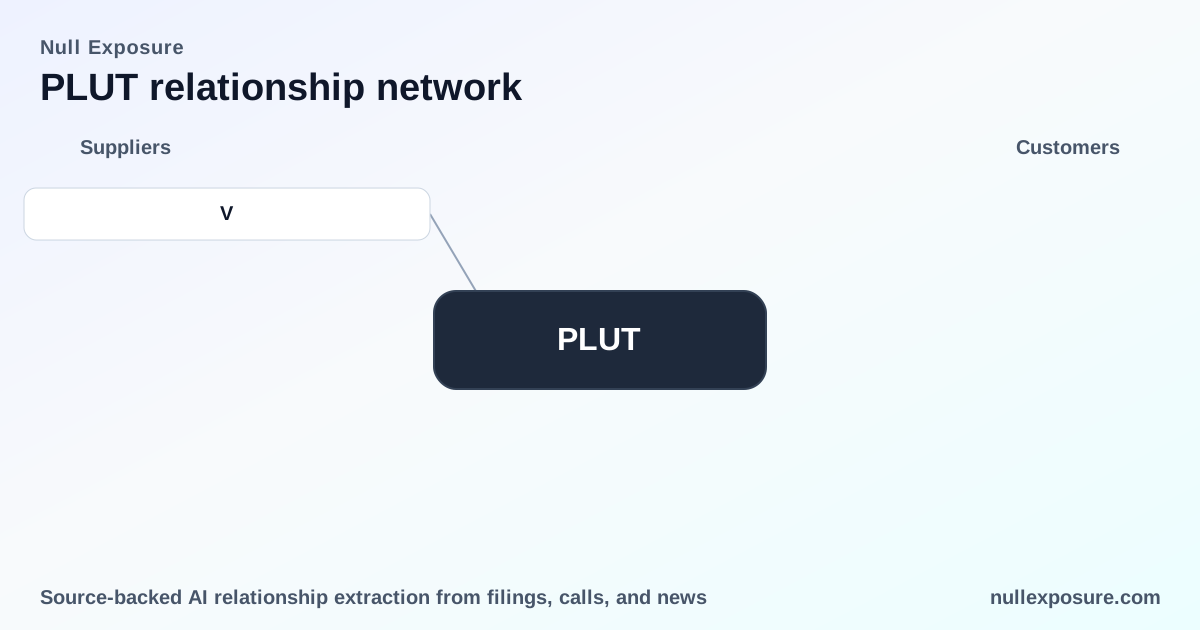
Plutus has an explicit commercial relationship with Visa through its card product. According to a profile published by Crowdfund Insider in April 2021, the Plutus app includes a decentralized exchange and a Plutus Visa Debit Card that awards users 3% in crypto rewards on eligible spending, enabling integrated crypto-to-fiat conversion and consumer rewards flows (Crowdfund Insider, Apr 2021: https://www.crowdfundinsider.com/2021/04/174246-danial-daychopan-ceo-at-plutus-explains-how-financial-services-provider-is-bridging-worlds-of-fiat-and-crypto/). This arrangement places Visa as a critical payments rails partner whose network, brand, and interchange model underwrite card economics.
Relationship-by-relationship rundown
Visa — Plutus issues a Visa-branded debit card that integrates with its app and decentralized exchange and delivers 3% crypto rewards on spending, making Visa the primary payments network enabling Plutus’s consumer-facing card product (Crowdfund Insider, Apr 2021: https://www.crowdfundinsider.com/2021/04/174246-danial-daychopan-ceo-at-plutus-explains-how-financial-services-provider-is-bridging-worlds-of-fiat-and-crypto/).
Business model constraints and company-level signals
PLUT’s operating model shows several structural characteristics that shape supplier negotiations and strategic optionality:
- Contracting posture — dependent on network rails: Card issuance depends on payment network relationships and issuer/acquirer partners. That creates a contracting posture where network terms and interchange rules influence unit economics and product feasibility.
- Concentration — insider ownership and tight float: With 67.23% insider ownership and only 386,050 shares float, governance and strategic direction are highly concentrated; this reduces market liquidity and increases single-party control over supplier selection and contract renewals.
- Criticality — card and conversion features are core: The Visa card and the in-app DEX are core to user acquisition and monetization, rendering supplier continuity (payments processors, network accreditation) operationally critical.
- Maturity — early commercial scale with negative profitability: Revenue TTM of $9.96M, negative EPS (-0.18), operating margin -11.82%, and profit margin -196.2% signal an early-stage business still investing in growth while operating below breakeven. Valuation multiples (Price-to-Sales ~4.8, EV/Revenue ~32.2) are elevated relative to current profitability, implying high future growth expectations priced in.
These company-level signals affect how Plutus negotiates supplier contracts, balances service levels against cost, and prioritizes capital allocation.
Financial and counterparty risk implications for operators and buyers
Plutus’s small market cap (~$47.7M) and concentrated ownership create counterparty risks for suppliers that provide infrastructure or credit lines. The company’s tight float and low institutional participation (9.1%) reduce public scrutiny and can accelerate strategic shifts decided by insiders. Elevated valuation multiples against negative margins indicate equity capital is being used to fund growth rather than current cash profitability; suppliers and counterparties should price for liquidity sensitivity.
Key risk drivers:
- Liquidity and refinancing risk driven by small market cap and negative operating cashflow.
- Operational contingency risk because the card/DEX combination is critical to revenue; any disruption to card network access or settlement pathways will materially compress revenues.
- Concentration risk from controlling shareholder influence on corporate strategy and supplier selection.
What this means for supplier diligence and investor engagement
For supplier negotiation or investment due diligence, prioritize verification of:
- Card-program continuity: confirm issuer agreements, principal-acquirer relationships, and compliance with network rules.
- Settlement and custody flows: map how crypto-to-fiat conversions settle and whether Plutus retains counterparty credit or hedging exposures.
- Balance-sheet flexibility: understand capital buffers given negative margins and the company’s exposure to volatility in transaction volumes.
If you need a structured supplier risk profile or a counterparty exposure map for PLUT, start here: https://nullexposure.com/.
Bottom line and next steps
Plutus occupies a niche at the intersection of card payments and embedded crypto rewards, anchored by a Visa-branded debit card and a native DEX that together drive transaction-based monetization. The business is strategically well-positioned to capture consumer payment flows tied to crypto rewards, but its small scale, concentrated ownership, and negative margins elevate supplier and liquidity risk. Investors and suppliers should treat the Visa relationship as operationally critical and prioritize contractual clarity on fees, settlement, and continuity.
For operationally focused diligence, model supplier termination scenarios and stress-test interchange and conversion economics. For further supplier intelligence and counterparty reporting on PLUT, visit https://nullexposure.com/.
Explore consolidated supplier exposure and monitoring tools for targeted counterparty analysis at https://nullexposure.com/.