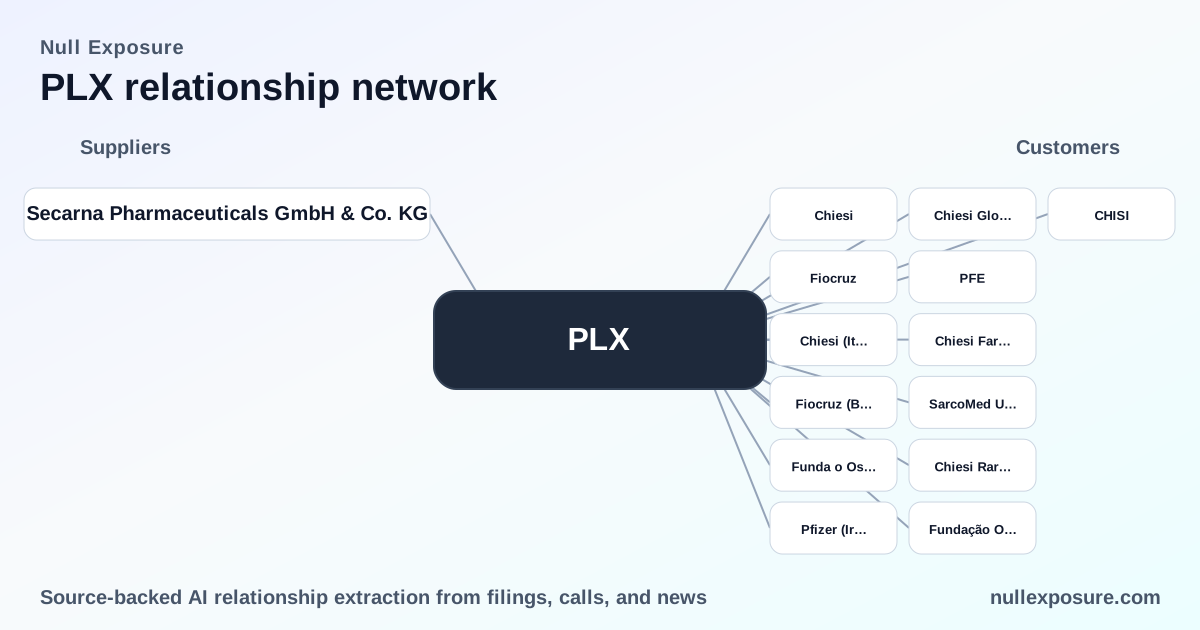
Protalix (PLX): Supplier relationships and what the Secarna deal signals for investors and operators
Protalix Biotherapeutics develops and commercializes recombinant therapeutic proteins using its ProCellEx plant cell expression system and captures value through product sales (notably Elelyso and Elfabrio), out‑licensed development programs, and milestone/royalty arrangements tied to collaborations. The company’s operating model is capital‑light on manufacturing (heavy use of third‑party providers) and license‑driven on R&D upside, so supplier relationships that deliver discovery, development and fill/finish services directly influence both near‑term cost structure and long‑term revenue optionality. For active monitoring of supplier risk and partner pipelines, see the company hub: https://nullexposure.com/.
The Secarna collaboration — what was announced and why it matters
Protalix entered into a collaboration and option agreement with Secarna Pharmaceuticals that gives Protalix an option to obtain an exclusive, worldwide, milestone‑ and royalty‑bearing license to develop and commercialize therapeutic programs generated under the collaboration. According to a PR Newswire release dated March 10, 2026, Secarna granted Protalix that option and structured the deal to include milestones and royalties tied to later commercialization. (PR Newswire, March 10, 2026.)
Under the same collaboration, Protalix selected targets in rare renal indications and Secarna will deploy its AI‑assisted OligoCreator platform to design antisense oligonucleotides (ASOs) against those targets, positioning the work as a discovery‑to‑option pipeline that can convert into licensed assets if preclinical validation is successful. This structure was described in a December 17, 2025 announcement carried by SahmCapital and repeated in market news feeds such as Finviz in March 2026. (SahmCapital, Dec 17, 2025; Finviz, March 10, 2026.)
Takeaway: this is a classic biotech collaboration where Protalix outsources discovery to a platform specialist in exchange for optioned rights, preserving capital while retaining upside through milestones and royalties.
Every reported relationship in the public record (no omissions)
- Secarna Pharmaceuticals GmbH & Co. KG — Protalix has a collaboration and option agreement that grants Protalix an exclusive, worldwide milestone‑ and royalty‑bearing license should it exercise the option; the collaboration targets rare renal indications using Secarna’s OligoCreator platform (PR Newswire, March 10, 2026).
- Secarna Pharmaceuticals GmbH & Co. KG — Protalix selected specific pharmaceutical targets for Secarna to design and profile antisense oligonucleotides, formalizing a discovery service component to the deal (SahmCapital, Dec 17, 2025).
- Secarna Pharmaceuticals GmbH & Co. KG — The same commercial terms and licensing option were summarized in market feeds and news aggregators, confirming broad distribution of the announcement (Finviz, March 10, 2026).
Each reporting instance covers the same contractual relationship from different publication channels; all three confirm that the engagement is option‑centric and milestone/royalty‑oriented.
How the Secarna agreement fits Protalix’s supplier posture
Protalix’s public disclosures describe a company that relies on third‑party research and manufacturing partners for key R&D and production tasks and uses collaborations to broaden its clinical pipeline without taking on full internal discovery costs. Company filings state that Protalix depends on third‑party research collaborators for product candidate development and on other external parties for manufacturing and clinical trial execution, and that it uses third‑party service providers in the United States and Europe for fill‑and‑finish activities for Elelyso and Elfabrio. That operating posture explains why an option/licensing structure with Secarna is an efficient way to acquire discovery services while preserving capital and limiting fixed manufacturing commitments.
Additional company signals matter to suppliers and counterparties: Protalix discloses reliance on a single, approved supplier for certain ProCellEx expression materials, creating a concentration risk in its supply chain. The company also reports multi‑year vehicle leases and other long‑term commitments and quantified total commitments under some agreements at about $1.5 million as of December 31, 2024, signaling modest but non‑trivial contracted spend levels. (Company filings, December 31, 2024.)
For procurement teams and potential service providers, the structural profile is clear: outsourced R&D and manufacturing, active collaboration pipeline, concentrated critical inputs, and moderate committed spend.
If you want to evaluate these supplier dynamics further, the company hub is available here: https://nullexposure.com/.
Operational constraints that determine counterparty risk
- Contracting posture: shorter, option‑centric R&D contracts plus third‑party manufacturing/service arrangements reduce capital outlay but increase dependency on external execution quality and timing.
- Concentration and criticality: the reliance on a single approved materials supplier for ProCellEx creates single‑point operational risk for batch continuity and regulatory filings.
- Spend maturity and visibility: commitments in the $1M–$10M band (company disclosure of roughly $1.5M) indicate committed near‑term spend that is material for smaller suppliers but manageable relative to Protalix’s revenue base (~$61.8M TTM).
- Relationship stage: disclosures classify key supplier interactions as active, implying ongoing operational integration rather than exploratory MOUs.
These constraints make Protalix an attractive partner for niche, high‑quality service providers that can meet regulatory standards, but they require counterparties to accept execution discipline and documentation demands typical of regulated biologics work.
Investment implications: risk, upside and valuation context
Protalix is a small‑cap biotech with market capitalization around $231M and revenue of ~$61.8M TTM, operating at positive profit margins and a trailing P/E near 36. Collaborations like the Secarna agreement deliver asymmetric upside through milestones and royalties without large upfront capital requirements, supporting a thesis of measured growth funded by partnerships. However, the manufacturing and supplier concentration risks amplify operational exposure: a disruption at a single approved supplier or a fill/finish vendor would have outsized programmatic effects.
From a valuation standpoint, the company sits at premium multiples relative to revenue given the optionality embedded in its pipeline; the market is effectively pricing growth from licensing and specialty product sales rather than large‑scale endemic manufacturing. Analysts set a consensus target price near $11, reflecting the combination of current cash flow and pipeline optionality.
If you are assessing counterparty risk or commercial opportunity with Protalix, prioritize contractual protections around exclusivity triggers, milestone definitions, and supply continuity.
Discover more supplier risk profiles and matchup analyses at https://nullexposure.com/.
Practical next steps for operators and investors
- For suppliers: negotiate clear quality metrics, contingency manufacturing terms and payment milestones that reflect regulatory inspection cycles.
- For investors: monitor milestone triggers tied to the Secarna option exercise and watch for any supply disruptions related to the single approved supplier for ProCellEx inputs.
- For procurement and legal teams: require robust IP‑assignment language and defined transition plans in option‑to‑license deals so technology transfer and scale‑up timelines are executable.
Bottom line
Protalix’s collaboration with Secarna exemplifies the company’s capital‑efficient strategy: outsourcing early discovery to secure optioned access to R&D upside while limiting fixed manufacturing risk. That model generates attractive upside through milestone and royalty economics but places a premium on supplier quality, documentation and continuity. For investors and operators, the essential questions are execution and concentration: can Protalix convert optioned programs into licensed assets without a supply chain interruption? To explore supplier profiles across the healthcare universe and track partner disclosures, visit https://nullexposure.com/.