Powell Max (PMAX): capital-hungry specialist with concentrated ownership and market-level valuation
Powell Max Limited (NASDAQ: PMAX) operates as a specialty business services company that monetizes through product and service contracts while relying on external capital to fund growth and working capital. The company’s core economics show meaningful top-line scale relative to market value but persistent operating losses; management supplements cash flow with equity solutions and placement transactions to maintain operations and pursue expansion. For investors evaluating supplier or counterparty relationships, PMAX is best understood as a small-cap, equity-financed operator where capital-provider relationships are operationally critical and insider control is the dominant governance force.
Discover more on the company and supplier landscape at https://nullexposure.com/.
The short read for investors
Powell Max generates roughly $37.7M of trailing revenue with $15.2M gross profit, but it reports negative operating and net margins and large negative EBITDA, meaning the company depends on capital markets to bridge cash needs. Market capitalization is small (~$5.6M) and insider ownership is majority-controlled (54.7%), creating a capital and governance profile that favors insider direction over broad institutional influence. Valuation is low on a price-to-sales basis (0.15), while leverage of public equity instruments and placement agents is a prominent feature of the funding strategy.
How the financing relationships actually look
PMAX uses transactional capital relationships rather than institutional long-only depth. The company’s public reporting and news coverage show direct engagements with placement agents and equity counterparties to secure cash—an operating pattern consistent with early-stage or turnaround firms that are revenue-generating but not profit-positive.
Capital relationships you need to know
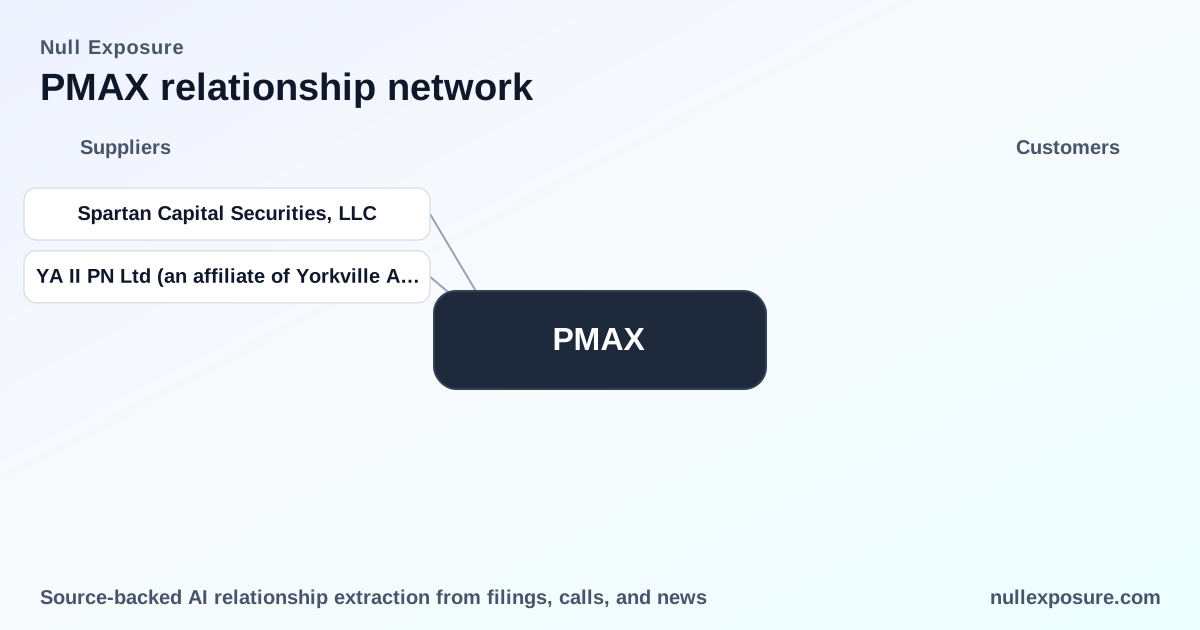
- Spartan Capital Securities, LLC — placement agent for a $17.0M PIPE (FY2026). Spartan Capital served as sole placement agent on a $17 million private investment in public equity financing for PMAX, a direct capital infusion that reflects reliance on intermediary-led equity raises to fund operations and growth. According to a Yahoo Finance release (March 10, 2026), Spartan Capital executed the transaction as the exclusive placement agent.
- YA II PN Ltd / Yorkville Advisors — terminated equity line (May 2025). An equity line with YA II PN Ltd, an affiliate of Yorkville Advisors, was terminated in May 2025; press coverage at the time tied the termination to a positive share-price reaction as the market priced a reduction in potential near-term dilution. A December 3, 2025 market write-up on ts2.tech noted that the termination produced a 20–30% rise in PMAX shares as investors welcomed lowered dilution risk.
What these relationships imply for suppliers and counterparties
- Capital dependence is structural. The use of a PIPE and equity lines indicates PMAX requires external capital to operate at its current scale; suppliers should price for settlement risk and confirm contract clauses that protect against payment disruption when balance-sheet infusions are the primary liquidity source.
- Funding partners are a de facto operational lifeline. Placement agents and flexible equity counterparties are not ancillary; they function as critical liquidity suppliers whose activity directly affects the company’s ability to meet obligations.
- Equity dilution is a recurring governance tool. The terminated equity line itself was material to market perception; conversely, active equity lines or PIPEs will impose dilution that affects minority stakeholder economics and long-term supplier bargaining power.
Financial profile that shapes supplier decisions
Powell Max shows a stark mismatch between revenue scale and profitability: $37.7M revenue vs. negative EBITDA and EPS (-2.55). Insiders own a majority of the float (54.7%), while institutional ownership is minimal (1.42%), and shares outstanding are small—these attributes produce high control, low institutional oversight, and concentrated shareholder leverage. The company trades at a low price-to-sales ratio (0.148) and a modest EV-to-revenue figure (1.177), but EV/EBITDA is elevated (34.46) because EBITDA is negative. These are not neutral statistics; they translate into counterparty risk where liquidity events and financing transactions drive operational continuity.
Practical vendor/partner checklist
- Confirm payment triggers and remedies tied to financing events; include short-tenor payment terms or milestone-based releases where feasible.
- Require transparency clauses for financing arrangements that could affect payment or deliverable timelines.
- Treat equity dilution and shareholder concentration as negotiation levers when setting pricing, credit, or exclusivity terms.
Constraints and company-level signals
There are no formal constraints reported in the supplier-scope data for PMAX. Company-level signals drawn from financials and ownership structure are decisive: high insider ownership, very low institutional float, dependence on capital markets (PIPEs/equity lines), negative operating profitability, and small market capitalization. These characteristics define a contracting posture that will prioritize rapid access to capital, low tolerance for prolonged vendor credit, and governance dominated by insiders rather than diversified institutional pressure.
Explore supplier analytics and relationship diligence at https://nullexposure.com/ for deeper due diligence and monitoring tools.
What investors and operators should watch next
- Upcoming financing announcements or placement transactions, which will immediately alter liquidity and dilution profiles.
- Changes in institutional ownership and insider selling or buying patterns; even small swings are consequential given the tight float.
- Quarterly operating performance relative to breakeven; revenue growth without margin improvement will keep capital-raising as the primary lever.
Final takeaway and next steps
Powell Max is a revenue-generating specialist whose operational continuity is tightly coupled to external capital flows and a small, insider-dominated shareholder base. For suppliers and investors, the immediate priorities are contractual protections against financing-driven disruption and ongoing monitoring of capital-market activities that directly affect liquidity and dilution. For structured diligence and ongoing monitoring of PMAX supplier relationships, visit https://nullexposure.com/ — our platform centralizes these signals and the primary-source reporting that drives commercial and investment decisions.