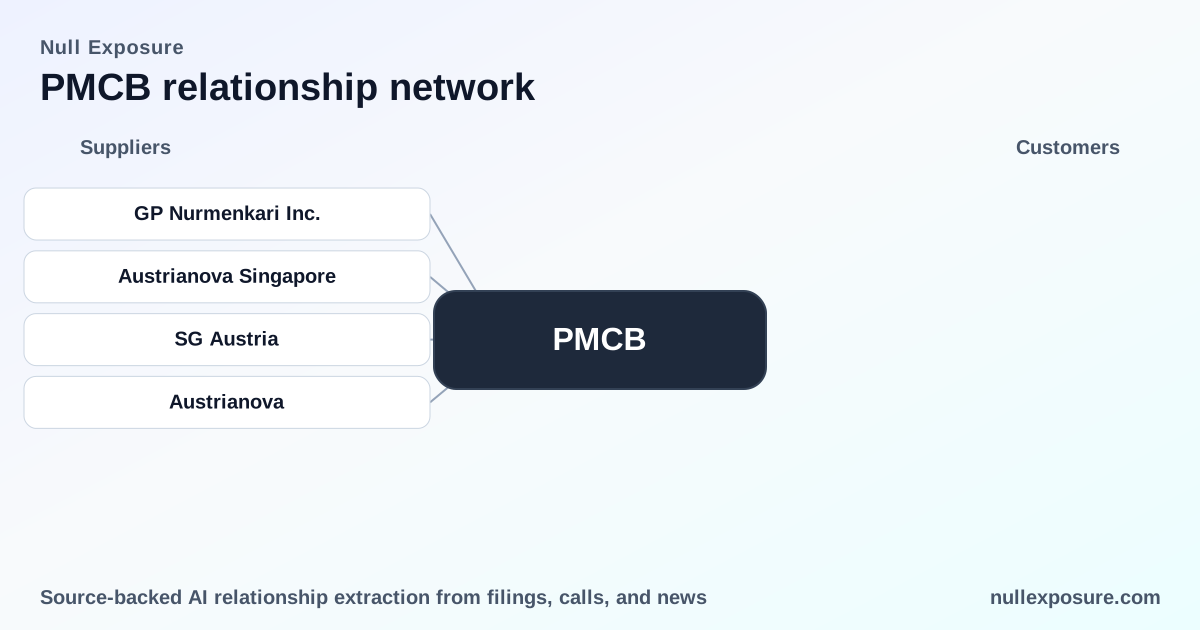
PharmaCyte Biotech (PMCB): supplier relationships that determine clinical runway and commercial readiness
PharmaCyte Biotech operates as a clinical-stage biotech that licenses and commercializes a proprietary cell-encapsulation technology (Cell-in-a-Box®) for oncology and diabetes programs, and monetizes via milestones, licensing arrangements and equity investments tied to development progress and partner transactions. Its operating model is heavily third-party dependent: manufacturing, specialized technical know‑how, and many trial services sit outside the company, creating concentration and operational risk that directly affect time-to-market and capital efficiency. For a deeper look at supplier risk and relationship mapping, visit https://nullexposure.com/.
How PharmaCyte runs and how that converts to value
PharmaCyte has structured its business around licensing and outsourcing. It holds licenses from SG Austria and Austrianova Singapore for the Cell-in-a-Box technology and contracts Austrianova for manufacturing and encapsulation services, while maintaining minority equity exposure in SG Austria. The company supplements its cash position through strategic securities purchases and private placements, sometimes using third parties as placement agents. This mix produces two dominant value drivers: technology control through licensing and execution risk concentrated in a small number of external manufacturers and service providers.
- Contracting posture: a combination of long-term financial commitments (for example, long-term warrants tied to an equity purchase) and short-term operational flexibility (month-to-month office and storage leases).
- Concentration: manufacturing and encapsulation are single-source through Austrianova, creating direct supply-chain sensitivity.
- Criticality: manufacturing and proprietary know‑how are mission-critical; any disruption halts clinical supply and commercial launch.
- Maturity: company remains clinical-stage with limited revenue and modest institutional ownership, indicating a high dependence on financing and partner execution.
See full supplier intelligence on Null Exposure: https://nullexposure.com/.
The supplier map (each reported relationship, what it means)
GP Nurmenkari Inc.
GP Nurmenkari acted as the sole placement agent for a $7.0 million private placement led by existing investors, indicating active capital-raising arrangements with third‑party placement agents to fund operations. According to InvestingNews’ coverage of the March 2026 transaction, GP Nurmenkari served as the exclusive placement agent for that private placement.
Austrianova Singapore
PharmaCyte purchased an exclusive worldwide license in 2013 from Austrianova Singapore for the Cell-in-a-Box encapsulation technology for diabetes treatment, reflecting an early, fundamental IP acquisition that underpins its programs. Nanalyze documented the $2 million license payment to Austrianova Singapore in 2013 when reviewing the company’s historical licensing activity.
SG Austria
SG Austria is the licensor and an equity affiliate: PharmaCyte acquired licenses from SG Austria and owns a minority stake (reported at 13.9%), tying the company financially and legally to SG Austria’s subsidiaries and know‑how. TradingView summaries of PharmaCyte’s SEC filings (FY2025) note that SG Austria holds the critical know‑how for the Cell-in-a-Box® technology and is the subject of Board-level strategic review.
Austrianova
Austrianova is the sole manufacturer for PharmaCyte’s encapsulated cell candidates; the company contracts Austrianova for encapsulation and sourcing of proprietary raw materials, making Austrianova a single-point operational dependency. PharmaCyte’s FY2025 SEC disclosures, summarized on TradingView, warn that reliance on Austrianova for manufacturing could result in supply shortfalls or unacceptable costs and have prompted Board-level review.
SG Austria (Strategic Scientific Committee reference)
A second SEC-based note highlights the formation of a Strategic Scientific Committee to reassess risks tied to SG Austria and the Cell-in-a-Box® know‑how, signaling governance attention to the SG Austria relationship beyond pure licensing. TradingView’s reporting on PharmaCyte’s FY2025 filings records this committee formation and the stated purpose to evaluate development risks related to SG Austria.
What the constraints tell investors about operating risk and execution
The compiled constraints are consistent and directional: PharmaCyte runs with mixed-tenor contracting, geographic exposure across EMEA and APAC, and highly concentrated manufacturing risk. Specifically:
- Long-term financial commitments exist (e.g., long-term warrants tied to the TNF securities purchase) while short-term operational leases are handled month-to-month, reflecting financial commitment on investment positions but operational flexibility for real estate.
- Geographic footprint spans EMEA (clinical trial centers in Germany and Switzerland) and APAC (manufacturing and cGMP certification activity in Bangkok), which creates regulatory complexity and cross-border supply reliance.
- The relationship with Austrianova is explicitly flagged as critical: supply chain delays and liquidity issues at that manufacturer would directly impede clinical supply and commercialization.
- Relationship roles are concentrated in service provision and manufacturing: PharmaCyte uses third parties extensively for trials, manufacturing, consulting, and information systems, indicating an asset-light execution model but high vendor dependency.
- Spend signals show modest direct procurement outlays (sub-$100k purchases historically from related-party subsidiaries) but material obligations remain (estimated remaining costs ~ $591k with $157k to related parties), consistent with a clinical-stage sponsor with low current procurement but non-trivial upcoming spend.
These constraints collectively define an operating model where intellectual property control and supplier reliability matter more than raw procurement scale.
See full supplier intelligence and risk scoring at https://nullexposure.com/ for actionable monitoring.
Investor implications and what to watch next
- Primary risk: a single-source manufacturing relationship (Austrianova) that is both operationally and financially critical; any manufacturing disruption immediately compresses clinical timelines and increases capital burn.
- Governance response: Board-level and Strategic Scientific Committee reviews are active controls; investors should monitor outcomes of those reviews in SEC filings and press releases.
- Capital strategy: reliance on placement agents and securities transactions (for example the TNF purchase and related long-term warrants) indicates equity-linked cash management rather than organic revenue, so watch dilution and related-party transactions closely.
- Geographic complexity: regulatory and cGMP certification timelines in APAC (Bangkok) and ongoing EMEA trial oversight create schedule and cost risk that translate to valuation volatility.
Actionable monitoring items: near-term updates on Austrianova’s cGMP status, disclosures from the Business Review Committee on SG Austria, and subsequent capital raises or exercise of warranted securities.
Conclusion and next steps
PharmaCyte’s value rests on exclusive licensing of Cell-in-a-Box® plus the operational reliability of a small set of external partners. For investors and operators, the thesis is binary: if manufacturing and partner governance stabilize, development value will unlock; if supplier or funding issues persist, timeline and dilution risks escalate. Track SEC filings and corporate updates focused on SG Austria, Austrianova and capital transactions to refine conviction.
Explore detailed supplier mappings and live updates at Null Exposure: https://nullexposure.com/ — and sign up for alerts on PMCB supplier risks and governance actions at https://nullexposure.com/.