Primech Holdings (PMEC): Supplier relationships that shape a capital-light robotics push
Primech Holdings monetizes by designing and commercializing autonomous cleaning robotics and related engineering services, then scaling through strategic manufacturing and technology partnerships and novel revenue constructs such as robot-as-a-service (RaaS) and tokenization. The company combines product engineering and outsourced manufacturing with third‑party AI and commercialization channels to move from prototype to recurring revenue. For investors evaluating supplier exposure, the critical questions are partner concentration, technology dependency, and the timing of revenue generation from new commercial models. Learn more or track ongoing relationship signals at https://nullexposure.com/.
How Primech runs its go-to-market: product + partners, not heavy capex
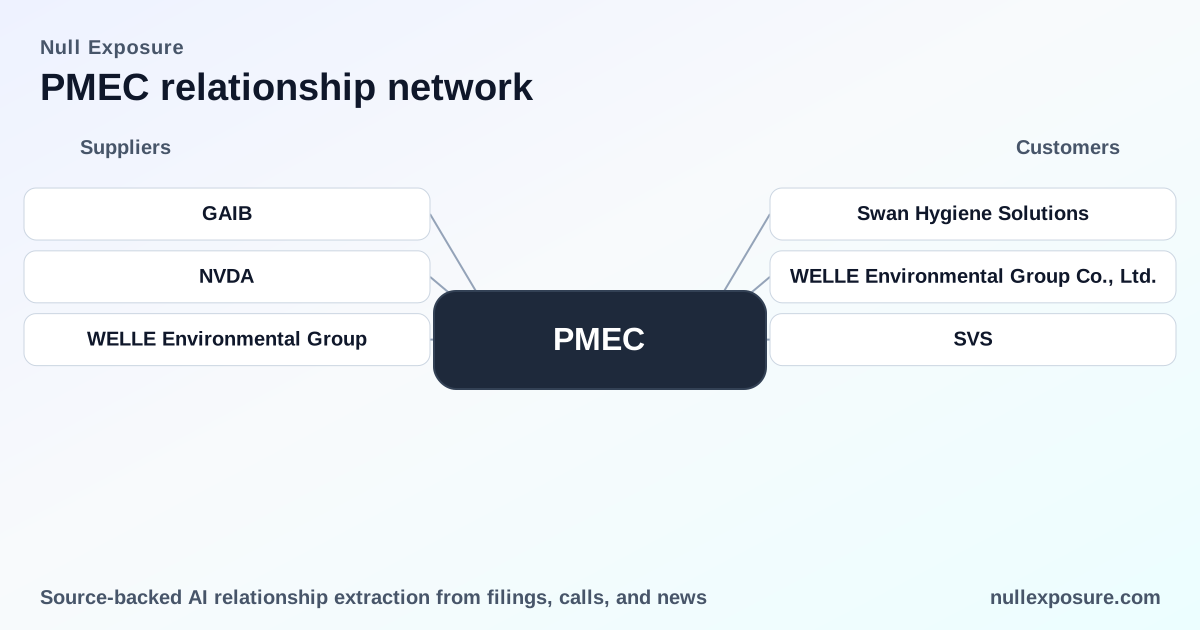
Primech is small by market cap (about $27.7 million) with negative EBITDA and operating losses, so the corporate strategy relies on partnerships to deliver scale without large balance‑sheet investment. The company’s disclosures and press coverage show three supplier/partner relationships driving its current commercial narrative:
- a tokenization partner to enable fractional ownership revenue models;
- an AI/edge‑compute supplier for on‑device perception and navigation; and
- a manufacturing joint‑venture partner for industrial scale production.
Those relationships reflect a capital-light contracting posture (outsourced manufacturing and licensing of core AI modules), technology criticality around AI compute, and concentrated ownership—management and insiders hold a large majority of shares—meaning supplier decisions will have outsized impact on execution and valuation.
Visit https://nullexposure.com/ for up-to-date linkage and signal monitoring.
Relationship rundown — what to know, company by company
GAIB — tokenization and fractional-ownership protocols
Primech signed a memorandum of understanding with GAIB for tokenization protocols to fractionalize ownership of the Hytron robot, enabling secondary markets and ARAAS-style revenue models. According to Laotian Times (Oct 16, 2025) and follow-up coverage in DagangNews, the MOU calls for GAIB to develop protocols to tokenize Hytron as digital assets and enable liquid secondary markets for robot investments (FY2025 reporting). These arrangements are intended to convert a product sale flow into recurring, market-driven revenue streams.
Source: Laotian Times coverage (Oct 16, 2025) and DagangNews reporting in FY2025.
NVIDIA (NVDA) — on-device AI compute and perception stack
Primech’s Hytron robot is built on the NVIDIA Jetson Orin Super System-on-Module, providing on‑device inference for real‑time perception, navigation, and sanitation verification. QuiverQuant and The Robot Report highlighted that Hytron leverages the Jetson Orin platform (FY2025–FY2026 coverage), and marketing notes claim greater than 99% bacterial reduction in controlled tests when powered by this stack. That makes NVIDIA a critical technology supplier for Hytron’s navigation and hygiene performance claims.
Source: QuiverQuant coverage of the CES 2026 launch (FY2025) and The Robot Report (FY2025).
WELLE Environmental Group — industrial-scale manufacturing partner
Primech lists WELLE Environmental Group as a strategic joint‑venture partner responsible for industrial-scale manufacturing and sustainability leadership for the Hytron platform. SahmCapital and QuiverQuant reported that WELLE (300190.SZ) provides capacity and manufacturing expertise to move Hytron toward mass production (FY2025 coverage). This JV addresses production scale and compliance requirements that would otherwise be capital‑intensive for Primech.
Source: SahmCapital news release (Dec 19, 2025) and QuiverQuant CES coverage (FY2025).
What the supplier set implies about risk and execution
Primech’s supplier map is targeted and small, which gives clarity to execution but concentrates risk. The company outsources two of the most capital‑intensive parts of hardware commercialization—compute integration (NVIDIA) and manufacturing (WELLE)—and complements them with an experimental commercialization partner (GAIB) to create recurring revenue via tokenization.
- Contracting posture: Primech favors strategic MOUs and JVs rather than owning production or deep AI stacks outright, reducing capital expenditure but increasing vendor dependency.
- Concentration: With only a handful of named partners, a vendor setback—supply chain delays at WELLE or a change in NVIDIA supply policy—would materially affect rollout timing.
- Criticality: NVIDIA’s Jetson platform is functionally core to Hytron’s real‑time perception; Primech’s product claims (e.g., >99% bacterial reduction) are tied to that on‑device compute capability.
- Maturity: Public visibility peaked around CES 2026 product launches and industry writeups; the business model is still moving from prototype/pilot to commercial scale, so near‑term revenue is dependent on partner execution and adoption of new revenue constructs like tokenized fractional ownership.
Key takeaway: Primech trades capital efficiency for supplier concentration—this structure can accelerate go‑to‑market on limited balance sheet resources but raises counterparty and execution risks.
Financial and ownership context that matters to supplier relationships
Primech operates with limited public float and highly concentrated insider ownership ( >81% insiders, <1% institutions), which influences negotiation leverage and strategic alignment with suppliers. Financially, trailing revenue is roughly $74.3 million with negative EBITDA and EPS, signaling that the company is still scaling margins and needs partner performance to move to positive operating results. The combination of small market capitalization, negative operating margins, and concentrated ownership means supplier outcomes will be a primary determinant of consensus re‑rating.
Investor implications and what to watch next
- Monitor inventory and manufacturing updates from WELLE and any legal filings that confirm JV terms; production ramp timing is the most tangible commercial milestone.
- Track NVIDIA supply and product announcements for Jetson Orin availability and pricing—compute platform stability is a gating factor.
- Watch how GAIB’s tokenization protocols translate into actual revenue contracts or secondary-market liquidity; the tokenization strategy is high potential but unproven as a recurring revenue engine.
If you are evaluating counterparty risk or modeling Primech’s revenue ramp, review partner announcements and production guidance carefully—Primech’s upside is tightly coupled to timely, scalable execution by its suppliers.
For continuous monitoring of Primech supplier signals and relationship changes, visit https://nullexposure.com/.
Final assessment and action items
Primech’s supplier relationships show a deliberate strategy: leverage best‑in‑class AI compute, outsource manufacturing scale, and experiment with innovative monetization via tokenization to convert one‑time hardware revenue into recurring streams. That strategy is coherent and capital efficient, but it concentrates operational risk in a few partners and requires flawless execution to move into positive operating leverage.
If you want a structured tracker of these relationships and ongoing signal updates, go to https://nullexposure.com/ to subscribe or review our supplier monitoring coverage.