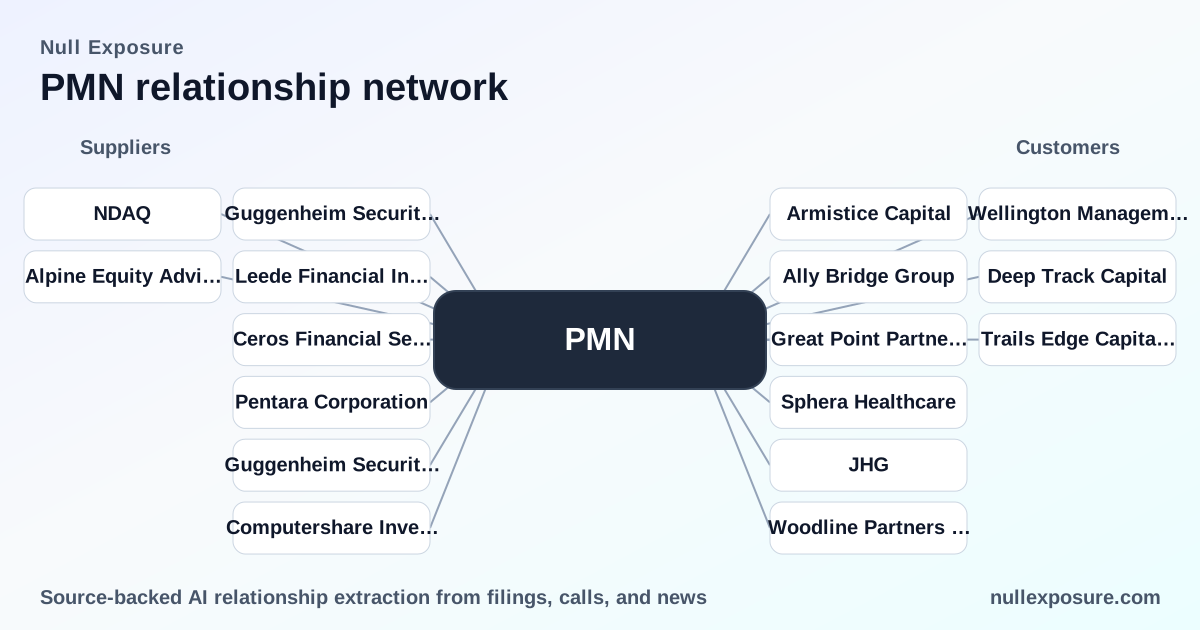
ProMIS Neurosciences (PMN): Supplier map and contract-level signals investors must price
ProMIS Neurosciences develops antibody therapeutics for neurodegenerative disease and monetizes through milestone and commercial licensing of proprietary molecules, grants and investor financing; the company’s cash runway and clinical progress depend heavily on third‑party financing and contracted service providers for clinical, manufacturing and data work. For investors, the thesis is straightforward: ProMIS is a small-cap clinical-stage biotech with limited revenue, negative operating cash flow, and a supplier footprint that drives both operational dependency and capital formation pathways. Learn more about supplier intelligence and partner risk at https://nullexposure.com/.
Why the supplier landscape matters for a clinical-stage biotech
ProMIS has negligible revenues and negative EBITDA; therefore, supplier relationships directly influence timeline risk and dilution risk. Contracted manufacturers and CROs determine the pace and cost of trials; placement agents and investment banks determine the company’s ability to raise non-dilutive and dilutive capital; transfer agents and exchanges shape shareholder mechanics and listing continuity. The company’s public filings and press releases disclose a mix of licensing obligations and active financing engagements that are central to valuation and event timing.
Partner-by-partner readout (concise investor notes)
Below are every supplier relationship identified in public filings and press coverage, with a one-to-two sentence plain-English summary and source reference.
Guggenheim Securities, LLC
Guggenheim acted as lead placement agent on ProMIS’s PIPE financings, helping to structure and place equity to extend runway. This engagement is documented in company press releases announcing two private placement programs (one originally announced in July 2024 and expanded in January 2026). See GlobeNewswire press releases (July 26, 2024; Jan 30, 2026) and QuiverQuant reporting (FY2026).
Leede Financial Inc.
Leede Financial served as a placement agent alongside Guggenheim and Ceros in the announced PIPE financings, supporting distribution to investor networks. The role is disclosed in ProMIS press materials for financings covering FY2024 and the FY2026 program. See GlobeNewswire (July 26, 2024) and the Jan 30, 2026 release; also reported on QuiverQuant (FY2026).
Ceros Financial Services, Inc.
Ceros Financial functioned as a placement agent in the same PIPE transactions, indicating ProMIS’s deliberate use of multiple boutique and institutional placement channels to secure funding. Ceros’s involvement is stated in the company’s financing press releases (July 26, 2024; Jan 30, 2026) and in FY2026 press coverage.
Pentara Corporation
Pentara provided clinical data analysis services for ProMIS and is cited in a December 2025 peer-reviewed publication announcement, highlighting a vendor relationship for biomarker and trial data analytics. This is referenced in the GlobeNewswire announcement of Dec 1, 2025 describing published work supporting the PRECISE‑AD Phase 1b trial.
Computershare Investor Services, Inc.
Computershare is ProMIS’s transfer agent for registered share records and was referenced in the company’s 2022 reverse share split notification, which explained the mechanics for registered and street‑name holders. See GlobeNewswire release dated June 27, 2022.
The Nasdaq Stock Market LLC (Nasdaq)
Nasdaq issued a deficiency letter to ProMIS in 2025 regarding the minimum bid price requirement, triggering actions (including a reverse split) to maintain listing compliance—an exchange-level relationship that directly affects liquidity and investor access. See the GlobeNewswire Nov 24, 2025 disclosure.
Alpine Equity Advisors
Alpine Equity Advisors provided investor relations contact services and appears in the company press announcement around the 2022 reverse split, indicating outsourced investor relations support. See GlobeNewswire June 27, 2022.
What the constraints and contract excerpts tell investors
Public excerpts and filings reveal a set of company-level signals about how ProMIS contracts and where operational risk concentrates:
- Licensing obligations are explicit and ongoing. The company pays annual license fees and is obligated for royalties tied to revenue under amended license agreements, which creates a recurring, contractual cash outflow profile as programs progress (company filings referenced in the constraints).
- Contracting posture is outsourced and dependent. Filings emphasize reliance on third‑party manufacturers, CROs, and service providers for manufacturing, clinical conduct, and data functions. That increases operational leverage: delays at vendors translate directly into development and commercialization delays.
- Materiality is mixed but consequential. The company discloses both immaterial legal indemnification exposures (historically immaterial) and material development risks—specifically that trial delays or failures can have material adverse effects on business and financial performance. Investors must weigh small legal cost exposure against large development execution risk.
- Relationship roles are diverse. The company operates as a licensee for key intellectual property, and engages manufacturers and service providers extensively; these roles show a mature externalization model rather than vertical integration.
- Segments concentrate on manufacturing and services. The clear segmentation is third‑party manufacturing and outsourced trial services, which translates into concentration risk: a limited set of external vendors could bottleneck programs.
- Relationship maturity is active but transactional. Annual license payments and repeated financing engagements indicate continuing, active contracts rather than one‑off consultancies.
Taken together, these signals define ProMIS as a capital‑intensive, outsourced clinical-stage firm where vendor execution and placement-agent effectiveness drive dilution cadence and trial timelines.
Investment implications and risk checklist
- Operational risk is execution risk. Major value inflection depends on clinical milestones; vendor delays raise probability of missed timelines and additional financings.
- Financing channels are established. Engagements with Guggenheim, Leede and Ceros demonstrate access to placement markets, which reduces short-term liquidity risk but increases dilution potential when markets reprice clinical risk.
- Regulatory and listing mechanics matter. Nasdaq deficiency notices and transfer‑agent mechanics are operational constraints that affect liquidity and investor confidence.
- Data and analytics vendors matter. Use of firms like Pentara for biomarker analytics is a positive sign of professionalized trial support that can compress time-to-readout if executed well.
If you want a vendor-risk scorecard and timeline decomposition for ProMIS’s pipeline events, start your analysis at https://nullexposure.com/ for structured supplier intelligence.
Bottom line — where value and risk are concentrated
ProMIS’s supplier map shows a lean internal footprint with outsized dependence on external manufacturers, CROs and placement agents. That structure optimizes cash outflows in early stages but transfers critical path risk to third parties and to capital markets. For investors, the practical read is: track vendor milestones, watch PIPE milestones and placement‑agent announcements, and treat licensing obligations and Nasdaq compliance as near-term operational items that affect financing cadence.
For a deeper supplier-risk analysis and to monitor changes in partner engagements use the resources at https://nullexposure.com/ — the next financing or clinical readout will be the most consequential short-term driver of valuation.