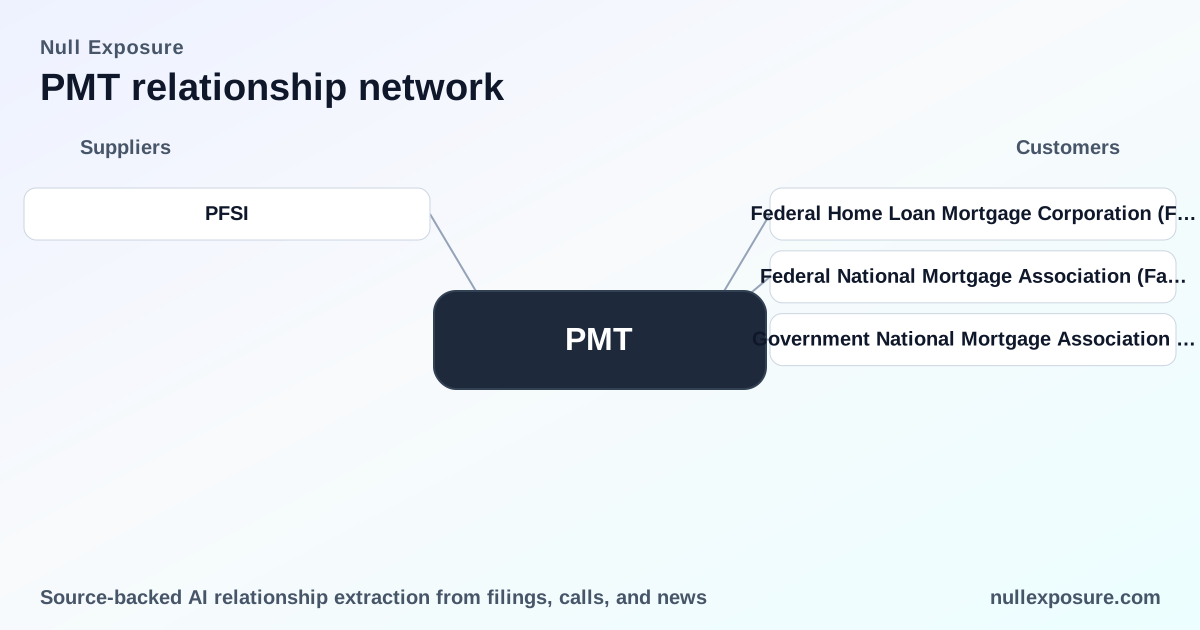
PennyMac Mortgage Investment Trust (PMT): Counterparty map and what investors should watch
PennyMac Mortgage Investment Trust (PMT) is a mortgage REIT that earns returns by investing in mortgage-related assets and collecting servicing and management economics—funded largely through short-duration repurchase facilities and longer-term management and servicing contracts. For investors evaluating supplier relationships, the key dynamic is PMT’s dependence on originators and service providers to supply assets and to execute servicing workflows while it funds positions and monetizes interest spread and fee income. Learn more and benchmark counterparties at https://nullexposure.com/.
Quick operating thesis: how PMT makes money and where suppliers matter
PMT invests in residential mortgage loans, mortgage servicing rights (MSRs) and agency securities; it monetizes via net interest margin on financed assets, fee income from servicing arrangements, and incentive/management fees payable under external management contracts. PMT’s balance-sheet funding is a mix of secured borrowings (repurchase agreements) with short weighted-average maturities and a set of contractual counterparty relationships—management, servicing, subservicing and correspondent purchase commitments—that determine asset flow and operational continuity.
How the counterparty structure shapes risk and optionality
- Short-term financing is a structural characteristic. PMT uses repurchase agreements and similar facilities with very short remaining maturities—many transactions are within 30–90 days for MBS and CRT assets—so liquidity rolling and counterparty access directly influence earnings volatility. According to PMT’s 2024 filings, repurchase structures commonly run 30–90 days for MBS and CRT and up to two years for certain participation certificates.
- There are also longer-dated commercial contracts that lock in operating relationships. Management and servicing agreements extend through December 31, 2029 with automatic renewal provisions, and PMT amended material terms (for example, incentive fee timing) in December 2024—this creates entrenched vendor relationships with renewal optionality but also creates lock-in that affects governance economics.
- The relationship footprint is both operational and material. PMT reported $12.1 billion of total indebtedness as of December 31, 2024 and retains committed secured borrowing capacity; that leverage profile makes supplier continuity and collateral acceptance criteria material to funding cost and access.
- Supplier spend and committed capacity are significant. PMT disclosed committed borrowing capacity (for some facilities) at the $1.1 billion level under two-year repurchase agreements, signaling meaningful counterparty exposure sizes.
If you want a quick view of counterparties and constraints, start here: https://nullexposure.com/.
The counterparties you can see from public reporting
Pennymac (inferred ticker PFSI)
Pennymac operates as a major correspondent originator and service provider whose conventional loans fulfilled for PMT represented 15% of Pennymac’s 2023 production, indicating a material origination flow from Pennymac into PMT’s pipeline; Pennymac’s correspondent channel itself accounted for 72% of its $99.4 billion production in 2023. This positions Pennymac as both a significant supply source of mortgage assets to PMT and a strategic operational partner. (Source: Inman report on Sept. 17, 2024 summarizing Pennymac disclosures.)
- Why this matters to investors: a concentrated origination relationship creates dependency on counterparty throughput and underwriting alignment; changes in Pennymac’s correspondent appetite or pricing will transmit to PMT’s asset mix and yield.
What the constraints say about counterparty posture and maturity
The structured evidence around PMT’s contracts delivers a clear set of company-level signals that define how supplier relationships function in practice:
- Contracting posture mixes short-term funding with selective longer-term service contracts. Public disclosures describe repurchase agreements and repo-style borrowings with very short maturities for MBS/CRT (commonly 30–90 days) and loan repurchase terms of up to two years, while management and servicing agreements have multi-year terms through 2029 with renewal mechanics. This structure forces PMT to manage liquidity timing risk actively while benefiting from predictable services under longer agreements.
- Relationships are operationally critical and materially sized. PMT’s leverage (approximately $12.1 billion total indebtedness at year-end 2024) and committed facility capacity indicate counterparties are financially consequential, not peripheral vendors. That transforms routine contract language—eligibility, termination rights, haircut schedules—into portfolio-level risk drivers.
- Relationship lifecycle: active and renewing. PMT maintains active buying relationships through its correspondent channel (hundreds of approved delegated sellers) and has recently renewed multiple agreements, including management and MSR recapture arrangements effective January 1, 2025, demonstrating an active renewal cadence rather than one-off contracting.
Investor implications: risk and due diligence focus
- Funding rollover is the first-order risk. Short-term repo facilities require continuous market access; any disruption in counterparty acceptance of PMT collateral or increases in haircuts will compress margins immediately. Examine facility terms, counterparties’ concentration, and historical roll rates.
- Counterparty concentration in originations. The Pennymac link—representing a meaningful share of originations fulfilled for PMT—creates an operational concentration that affects asset quality and pipeline volume. Confirm the scope of that flow, underwriting alignment and stress scenarios for a material reduction in supply.
- Contractual renewal clauses create both stability and lock-in. Multi-year management and servicing agreements protect operations but also embed fee structures and high-water marks that shape net returns; pay attention to amendment mechanics and termination triggers disclosed in FY2024–FY2025 filings.
- Quantitative thresholds matter. Committed borrowing capacity (e.g., the $1.1 billion combined VFNs facility) and the $12.1 billion indebtedness figure are concrete inputs to stress testing liquidity coverage ratios and covenant sensitivity.
Practical diligence checklist for PMT counterparties
- Confirm the identity and scale of originators supplying PMT (volume, % of production, underwriting standards) and validate Pennymac’s 15% share using underlying statements.
- Review the repurchase agreement book: average maturities, counterparty haircuts, collateral eligibility, and historical renewal/roll behavior.
- Read the management and servicing agreements for renewal provisions, incentive fee calculations and high-water mark periods (noting the December 2024 amendments).
- Stress-test liquidity: model haircuts + 30–90 day roll failure scenarios and their impact on net interest margin and forced asset sales.
- Evaluate MSR recapture language and any subservicing arrangements that affect cash flows on servicing income.
If you want a consolidated supplier map and checklist you can act on, visit https://nullexposure.com/ for detailed counterparty profiles and issue spotting.
Bottom line
PMT’s supplier footprint is a hybrid of short-dated funding counterparties and longer-term management/servicing partners. That combination produces a business that is sensitive to repo market conditions, counterparty behavior on collateral acceptance, and the continuity of originator flows such as those from Pennymac. Investors should prioritize liquidity resilience, contract provisions that affect fee economics, and concentration of originator supply when assessing PMT’s counterparty risk and earnings durability. For a practical, investor-ready breakdown of counterparties and contract exposures, see https://nullexposure.com/.