PMT-P-A: External management, concentrated counterparty exposure, and what that means for preferred holders
PennyMac Mortgage Investment Trust’s 8.125% Series A preferred (PMT-P-A) gives investors a fixed-to-floating income profile backed by a mortgage REIT balance sheet; the trust acquires and manages residential mortgage loans and related assets and monetizes those holdings through net interest income and distributions to equity and preferred holders. The vehicle is externally managed, which concentrates operational and execution risk in a single manager and directly links dividend reliability to that manager’s decisions and legal exposure. For quick access to further supplier intelligence and relationship reporting, see https://nullexposure.com/.
Why structure and supplier relationships matter for a preferred investor
PMT-P-A’s value proposition is straightforward: secure yield with a fixed-to-floating dividend that protects against rising-rate environments while providing downside protection compared with common equity in the REIT capital stack. The economic performance of those preferred shares, however, is not driven solely by mortgage spreads and prepayment behavior — it is also driven by who runs the trust and how that manager contracts, litigates, and executes capital strategy.
The trust’s operating model therefore contains two central vectors for investor focus: the asset engine (mortgage holdings and their interest spread) and the governance/operational engine (the external manager and its corporate parent). Both must be evaluated together when assessing dividend durability and tail risk.
For more context on supplier exposure analysis for financial instruments like PMT-P-A, visit https://nullexposure.com/.
How management posture, concentration, criticality and maturity shape the business
- Contracting posture: PMT operates under an external management arrangement, which generally means the manager controls day-to-day asset selection, hedging, and capital allocation. That posture creates a single point of execution — efficient when the manager performs, problematic when it does not.
- Concentration: External management concentrates counterparty risk in the manager and its corporate family; any operational, financial, or legal stress at the manager transmits directly to the trust’s distributions and market confidence.
- Criticality: Management is critical to dividend delivery because preferred coupons flow from net operating income and the manager’s decisions on leverage, hedging, and asset strategy. The manager’s reputation and legal exposure therefore carry outsized significance.
- Maturity: Mortgage REITs and their preferred tranches are an established corner of real estate finance; however, the combination of interest rate regime shifts and legal transition issues (e.g., LIBOR to SOFR) elevates operational complexity for externally managed trusts.
These are company-level signals about PMT-P-A’s operating model and risk structure: they reflect the trust’s governance architecture rather than a single transaction or metric.
Supplier relationships on record
Below are the supplier/manager relationships reflected in the public reporting and media coverage collected for PMT-P-A. Each entry below is a plain-English summary with a concise source reference.
-
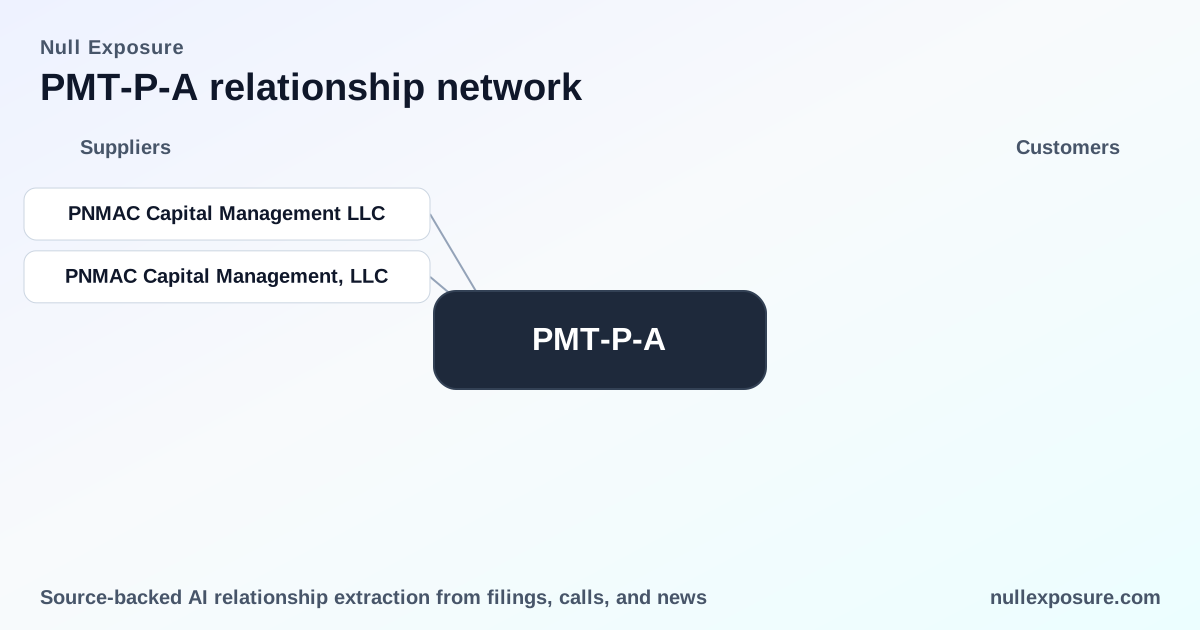
PNMAC Capital Management LLC — the manager is directly implicated in litigation over dividend-rate treatment. A USA Herald piece reported that an investor filed a class action alleging the decision to maintain fixed-rate dividends rather than transition to a floating rate tied to SOFR violated the LIBOR Act; the article referenced PNMAC Capital Management LLC in the complaint context (article dated March 10, 2026).
Source: USA Herald report on litigation, March 10, 2026. -
PNMAC Capital Management, LLC — the trust is externally managed by PNMAC Capital Management, LLC, which is a wholly owned subsidiary of PennyMac Financial Services, Inc. The fact is stated in a Markets/FinancialContent press release announcing PMT Q3 2025 reporting cadence and corporate relationships (press release dated October 14, 2025; FY2025 context).
Source: Markets/FinancialContent BizWire release, October 14, 2025.
(These two records reference the same operational counterparty — PNMAC — once from a corporate/management disclosure perspective and once in the context of litigation coverage.)
What the relationship map implies for investors
- Operational dependency is concentrated. The trust’s external management construct makes PNMAC the de facto operational supplier; that concentration elevates counterparty risk for preferred holders.
- Legal and policy transitions are a direct risk to distributions. Public reporting includes litigation tied to the LIBOR transition and dividend-rate mechanics; legal outcomes could affect dividend treatment or impose remediation costs.
- Parent company affiliation matters. The manager’s ownership by PennyMac Financial Services, Inc. (PFSI) creates a corporate linkage that can provide support or transmit parent-level stress — both outcomes are material to preferred holders.
These implications are structural rather than speculative: one public filing notes external management, and one media item documents legal action connected to the manager’s dividend decisions.
Risks, opportunities and the investor checklist
- Risk: Litigation over rate-transition mechanics (LIBOR→SOFR) has surfaced publicly and can create both cash drag and reputational risk; legal outcomes are asymmetric for preferred holders because dividend rights can be affected by remedial actions. See USA Herald litigation coverage (March 10, 2026).
- Risk: Counterparty concentration with PNMAC as the exclusive manager elevates single-point-of-failure risk; confirm the terms of the management agreement and parent support in filings and quarterly commentary (see Markets/FinancialContent release, October 14, 2025).
- Opportunity: Fixed-to-floating structure benefits holders if floating resets track market rates at the right time; understand the specific reset mechanics in proxy or offering documents where available.
- Action: Prioritize diligence on the manager’s balance sheet, hedging program, and litigation reserves; review parent-company ties to PFSI to evaluate support capacity.
For additional supplier and counterparty visibility tools aimed at fixed-income and preferred instruments like PMT-P-A, go to https://nullexposure.com/.
Final takeaways and next steps for allocators
- PMT-P-A delivers yield but is structurally dependent on an external manager whose decisions and legal exposures are material. Both the management relationship and the litigation cited in public coverage are immediate inputs to dividend risk assessment.
- Concentration in PNMAC/parent group is the defining supplier risk. Investors should treat the manager as a primary counterparty rather than a background service provider when sizing positions and stress-testing scenarios.
- Next steps: demand management-agreement transparency, monitor litigation developments, and stress-test dividend coverage under manager-disruption scenarios.
To explore deeper supplier-level intelligence and continuous monitoring for financial instruments and their counterparties, visit https://nullexposure.com/.