PennyMac Mortgage Investment Trust (PMTW): supplier posture, counterparties and operational constraints investors should price in
PennyMac Mortgage Investment Trust (PMTW) monetizes by acquiring residential mortgage loans and mortgage servicing rights (MSRs), securitizing and financing those assets, and collecting servicing and investment management fees while managing short-term financing lines and secured borrowings. The business combines stable fee income from external management and servicing with market-sensitive returns on mortgage assets, creating a capital structure that leverages short-term funding to hold and rotate mortgage exposures.
For active diligence on PMTW’s supplier relationships and counterparty risk, see more on Null Exposure: https://nullexposure.com/
How PMTW’s operating model drives supplier relationships and funding patterns
PMTW is externally managed and operationally integrated with PennyMac affiliates for servicing and loan production. The company’s economics depend on three linked drivers: fee revenue from an external manager, cash yields on held mortgage assets, and access to short-term secured financing. Those drivers translate into a supplier posture that is both long-term and transactional:
- Long-term governance and management linkage. PMTW has a management agreement that establishes a continuing fee relationship with PennyMac’s management arm and creates predictable governance and operational dependency over multiple years. According to the company’s management agreement language, the Management Agreement and the Servicing Agreement both expire December 31, 2029, with automatic 18-month renewals unless terminated per the agreement (company filings, Dec 31, 2024).
- Short-term funding and asset rotation. The company finances a large portion of its assets with short-dated facilities and repo-style repurchase arrangements, reflected in a weighted average maturity of financing of roughly 1.6 months and explicit repurchase timeframes ranging from 30–90 days for many MBS exposures (company notes, Dec 31, 2024). This makes liquidity access and counterparty credit for short-dated lenders critical to daily operations.
- Operational concentration in PennyMac affiliates. PMTW is externally managed by PNMAC Capital Management (PCM) and uses PennyMac Loan Services (PLS) for servicing and subservicing, which concentrates operational risk with the parent-group ecosystem (company filings, Dec 31, 2024).
These characteristics show a hybrid supplier profile: strategic, long-term contractual ties to PennyMac affiliates paired with material reliance on short-term market counterparties and financing providers.
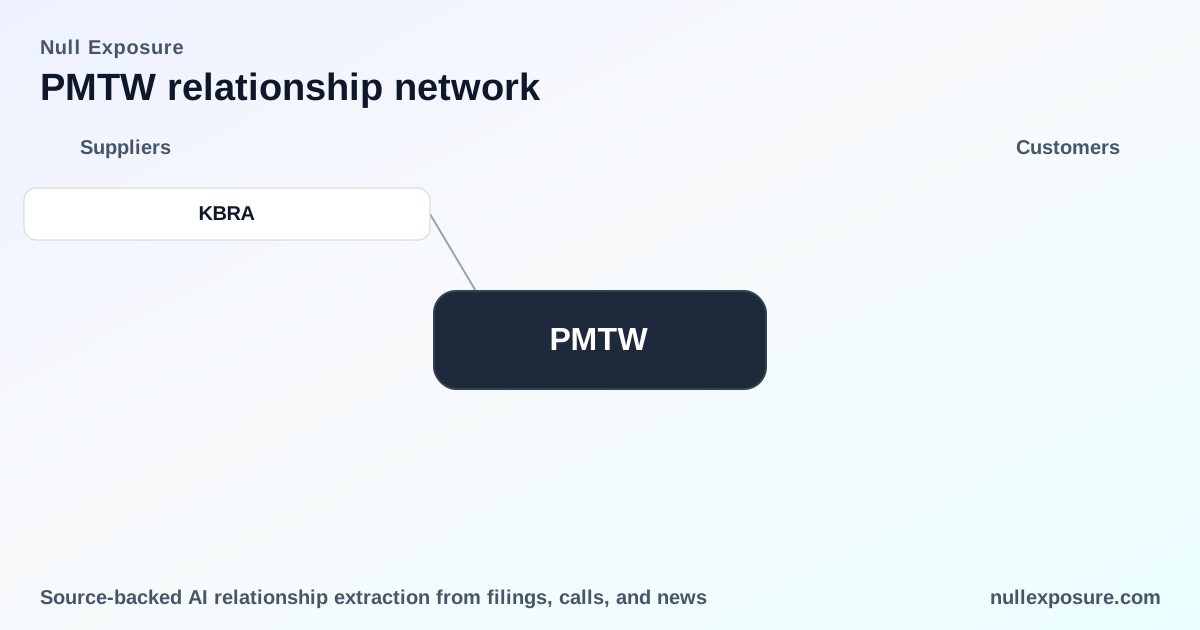
The explicit supplier relationship in the record: KBRA and a prime RMBS transaction
KBRA assigned preliminary credit ratings to the classes of securities issued by PMT Loan Trust 2026‑CNF1, a prime RMBS sponsored by PennyMac Corp., which is an indirect wholly owned subsidiary of PMTW. KBRA’s preliminary rating action reflects market placement of 576 conforming, agency‑eligible mortgages into a securitization vehicle sponsored by PennyMac (Simply Wall St citing KBRA, March 10, 2026). Source: a Simply Wall St news item summarizing KBRA’s preliminary rating action on PMT Loan Trust 2026‑CNF1 (FY2026).
What the constraints tell investors about supplier risk and criticality
PMTW’s constraint profile in filings provides direct signals about counterparty exposure, contract maturity, and materiality:
- Contracting posture: mixed-term with legal lock-ins. The Management Agreement and Servicing Agreement run through Dec 31, 2029 with automatic 18‑month renewal provisions, indicating a multi-year contractual foundation for management and servicing, which reduces near-term termination risk but increases strategic dependence on PennyMac affiliates (company filings, Dec 31, 2024).
- Funding maturity and liquidity intensity: short-dated and active. The company uses short-term facilities and repurchase arrangements heavily; reported remaining maturities at Dec 31, 2024 show the bulk of secured financing matures within 90 days and a weighted average maturity of 1.6 months. Liquidity providers and repo counterparties are therefore critical to day-to-day solvency (company notes, Dec 31, 2024).
- Counterparty mix: broad but skewed to small originators. PMTW had 789 approved sellers with delegated underwriting authority, primarily independent mortgage originators and community banks; this speaks to a distributed supply base for loan acquisition but one that includes numerous small-business counterparties (company filings, Dec 31, 2024).
- Geographic breadth: licensed nationwide. Servicing operations are licensed across all 50 states, DC, Guam and the U.S. Virgin Islands, indicating operational scale and regulatory exposure across jurisdictions (company filings, Dec 31, 2024).
- Material leverage: financing scale is a business constraint. PMTW reported approximately $12.1 billion of total indebtedness outstanding as of Dec 31, 2024 (about $11.5 billion secured) with up to $5.5 billion additional secured capacity; this scale of leverage is a material counterparty and covenant risk that suppliers and counterparties must price (company filings, Dec 31, 2024).
- Roles and flow relationships: buyer, seller, service provider. Filings show PMTW both purchases loans from its seller network (e.g., loans acquired for sale from PLS) and is serviced/subserviced by PennyMac Loan Services, while PCM provides management — meaning supplier relationships include correspondent sellers, financing counterparties, servicers, and rating agencies (company filings, Dec 31, 2024).
These constraints create a profile where strategic supplier relationships (management and servicing) are durable, while funding and trading counterparties are short-term and high-frequency, so counterparties need to evaluate both contractual durability and daily liquidity interactions when engaging with PMTW.
For a deeper mapping of PMTW counterparties and exposures, consult Null Exposure’s supplier analytics at https://nullexposure.com/
Implications for investors and partner operators
- Counterparty credit for short-term funding matters more than ever. Given the repo-style funding and concentrated secured borrowings, stress on funding counterparties will directly transmit to PMTW cash flows.
- Operational dependence on PennyMac affiliates is a double-edged sword. The management and servicing arrangements provide operational scale and expertise but create single-group concentration risk; changes in affiliate strategy or fees have direct earnings implications.
- Credit placement and securitization cadence is a visible revenue lever. Rating actions like KBRA’s on PMT Loan Trust 2026‑CNF1 are real-time signals of the company’s securitization activity and distribution capability (KBRA/Simply Wall St, March 2026).
Practical due‑diligence checklist for suppliers and investors
- Confirm covenant compliance and the liquidity buffer given the company’s secured debt profile.
- Validate counterparty onboarding standards for the 789 approved sellers if you are a correspondent or joint originator.
- Review the Management and Servicing Agreement terms through 2029 to quantify termination costs and fee schedules.
- Monitor RMBS issuance cadence and rating actions as forward indicators of asset rotation and distribution capacity (example: KBRA rating action, March 2026).
For ongoing supplier risk monitoring and to see how PMTW’s counterparty map evolves, visit Null Exposure for supplier-level insights: https://nullexposure.com/
Bottom line
PMTW combines durable affiliate-driven servicing and management relationships with high-frequency, short-term funding and a broad correspondent network. Investors should underwrite both the structural concentration in PennyMac affiliates and the operational dependency on short-term secured financing. Rating actions and securitization volumes, such as KBRA’s preliminary ratings for PMT Loan Trust 2026‑CNF1, serve as timely indicators of funding and distribution health (KBRA/Simply Wall St, March 2026).
Keep an eye on covenant compliance, counterparty credit in the repo/secured markets, and any moves by the PennyMac group that would reprice management or servicing arrangements. For tailored supplier risk reports and relationship mapping, go to https://nullexposure.com/ and request a briefing.