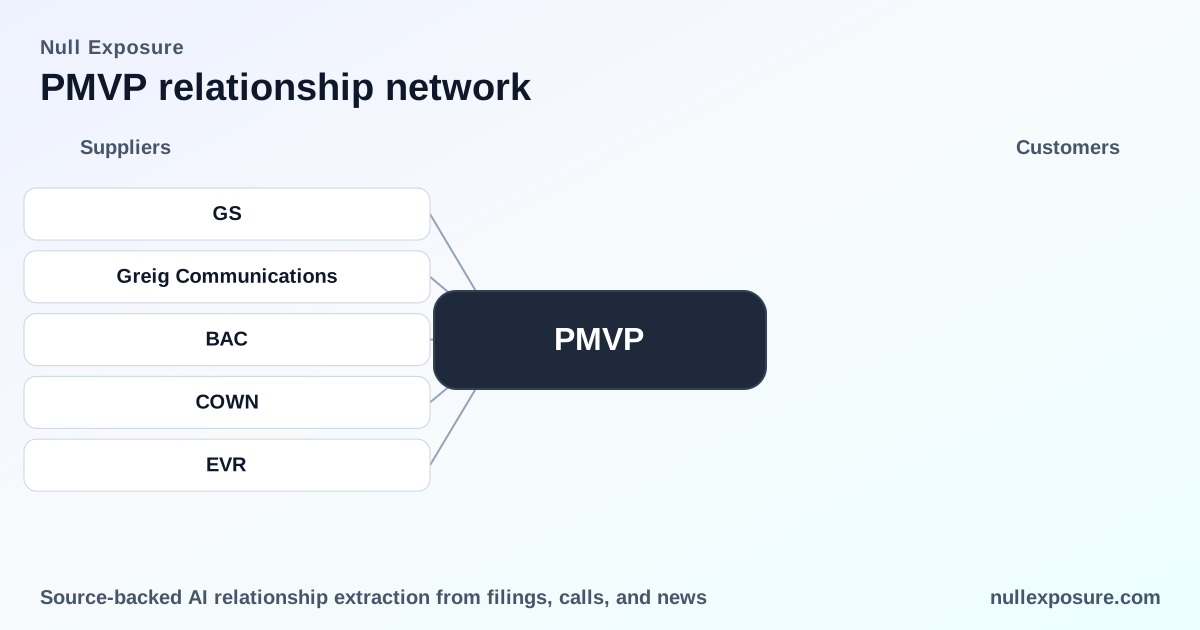
PMV Pharmaceuticals (PMVP): Supplier relationships and what they mean for investors
PMV Pharmaceuticals is a development-stage precision oncology company that builds value by advancing small-molecule therapies targeted at p53-mutant tumors. The company currently generates no product revenues; its economic model is financing-led — capital raises and investor-backed development drive valuation, with eventual monetization through regulatory approvals, licensing, or commercialization partnerships. Cash consumption is driven by outsourced R&D and manufacturing, not in-house production, which concentrates counterparty importance for program timelines and costs. For a concise vendor-risk snapshot and supplier intelligence, visit https://nullexposure.com/.
How PMV runs its supplier network — the operational thesis
PMV runs a highly outsourced operating model. The company does not own manufacturing facilities or dedicated production personnel, and explicitly contracts CROs and CMOs for preclinical, clinical and, if approved, commercial manufacture. This structure produces three practical characteristics:
- Contracting posture: short-term and cancelable agreements dominate, limiting long-term supplier lock‑in but increasing downstream execution risk when continuity is required for regulatory submission or commercial launch.
- Concentration and criticality: manufacturing and clinical service providers are mission-critical; failure or disruption at a CMO/CRO would directly delay development and materially affect timelines for value creation.
- Maturity and stage: relationships are operationally active but commercially immature, reflecting trial-stage programs rather than recurring revenue supplier ecosystems.
The company also documents consulting agreements with three board members, one of whom waived fees as of September 2021—an indicator of close executive/insider engagement with external advisors. PMV discloses exposure to service providers in China and broader APAC, which creates geopolitical, regulatory, and supply-chain concentration considerations for investors.
The counterparties named in public coverage
Below are the named counterparties that appear in PMV’s public reporting and media flow, with plain-English takeaways and source references.
Goldman Sachs & Co. LLC
Goldman Sachs acted as a joint book-running manager on PMV’s offering, positioning the firm as a capital markets arranger during the IPO process. This relationship reflects standard underwriting engagement for a biotech bringing equity to market (RTT News reported the transaction and syndicate composition).
BofA Securities
BofA Securities joined the syndicate of bookrunners for PMV’s public offering, serving the distribution and placement role that supports institutional and retail capitalization. The participation signals conventional investment‑bank support during PMV’s capital formation (reported by RTT News).
Cowen
Cowen was also listed as a joint book-runner on PMV’s offering, providing equity research and distribution capacity to the deal. Cowen’s inclusion aligns PMV with a bank that specializes in healthcare equity underwriting and investor outreach (RTT News coverage).
Evercore ISI
Evercore ISI completed the syndicate of book-running managers on the IPO, contributing to deal execution and syndicate reach. Inclusion of Evercore suggests PMV sought a broad institutional placement network for its equity raise (noted in RTT News).
Greig Communications
Greig Communications is identified as the media contact for PMV’s presentation of pivotal phase 2 data and a natural history study at the AACR–NCI–EORTC conference in 2025; this indicates PR support for scientific and investor communications around clinical milestones (GlobeNewswire press release, Oct 13, 2025).
What the disclosed constraints signal for supplier risk and execution
PMV’s public filings and disclosures produce clear company-level signals that shape supplier risk assessment and procurement strategy:
- Short-term, cancelable contracts dominate: the company explicitly states many supplier arrangements provide termination on notice and are excluded from long-term contractual obligation schedules. For operators, this means procurement flexibility is high but replacement risk during critical development windows is material.
- Board-level consulting is active and modestly compensated: the company maintains consulting agreements with three directors (with total consulting fees disclosed across recent years), suggesting a governance dynamics where insiders provide advisory services alongside external partners.
- APAC/China exposure is documented: PMV acknowledges reliance on Chinese CROs/CMOs and vendors, which requires investors to price in geopolitical, export control, and quality‑assurance vectors for manufacturing continuity.
- Outsourced manufacturing is central: PMV’s lack of internal manufacturing capacity makes CMOs and CROs a primary concentration point for program delivery and scaling; operational hiccups at those providers convert directly to clinical or commercial delays.
- Relationships are active: consulting payments and public communications around clinical data demonstrate live, functioning supplier and advisor relationships rather than dormant or theoretical arrangements.
These are company-level characteristics; they frame PMV as a lean clinical-stage biotech that relies on third-party execution rather than owning vertical production, which accelerates cash efficiency but increases counterparty importance.
For a deeper vendor-risk profile and supplier mapping you can act on, see https://nullexposure.com/.
Investment and operational implications — what to watch
- Timeline risk from third parties is principal: underwriting and commercialization value are time-sensitive; investors should treat CMO/CRO performance as a direct driver of dilution risk and licensing leverage.
- Geopolitical concentration is a valuation lever: APAC/China reliance creates a non-linear risk premium—regulatory or logistics disruption would amplify cash burn and push out catalysts.
- Contract tenor reduces stranded-asset risk but increases substitution risk: cancelable contracts limit long-term liability on the balance sheet but raise runway vulnerability if replacement vendors require lead time.
- Communications and capital markets relationships matter: the presence of reputable bookrunners and active PR support enhances access to capital and market visibility, which is important for a pre-revenue specialty biotech.
Quick takeaways for investors and operators
- PMV’s vendor model is outsourced and execution-sensitive: operational success is tied to third-party CROs and CMOs rather than in-house manufacturing.
- Short-term contracts give flexibility but concentrate operational risk: management can terminate relationships, but replacement during pivotal moments is costly.
- APAC exposure requires active monitoring: supply-chain resilience, regulatory reviews, and vendor audits should be priority items for diligence.
- Capital markets partners and PR support reduce financing friction: participation by Goldman Sachs, BofA, Cowen, and Evercore, plus active communications firms, supports future raises and message control.
For ongoing supplier intelligence and to monitor these counterparties as events unfold, visit https://nullexposure.com/ for detailed tracking and analysis.
Bottom line and next steps
PMV is a development-stage biotech whose value hinges on clinical execution delivered largely through external manufacturers and service providers. Investors should underwrite the company as a sponsor of outsourced R&D with concentrated operational dependencies, short contract tenors, and APAC supply exposure. Operators and partner managers should prioritize contractual clarity for continuity, vendor governance, and contingency capacity with alternate CMOs/CROs.
To review a vendor-focused due diligence checklist tailored to companies with similar outsourcing profiles, go to https://nullexposure.com/.